
CertainTeed vs Owens Corning Roofing: Portland Guide
Two roofing quotes are sitting on the kitchen counter, and they both look reasonable. One says CertainTeed, the other says Owens Corning. The current roof has dark streaks running down the north side, moss growing in the valleys, and a few shingles that lifted during last fall's windstorm. It's time. But which brand actually makes sense for the house — not in general, for this house specifically? That's what this comes down to. Roof direction, pitch, shade cover, wind exposure. Those specifics determine which shingles will still be doing their job in 25 years.
CertainTeed vs Owens Corning: How They Compare
CertainTeed has over a century of experience building shingles for wet climates. They focused on moisture problems — algae, moss, and water shedding. Owens Corning went the other direction and put their money into wind resistance. Their SureNail Technology is the strongest wind-rated system on the market right now. Neither brand is better across the board. The right choice depends on what the roof actually deals with every year.
| Feature | CertainTeed | Owens Corning |
|---|---|---|
| Warranty | SureStart PLUS (certified installer required) | Preferred/Platinum tiers (certified installer required) |
| Wind Resistance | Strong (architectural grade) | Up to 130 mph with SureNail Technology |
| Algae/Moss Defense | StreakFighter granules | Standard granule formulation |
| Best Lines | Landmark 30yr, Presidential TL 40yr | Duration Premium, TruDefinition |
| Portland Style Match | Craftsman, traditional | Modern, high-exposure homes |
Portland throws 37+ inches of rain at every roof, every year. November through March is nonstop freeze-thaw — water seeps in, freezes, expands, cracks things open. Moss loves every minute of it. Then fall and early winter bring southwest storms that regularly push past 60 mph. The roof sits in the middle of all that punishment. The real question is whether the biggest problem is moisture and moss, or wind. CertainTeed was built to handle the first one. Owens Corning was built for the second.
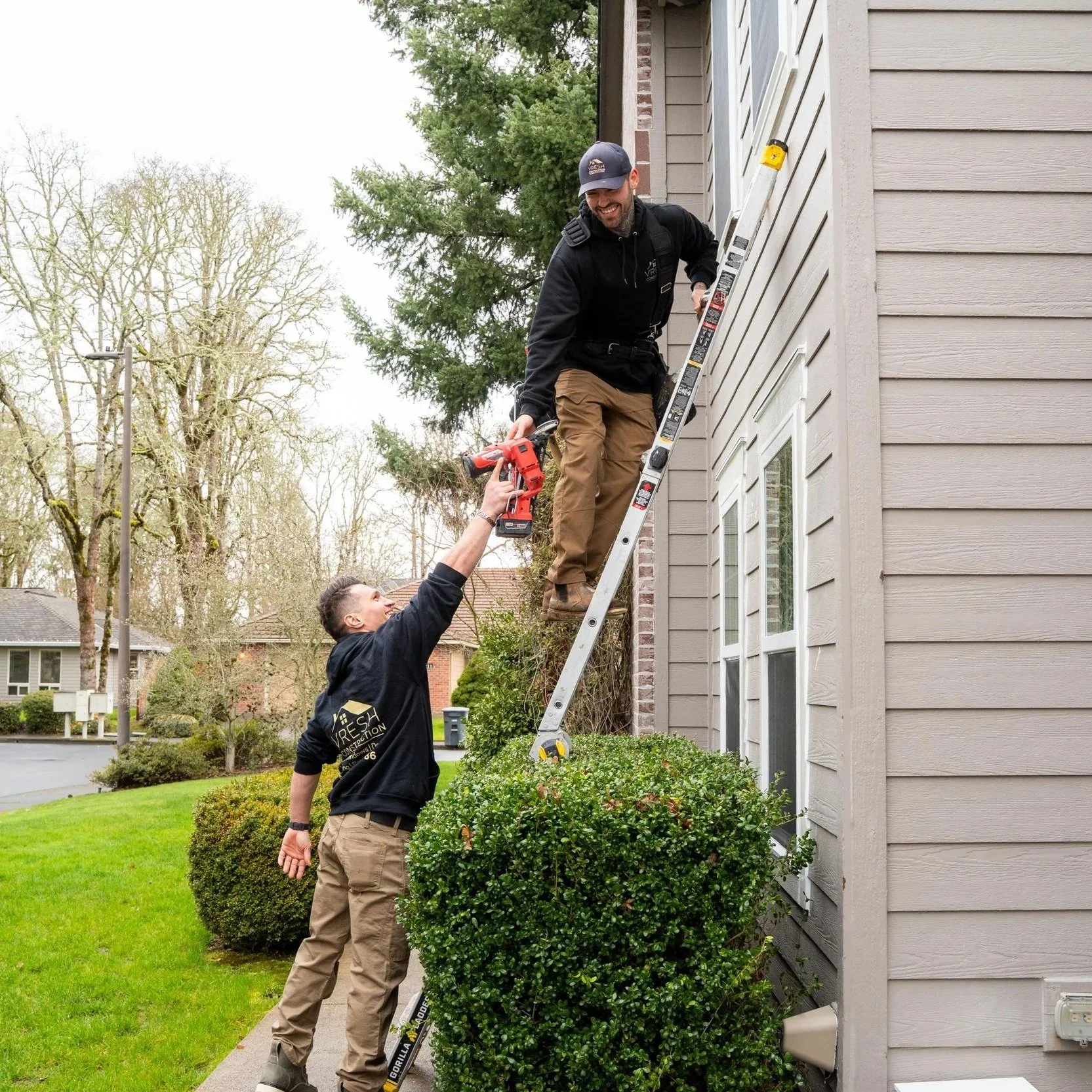
Vresh Construction's crew working on a residential roofing project in Portland — the hands-on expertise that helps homeowners choose between CertainTeed and Owens Corning with confidence.
Where CertainTeed Outperforms
A shaded roof facing north or with trees hanging over it tells the same story every time. Algae and moss show up within a few years, and they don't stop. It's not just ugly — moss traps moisture against the shingles, creating a pathway for water to work its way underneath. The roof stops shedding rain properly, and the lifespan shrinks. CertainTeed's StreakFighter technology was built specifically for this. It's engineered into the granules themselves, so it stops algae at the source instead of relying on a surface coating that washes off in Portland's rain.
North-facing roofs in Portland stay damp for weeks straight between October and April. Without algae-resistant granules, dark streaking becomes visible in three to four years. That's not a guess — it's what happens on roof after roof in damp shade. StreakFighter stops it at the granule level. Surface treatments can't compete with that.
CertainTeed also wins on color selection for period homes. Their Landmark line — Weathered Wood, Colonial Slate — fits Craftsman bungalows and Victorians like it was made for them. These colors age well and match the architecture. Owens Corning's palette leans modern and contemporary, which looks wrong on a home built before 1950.
SureStart PLUS covers defects with labor included for the first ten years when a certified installer does the work. That's worth something. If a shingle fails early, CertainTeed pays for the material and the labor to fix it. Most warranties don't include labor, so this is real protection in those early years.
Where Owens Corning Outperforms
A house on a ridge or a roof facing southwest takes the worst of Portland's wind. Shingles ripped off after a storm. Edges lifted up. Water getting in around the flashing where it shouldn't. Owens Corning built SureNail Technology to stop exactly that. The reinforced nailing zone holds through 130 mph wind — and that's not overkill for Portland. Ridge homes catch storms that hit that hard. Southwest storms push past 60 mph regularly here.
Duration Premium is their strongest product line. Premium granules, better water shedding, serious wind performance — all in one shingle. On a roof with complex geometry — multiple planes and angles — or where wind exposure is the main concern, Duration Premium delivers. The Preferred and Platinum warranty tiers back it up with real defect coverage.
What most people don't think about is how much engineering goes into wind resistance. Owens Corning tests in wind tunnels, validates in real storms, and studies how shingles actually fail. On a roof that's taken decades of Portland's fall and winter windstorms — especially one that's already lost shingles or let wind-driven rain in — that engineering makes a measurable difference in what happens next time.
And Owens Corning offers better options for modern or transitional homes. The color range is broader, and TruDefinition shingles have the dimensional depth and shadow lines that contemporary architecture needs. The roof can actually be part of the home's look, not just something functional sitting on top.
Cost and Value Comparison
The price between the two is almost identical. A standard Portland ranch — 1,500 to 2,000 square feet of roof — runs $9,000 to $16,000 installed for either brand's 30-year line. Complex roofs with multiple angles, valleys, and penetrations push toward $14,000-$25,000+. The actual cost depends on roof size, pitch, how much decking needs repair, and location in the Portland metro area.
Premium lines add 15-25% to base cost. Worth it? Depends on the roof. CertainTeed's StreakFighter pays for itself on shaded, damp roofs — less moss cleaning, longer before the roof starts looking worn out. Owens Corning's SureNail pays for itself if wind is the problem — fewer storm repairs, fewer insurance claims, lower costs over time.
Both brands pair their manufacturer warranty with installer workmanship warranties. Most contractors warrant labor for 5-10 years. The manufacturer covers materials for 25-40 years. Together, the homeowner is protected against installation mistakes and product defects. But material defects are rare with either brand. Installation problems — skipped ice and water shield, incomplete flashing, shortcuts on tear-off — that's where roofs fail in Portland. The workmanship warranty is the one that really counts.
Which Is Right for the Home?
Pick CertainTeed for a roof that sits in shade, has trees hanging over it, or faces north, where moss grows thick. For a Craftsman or Victorian where roof color matters, CertainTeed's range better fits period architecture. And for anyone scraping moss and algae off the current roof every year, StreakFighter puts an end to that cycle.
Go with Owens Corning if southwest winds hammer the roof or the home is modern in style. For anyone who's dealt with wind damage before — missing shingles, lifted edges, water intrusion — SureNail gives real confidence it won't keep happening. Their color options and dimensional shingles work on contemporary and transitional homes in a way CertainTeed's don't.
But none of that matters if the installation is bad. A $12,000 roof fails in 15 years when the contractor skips steps. Same roof done right — full tear-off down to the deck, complete ice and water shield, every piece of flashing sealed — lasts 30-40 years. Make sure the contractor commits to doing it the right way before signing anything.