Deck Installation in Portland, OR

New Deck Construction. Deck Replacement & Repair. Properly Flashed Ledger Connections — Not Just Lag-Bolted to the Wall. Pressure-Treated, Cedar & Composite Decking. Licensed OR #241979.


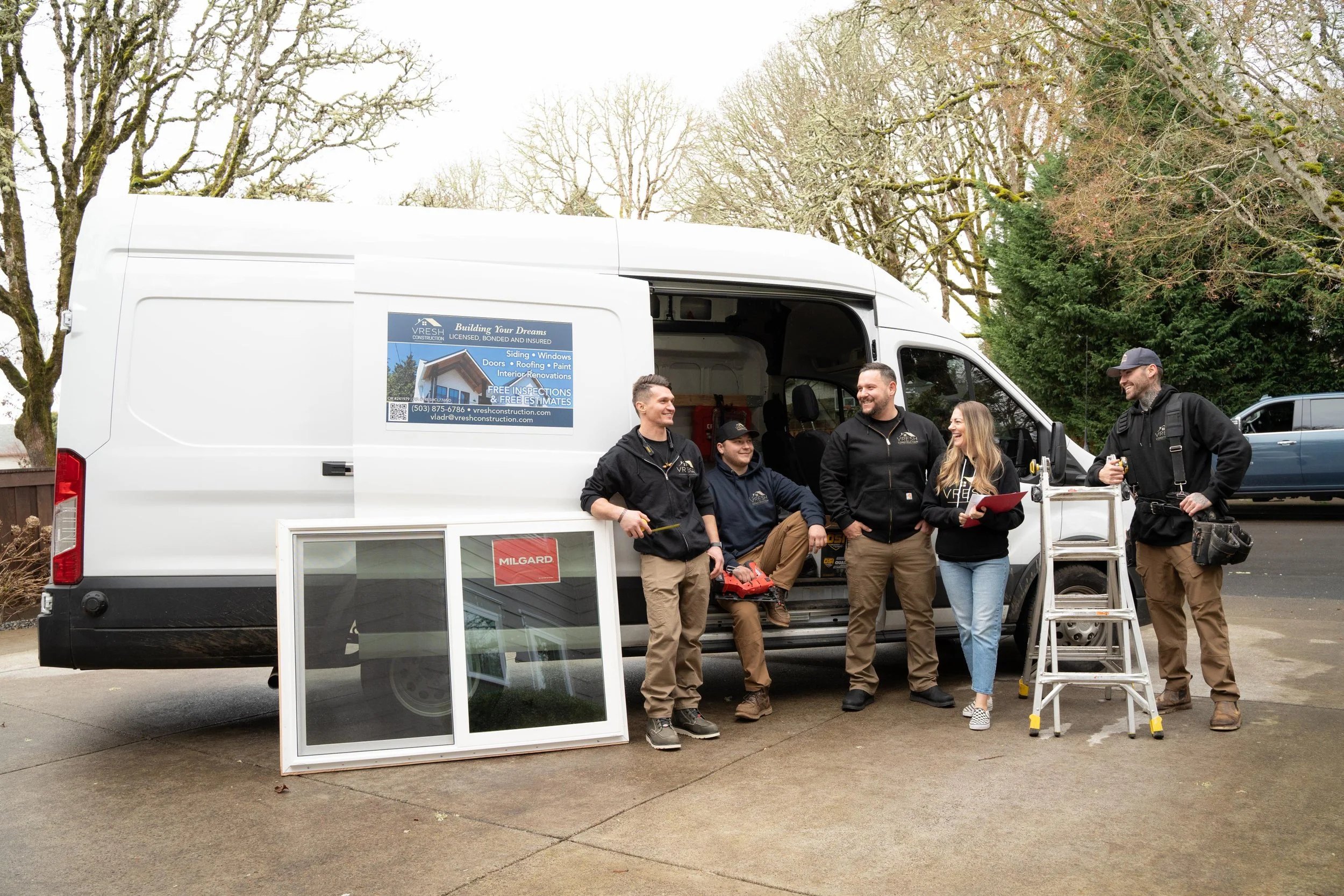
Group of five construction workers and a woman talking and smiling standing near a white service van outdoors, with trees in the background.

Decks in Portland face the same moisture challenge as every other exterior structure — sustained rainfall, high ambient humidity, and a climate that keeps wet wood wet for months at a time. The leading cause of deck replacement in the Pacific Northwest is not surface weathering — it is structural rot at the ledger connection, where an improperly flashed deck attachment allows water to enter the wall cavity behind the house and saturate the rim joist and floor framing. VResh Construction builds decks with properly flashed ledger connections every time.
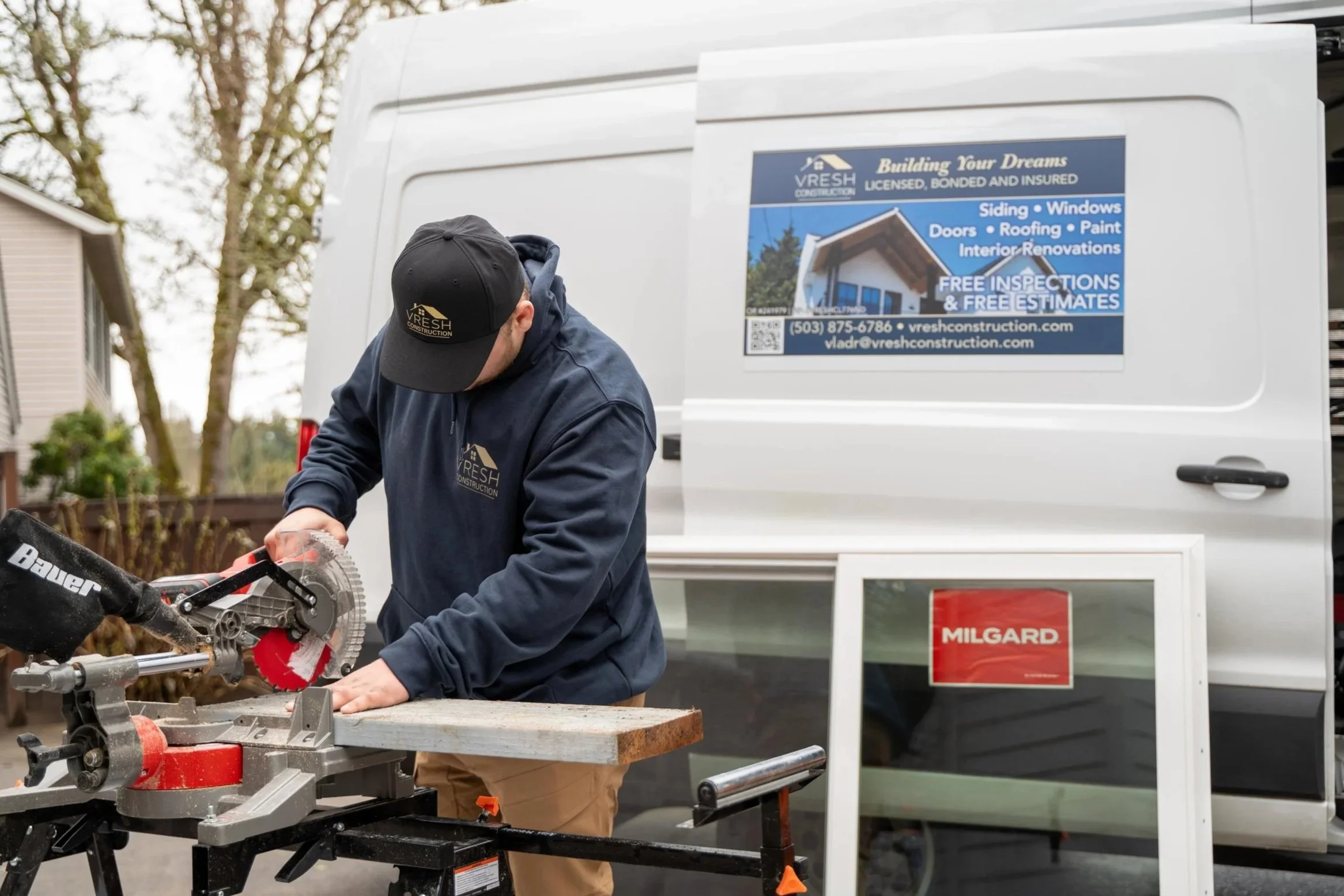
Group of five construction workers standing and sitting outside near a white van with a sign, with window frames and a ladder in front, amidst trees on a cloudy day.

(503) 272-6436 — Call or Text, Available 24/7

We answer calls and texts at any hour. For storm damage, active leaks, or structural emergencies, calling directly is the fastest path to a response.

Deck Materials We Work With

Pressure-Treated Lumber

The most common deck material in Portland. Current pressure-treated lumber (ACQ or CA-B treatment) is rated for direct ground contact and above-grade applications. Cost-effective and structurally sound.

Pressure-treated decks require regular sealing/staining every 2–3 years for optimal appearance. Fasteners must be rated for use with pressure-treated lumber — hot-dip galvanized, stainless steel, or approved coated fasteners. Standard steel corrodes rapidly in contact with ACQ.

Best for: Most Portland residential applications. Best value for structural decks.

Cedar and Redwood

Western red cedar and redwood are naturally rot-resistant and visually beautiful. Cedar decks are common in Portland's higher-end residential market.

Trade-off: Higher material cost than pressure-treated. Cedar's natural rot resistance does not extend to structural framing — posts and beams should still be pressure-treated where near grade or subject to water contact.

Best for: Homeowners who prioritize appearance and are committed to regular maintenance.

Composite Decking

Composite decking (Trex, TimberTech, Fiberon) is made from wood fiber and recycled plastic. It does not require sealing, does not splinter, and resists staining and fading significantly better than natural wood.

Higher upfront cost than pressure-treated, but lower lifetime maintenance cost.

Best for: Homeowners who want minimal maintenance and are willing to pay the upfront premium.

Our Deck Installation Process

#
Item
What We Do — And Why It Matters
1
Site assessment
Assess the existing ledger condition, rim joist, and adjacent siding at the attachment point. If the existing ledger has rot damage, we repair the rim joist and framing before new ledger installation.
2
Ledger installation with flashing
Install the ledger board with proper through-wall flashing — a continuous flashing assembly that prevents water from entering the wall cavity at the connection point. Ledger attached to rim joist with structural bolts, not just lag screws.
3
Permit and footing
Pull permit. Install concrete footings to depth required by Portland's frost depth and soil bearing conditions. Footings sized for the deck load. Deck installation without a permit is not an option — it affects your ability to sell the home.
4
Post, beam, and joist framing
Install structural posts, beams, and joist framing per the structural design. Joist hangers at all joist-to-beam connections — not toe-nailed. Blocking at mid-span for joist stability on larger spans.
5
Decking installation
Install decking boards with appropriate fasteners for the material — hidden fasteners for composite, stainless, or coated screws for wood. Consistent spacing, proper edge clearance at the house wall to prevent moisture accumulation.
6
Railing system
Install code-compliant railing system — 36-inch minimum height for decks under 30 inches above grade, 42-inch for higher decks, balusters spaced no more than 4 inches apart. Post attachment at the rim joist or through the decking to the framing — not surface-mounted to the deck surface.
7
Stair construction
Install stairs with code-compliant riser height and tread depth, a continuous graspable handrail, and a proper landing at the base. Stringers attached to ledger or beam with proper hardware.
8
Inspection and permit close
Schedule and pass the building inspection. Provide the homeowner with a copy of the permit and inspection record.
Close-up of large beige quotation marks on a dark background

Client's Talk

We have a wealth of experience working as main building contractors on all kinds of projects, big and small, from home maintenance and improvements to extensions, refurbishments and new builds.
Why Ledger Flashing Is the Most Important Part of Your Deck

The ledger board is the horizontal framing member that connects your deck to the house. Water that gets behind an improperly flashed ledger travels down the face of the rim joist, saturates the sill plate, and works its way into the floor framing of your home. This damage is invisible from the exterior until the structure has been compromised for years. We have seen Portland homes with $15,000+ of structural repair needed at the ledger connection — for a repair that proper flashing at original installation would have prevented entirely.

What Proper Ledger Flashing Requires

A through-wall flashing assembly — metal flashing that extends up behind the siding above the ledger and down over the face of the ledger, directing water to the exterior rather than into the wall cavity.

Lag bolt pattern that allows water to drain — not lag bolts drilled at the same height that create a water-collection ledge.

Standoffs or flashing washers at each lag bolt to prevent water pooling around the fastener.

Integration with the existing weather-resistive barrier behind the siding.

We document our ledger flashing installation with photographs for every deck project.

Deck Repair vs. Full Replacement — How to Decide

Condition
Repair or Replace?
Why
Surface boards weathered, some splitting — framing is solid
Repair (board replacement)
If the structural framing passes inspection, new decking boards give you a like-new surface at a fraction of replacement cost.
Posts are solid but ledger shows rot
Partial replacement
Ledger rot requires removing the deck from the wall and replacing the ledger and rim joist — but the rest of the deck may be salvageable.
Multiple posts show rot at grade
Replace
Post rot means the structural foundation of the deck is compromised. Post-by-post replacement is labor-intensive enough that full replacement is often comparable in cost.
Joists are bouncy or show visible sag
Replace
Joist failure is structural failure. A deck with compromised joists is unsafe — replacement is the only appropriate response.
Deck is undersized or poorly configured for current use
Replace with upgraded scope
If the deck has never been the right size or configuration, replacing it is an opportunity to build what you actually want.
Deck is aging but structurally sound
Assess + repair
A thorough assessment tells you how many more years the structure has. We give you the honest answer rather than pushing replacement.

Serving Portland Metro Area

VResh Construction provides window replacement, siding installation, roofing, dry rot repair and full exterior renovation services throughout the Portland metro area and Southwest Washington.

Portland Metro — Oregon

Portland, OR
Oak Grove, OR
Cedar Mill, OR
King City, OR
Happy Valley, OR
Clackamas, OR
Milwaukie, OR
Gresham, OR
Wood Village, OR
Scappoose, OR
Sandy, OR
Newberg, OR
Estacada, OR
Lake Oswego, OR
Beaverton, OR
Hillsboro, OR
Tigard, OR
Sherwood, OR
West Linn, OR
Oregon City, OR

Southwest Washington

Vancouver, WA
Battle Ground, WA
Woodland, WA
Camas, WA
Ridgefield, WA
Washougal, WA
Kalama, WA

Extended Service Areas

Longview, WA
Kelso, WA
Salem, OR
Seaside, OR
Lincoln City, OR
Long Beach, WA
OUR FAQS

Deck FAQs — Portland Homeowners

How much does a new deck cost in Portland, OR?
A standard ground-level or low-elevation deck in pressure-treated lumber (12'×16', simple rectangular, single level) typically runs $8,000–$15,000 installed. Cedar or composite decking adds cost. Multi-level decks, elevated decks requiring tall posts and cross-bracing, and decks with railings, stairs, and built-in features run $15,000–$40,000+. Composite decking adds 30–50% to the material cost versus pressure-treated. We provide a free written estimate after an on-site assessment.
My deck has some soft spots — do I need a full replacement?
+
Not necessarily. A deck assessment tells us whether the structural framing — ledger, posts, beams, and joists — is sound. If it is, deck board replacement without structural replacement is often cost-effective. If the ledger or joists are compromised, structural replacement is required. We assess and give you an honest answer at the free estimate visit.
What prevents the deck from rotting where it attaches to my house?
+
Proper through-wall ledger flashing. The ledger board must be connected to the house framing through a flashing assembly that prevents water from entering the wall cavity at the connection point. Improperly flashed ledger connections are the leading cause of structural rot damage on Portland homes with decks. We flash every ledger we attach — and we repair the rot we find when we remove old improperly flashed ledgers.
Do I need a permit to build a deck in Portland?
+
Yes — virtually all attached decks above 30 inches in height require a building permit in Portland. Ground-level platforms (under 30 inches above grade, detached from the house) are sometimes exempt, but the rules vary by jurisdiction. We assess permit requirements at the estimate stage and pull all required permits as part of the project.
What is the difference between composite and capped composite decking?
+
Standard composite decking is a mix of wood fiber and recycled plastic — it resists rot and does not splinter, but the surface is somewhat porous and can stain and fade over time. Capped composite adds a polymer cap over all four sides of the board, making it highly resistant to staining, fading, and moisture absorption. Capped composite is the premium option and comes with 25–30 year fade and stain warranties. The cost premium over standard composite is approximately 15–25%.
How long does deck construction take?
+
A standard ground-level or single-story deck of 300–400 sq ft takes 3–5 days for framing and decking, plus 1–2 days for railing and stairs. Larger or more complex decks take proportionally longer. Permit timeline is often the most variable factor and may take several weeks depending on local processing times.
Can I add a roof or pergola to my deck?
+
Yes — covered deck structures and attached pergolas can be added. A fully roofed deck addition requires structural engineering, a building permit, and integration with the existing roofline. Pergolas are structurally simpler and may not require a permit depending on size and attachment type.
What maintenance does a new deck require?
+
Pressure-treated and cedar decks should be cleaned and sealed or stained every 2–3 years in Portland's climate. Composite and capped composite decking require only periodic cleaning. All decks should have debris cleared from between boards and underneath the deck after leaf fall to prevent moisture buildup and deterioration.