Roof Replacement in Portland, OR

CertainTeed, Owens Corning & Malarkey Certified Roofing Team. Full Tear-Off. Ice & Water Shield. Complete Flashing System. 10-Year Workmanship Warranty. Licensed OR #241979 | WA #VRESHCL776ND.

A man and a woman pointing to a house number on a brick wall outside a house.

A roof replacement is the single largest exterior investment most Portland homeowners make — and one where the installation quality, material selection, and flashing details determine whether you get 20 years of problem-free performance or a new roof that starts leaking around flashing penetrations within the first few years. VResh Construction's certified roofing team performs complete roof replacements on Portland-area homes using CertainTeed, Owens Corning, and Malarkey products — all three major manufacturers whose warranties require certified installation and offer the strongest coverage.

We perform full tear-offs on every replacement project. We do not install new shingles over existing roofing. We inspect the roof deck after tear-off, repair any damaged sheathing, install proper ice and water shield at all eaves and valleys, install synthetic or felt underlayment throughout, and complete a thorough flashing system at all penetrations, valleys, and roof-to-wall intersections. Then the shingles go on.
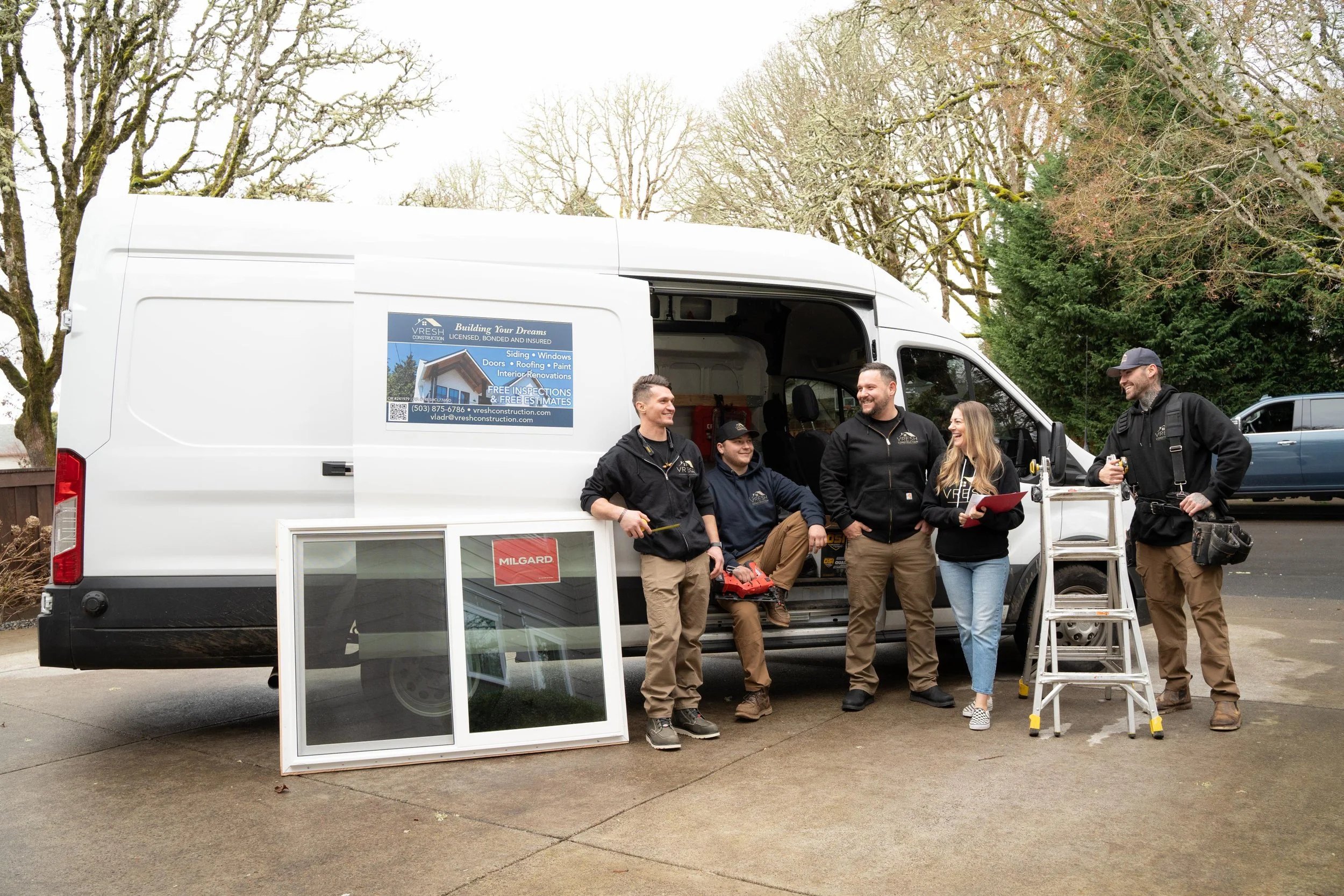
Five workers standing and sitting near a white van with a sign for a construction company, outdoors with trees in the background.

(503) 272-6436 — Call or Text, Available 24/7

We answer calls and texts at any hour. For storm damage, active leaks, or structural emergencies, calling directly is the fastest path to a response.

Roof Replacement vs. Roof Repair — How to Tell the Difference

Not every roofing situation calls for a full replacement. Here is our honest framework for advising homeowners on when replacement is the right call and when targeted repair is the more appropriate—and cost-effective—choice.

Roof Condition
Replacement or Repair?
Why
Shingles are 20–25+ years old and showing widespread granule loss
Replace
Granule loss indicates shingles are at or past their useful life. Widespread granule loss means the asphalt core is exposed across the roof — spot repairs on an aged roof are not cost-effective.
Multiple active leaks in different areas of the roof
Replace
Multiple simultaneous leaks indicate system-wide failure. Patching one area while others are actively failing is spending money to delay the inevitable.
Single leak at a flashing location — shingles otherwise in good condition
Repair
Most flashing-related leaks (chimney, skylight, pipe boot, valley) can be repaired at a fraction of replacement cost when the shingles themselves are in good condition.
Shingles are 10–15 years old with isolated damage (storm, fallen branch)
Repair
If the roof is in its middle years and the damage is isolated, repair is the right call. Save replacement for when the roof is genuinely at the end of its life.
Roof has been re-shingled over existing shingles and is now 2+ layers
Replace
Two layers of shingles is the code maximum in Oregon. If a second layer has been installed, the next work on the roof must be a full tear-off. The decking's weight and condition often require deck repair at this point as well.
Ice dam damage in winter / chronic ice damming
Assess + typically replace with ice & water shield upgrade
Ice damming causes water to back up under shingles. If the current roof lacks ice & water shield at the eaves and valleys, installing a proper ice shield may be the best long-term solution.
Moss or algae growing on shingles
Assess
Moss and algae do not automatically mean replacement. They can be treated on roofs that still have a useful life. However, moss can accelerate shingle deterioration and obscure underlying damage — always get a professional assessment when moss is visible.

Our Roof Replacement Process — What Happens on Every Project
#
Item
What We Do — And Why It Matters
PREPARATION AND TEAR-OFF
1
Protect the property
Set up tarps around the perimeter to catch debris. Protect landscaping, HVAC equipment, and decking at the start of each day. Remove satellite dishes or antennas that interfere with roofing work.
2
Full tear-off of existing roofing
Remove 100% of existing shingles, felt, and, in most cases, underlying layers. We do not install over existing shingles. Full tear-off is required to inspect the deck and install a proper underlayment system.
3
Roof deck inspection
Inspect all sheathing for soft spots, delamination, mold, and structural damage after the tear-off. Mark all areas requiring replacement before proceeding.
4
Deck repair
Replace any compromised OSB or plywood sheathing panels. Renail any sheathing that has pulled away from rafters. Confirm all edges are structurally sound and properly supported.
MOISTURE MANAGEMENT — UNDERLAYMENT SYSTEM
5
Ice and water shield — eaves
Install peel-and-stick ice and water shield at all eaves (minimum 24 inches inside the interior wall line per Oregon building code, typically 3–6 feet from the eave). Ice and water shield is the membrane that prevents water backup from ice dams or heavy rain from penetrating the roof deck at the most vulnerable location.
6
Ice and water shield — valleys
Install ice and water shield in all roof valleys — the highest-volume water concentration points on any roof. Valleys without ice and water shield are vulnerable to early failure even when shingles are in good condition.
7
Synthetic underlayment — full field
Install synthetic felt underlayment over the full roof field (except ice and water shield zones). Synthetic underlayment is more durable, more tear-resistant, and more water-resistant than traditional 15# or 30# felt. It stays in place during installation without wrinkling or tearing.
FLASHING SYSTEM
8
Drip edge — eaves
Install aluminum drip edge at all eave edges under the ice and water shield. Drip edge directs water off the roof deck edge and into the gutter rather than allowing it to run behind the fascia.
9
Drip edge — rakes
Install drip edge at all rake (gable) edges over the underlayment. Rake drip edge prevents wind-driven rain from getting under the shingles at the roof edge.
10
Step flashing — roof-to-wall
Install individual step flashing pieces at all roof-to-wall intersections — one piece of flashing per shingle course, interwoven with the shingles. Continuous flashing at these intersections is one of the most common causes of roof leaks on Portland homes.
11
Kickout flashing
Install kickout flashing diverters at the base of all roof-to-wall intersections where roof runoff would otherwise discharge directly at the wall. Absent kickout flashing is one of the most common sources of moisture damage to exterior walls on Portland homes.
12
Pipe boot flashing
Install new neoprene or lead pipe boot flashing at all plumbing vent penetrations. Old or cracked pipe boots are one of the most common sources of roof leaks on roofs that are otherwise in good condition.
13
Chimney flashing
Install new chimney flashing — step flashing at sides, counter-flashing (or reuse existing counter-flashing if sound), saddle flashing at upper chimney. Chimney flashing is among the most common sources of leaks on Portland homes.
14
Skylight flashing (if applicable)
Install the manufacturer-specified flashing kit for all skylights. Skylight flashing failures are a leading source of ceiling stains in Portland homes — most older skylights were not installed with current-standard flashing kits.
SHINGLE INSTALLATION AND FINISHING
15
Starter strip
Install starter strip at all eaves and rakes. The starter strip provides a sealed first course and prevents wind uplift at the roof perimeter.
16
Shingle installation
Install shingles per manufacturer specifications — correct exposure, correct nailing zone, correct number of fasteners per shingle, correct fastener length. Manufacturer certification requires adherence to installation specifications that affect both warranty and performance.
17
Ridge cap installation
Install ridge cap shingles (preferred over cut shingles — dimensional ridge cap provides better protection and appearance at the ridge). Hip caps at all hip ridges.
18
Cleanup and magnet sweep
Full perimeter cleanup of all debris. Magnetic roller sweep of all accessible areas around the home to collect nails. Remove all tarps and protective materials.
19
Final inspection and documentation
Walk the completed roof, inspect all flashing points, confirm that all penetrations are properly flashed, and provide the homeowner with written warranty documentation — both the manufacturer's product warranty and VResh's workmanship warranty.

Roofing Products We Install

CertainTeed — Landmark & Presidential Product Lines

CertainTeed is one of the longest-established roofing manufacturers in North America. Their Landmark series (30-year architectural shingles) and Presidential TL (40-year, shake-style) are among the most popular roofing products in the Pacific Northwest.

CertainTeed's SureStart PLUS warranty coverage requires installation by a CertainTeed-certified contractor. VResh Construction is CertainTeed certified.

Landmark in Weathered Wood or Colonial Slate is the most commonly specified product on Portland-area homes — it complements the Craftsman and traditional architectural styles prevalent in the Portland market.

Best for: Most Portland residential applications. Strong manufacturer support, wide color selection, and strong warranty program.

Owens Corning — Duration and TruDefinition Product Lines

Owens Corning's Duration series features SureNail Technology — a reinforced nailing zone that provides wind resistance ratings of up to 130 mph. Portland's windstorm events make this feature worth noting.

Duration Premium with WeatherGuard HP is specifically designed for high-wind and severe weather environments — appropriate for Portland homes exposed to storms from the west.

Owens Corning's Preferred and Platinum warranty tiers require installation by a certified contractor. VResh Construction is Owens Corning certified.

Best for: Homes on exposed ridges or westward-facing rooflines with higher wind exposure. Strong warranty coverage with certified installation.

Malarkey — Vista and Legacy Product Lines

Malarkey is a Portland-based roofing manufacturer — one of the few premium roofing brands that specifically formulates products for Pacific Northwest conditions. Their products contain Nexgen polymer-modified asphalt, which remains flexible in cold temperatures and resists the brittleness that causes shingle cracking during freeze-thaw cycles.

Malarkey's Legacy and Vista series also carry a smog-reducing granule technology (Scotchgard-treated) that resists algae growth — particularly valuable in Portland's damp, overcast climate, where algae colonization is accelerated.

As a local manufacturer with a strong warranty program, Malarkey is an excellent choice for Portland homeowners who want a product specifically engineered for Pacific Northwest conditions.

Best for: Portland homeowners who want a locally manufactured product specifically designed for this climate. Particularly good for north-facing rooflines and heavily shaded applications where algae is a concern.

Roofing in Portland's Climate — What Matters Here

Portland's climate creates roofing demands that differ from those in drier regions. Here are the climate factors that influence our material recommendations and installation approach for homes in the Portland area.

Sustained rainfall (37+ inches annually)

Valley flashing and ice & water shield in valleys are especially critical in Portland — valleys channel enormous water volumes during heavy rain events, and inadequate flashing at valleys is a very common source of leaks.

Moss and algae growth

Moss and algae growth: Portland's damp, low-UV winter conditions are ideal for colonization of roof surfaces by moss and algae. Malarkey's Scotchgard-treated granules and CertainTeed's StreakFighter granules resist algae growth. Algae-resistant products are worth the modest cost premium in Portland's climate.

Freeze-thaw cycling

Portland winters regularly cycle through freezing temperatures (often 20s–30s°F at night) and above-freezing temperatures during the day. This cycling stresses flashing materials and can cause ice damming at eaves on under-insulated roofs. Malarkey's polymer-modified asphalt remains flexible through these cycles; standard asphalt shingles can become brittle.

Wind events

Portland experiences strong west and southwest windstorms, particularly in fall and winter. Wind-rated shingles (Owens Corning Duration's 130 mph rating, for example) and proper starter strip installation at eaves and rakes meaningfully reduce wind uplift damage risk.

What Does a Roof Replacement Cost in Portland, OR?

General Cost Ranges — Portland, OR (Full Tear-Off + Installation)

  • Standard ranch or bungalow (1,200–1,800 sq ft footprint, simple gable or hip roof): $9,000–$16,000 in 30-year architectural shingles

  • Two-story home or complex roof (multiple valleys, dormers, steep pitch): $14,000–$25,000+

  • Premium shingles (Duration, Presidential TL, Malarkey Legacy): Add 15–25% to above

  • Roof deck repairs: $400–$2,000+, depending on the extent of sheathing damage found

  • Chimney re-flashing: $400–$800

  • Skylight re-flashing: $300–$600 per skylight

Typical Project Timeline

  • Estimate: Same day or within 24–48 hours of request

  • Permit (when required): 1–3 business days in most Portland jurisdictions

  • Installation: 1–2 days for standard residential roof; 2–4 days for complex or large roofs

  • Weather hold: We monitor the forecast and schedule installations during weather windows. We do not begin a tear-off that we cannot complete in a single day.


Close-up of stylized quotation marks in beige and brown colors.

Client's Talk

We have a wealth of experience working as main building contractors on all kinds of projects, big and small, from home maintenance and improvements to extensions, refurbishments and new builds.

OUR FAQS

Roof Replacement FAQs — Portland Homeowners

How much does a roof replacement cost in Portland, OR?
A standard Portland ranch or bungalow with a simple gable or hip roof typically ranges from $9,000–$16,000 for a full tear-off and installation of 30-year architectural shingles. Two-story homes or roofs with multiple valleys, dormers, or steep pitches usually range from $14,000–$25,000 or more. Premium shingles may add 15–25% to the total cost. Deck repairs, chimney re-flashing, skylight work, or ventilation upgrades may also affect the final price. We provide a free written estimate after an on-site roof inspection.
How long does a roof replacement take?
+
Most residential roof replacements take 1–2 days to complete. Larger or more complex roofs with steep pitches, multiple penetrations, or roof deck repairs may take 2–4 days. We schedule projects carefully based on weather forecasts and do not begin a tear-off we cannot complete the same day to ensure the home is never left exposed overnight.
Do you replace over existing shingles or perform a full tear-off?
+
We always perform a full tear-off. While building codes sometimes allow installing new shingles over existing ones, this prevents proper inspection of the roof decking and underlayment. It can also add unnecessary weight and reduce the lifespan of the new roof. Removing all existing roofing materials ensures a proper installation and allows us to inspect and repair the roof deck if needed.
Which roofing products do you recommend for Portland homes?
+
We commonly recommend architectural shingles from CertainTeed, Owens Corning, or Malarkey. Malarkey shingles are particularly well suited for Portland's climate because their polymer-modified asphalt remains flexible through freeze-thaw cycles and includes algae-resistant granules. Owens Corning Duration shingles also offer strong wind resistance, making them a good option for homes exposed to high winds.
Do you help with storm damage insurance claims?
+
Yes. We assist homeowners with documentation and estimates required for insurance claims related to storm damage, including hail, wind, or fallen tree damage. We can provide detailed inspection reports and communicate directly with insurance adjusters to help ensure the claim process moves smoothly.
How long will a new roof last in Portland?
+
Most architectural asphalt shingles installed in Portland carry manufacturer warranties ranging from 30 to 50 years. In real-world conditions, a properly installed architectural shingle roof typically lasts about 25–35 years in the Pacific Northwest climate. Premium shingles may last even longer when properly maintained and installed according to manufacturer specifications.