
Egress Window Well Drainage in Portland: Preventing Water Problems
The egress window went in two years ago. The well looked clean and dry for the first summer. Then fall arrived, the rain started, and by November, the well had four inches of standing water sitting against the bottom of the window. Leaves had settled into the gravel. The water sat there for weeks — not draining, not evaporating, just rising with every storm. By January, moisture was showing at the bottom of the window frame on the inside. The egress window that was supposed to make the basement bedroom legal was now making the basement wet.
Window well drainage failures are one of the most common callbacks on egress window installations in Portland. The window itself is fine. The well structure is fine. The problem is underneath — the drainage system either wasn't installed, wasn't connected to anything, or wasn't designed for the volume of water that Portland's climate delivers over a 7-8 month wet season.
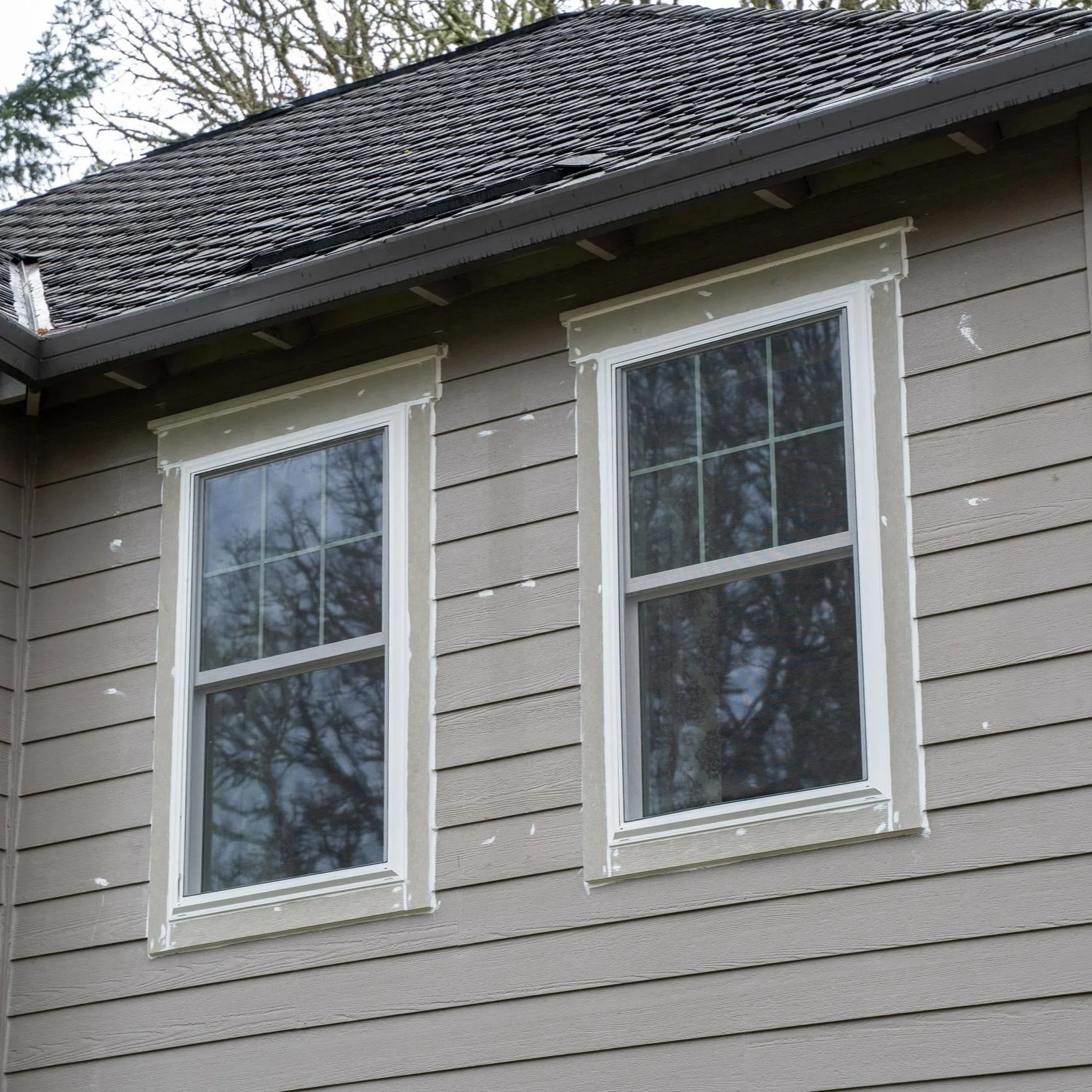
Exterior window installation on Portland home highlighting proper egress well drainage, waterproofing, grading, and moisture protection during heavy rainfall.
How Window Well Drainage Works
A window well is an excavated pocket outside a below-grade window. The well provides the space required by code for emergency egress — a minimum of 9 square feet of floor area, 36 inches of width, and 36 inches of projection from the foundation wall. Water enters the well from three sources: rain falling directly into the open well, surface runoff flowing toward the foundation, and groundwater rising during sustained wet periods.
The drainage system at the base of the well manages all three sources. Two approaches exist — passive and active — and the distinction matters in Portland.
Passive drainage relies on a gravel bed at the bottom of the well. Rainwater falls into the well, filters through the gravel, and percolates into the surrounding soil. No drain line. No mechanical connection. The system depends entirely on the soil's ability to absorb water faster than it accumulates. In well-draining sandy or loamy soil, passive drainage works. The water filters through the gravel and disperses into the ground.
Active drainage adds a dedicated drain line at the base of the gravel bed. The drain connects to the home's perimeter footing drain system or exits to daylight at a lower grade point away from the foundation. Water that enters the well passes through the gravel, enters the drain, and is carried away from the foundation — regardless of how saturated the surrounding soil is. Active drainage handles sustained volume because it doesn't depend on soil absorption.
Why Passive Drainage Fails in Portland
Portland's 36+ inches of annual rainfall arrive primarily between October and May — seven to eight months of sustained wet weather. During the heaviest months, rain falls for days without a meaningful break. The soil never fully dries between events.
Clay soil. Portland's predominant soil type in residential neighborhoods is clay-heavy — the Willakenzie, Cascade, and Aloha soil series that cover large portions of the metro area. Clay absorbs water slowly and retains it for extended periods. A gravel bed sitting in clay-heavy soil becomes surrounded by saturated ground during the wet season. The gravel can't drain because the soil around it is already full. Water backs up into the well and sits.
Saturated subsoil. By December, the subsoil around most Portland foundations is at or near saturation. Passive drainage works by moving water from the gravel bed into the surrounding soil. When the surrounding soil is already saturated — which it is for 5-6 months of the year in Portland — there's nowhere for the water to go. The gravel bed fills, the well fills, and the water sits against the window.
Volume over time. A standard 36-inch by 36-inch window well has a surface area of roughly 9 square feet. During a sustained rain event delivering 0.5 inches over several hours — a common Portland occurrence — that well receives roughly 4.5 gallons of direct rainfall. Add surface runoff from the surrounding grade flowing toward the foundation, and the volume doubles or triples. In well-draining soil, that volume disperses within hours. In Portland's clay, it doesn't.
Debris accumulation accelerates the failure. Leaves, pine needles, and organic matter settle into the gravel over time. In Portland's densely treed neighborhoods — inner southeast, the west hills, Lake Oswego — the volume of leaf fall is significant. A half-inch layer of compressed organic matter on top of the gravel acts like a plug, blocking the water's path to the gravel bed below. The water pools on top of the debris layer instead of filtering through.
Active Drainage: The Portland Standard
Active drainage connects the window well to a drainage system that carries water away from the foundation regardless of soil conditions. The installation adds cost to the egress project, but in Portland's climate, the alternative — a well that floods every winter — is worse.
Gravel base. The bottom of the well gets 8-12 inches of clean, washed drainage gravel — typically 3/4-inch to 1-1/2-inch river rock. The gravel provides the initial collection volume. Water entering the well passes through the gravel and reaches the drain line at the base.
Drain line. A 4-inch perforated PVC drain pipe sits at the base of the gravel bed, wrapped in filter fabric to prevent fine sediment from clogging the perforations. The pipe connects to the home's perimeter footing drain—the drain tile that runs around the foundation to manage groundwater. On homes where the footing drain exits to daylight at a lower elevation, the window well drain follows the same path. On homes with a sump pump system, the well drain connects to the sump.
Connection to footing drain. The footing drain is the primary below-grade drainage system for the foundation. Connecting the window well drain to it ensures that the well has an active path for water removal even when the surrounding soil is fully saturated. The connection requires excavation along the foundation wall from the well to the nearest footing drain access point — a step that adds labor but creates a reliable system.
Grading away from the well. The soil surface around the window well must slope away from the well opening — a minimum of 6 inches of fall over the first 10 feet. Grading that slopes toward the well directs surface runoff into it, overwhelming the drainage system and filling the well from above. Correct grading is a basic site detail, but on Portland homes where landscaping, mulch, and grade changes have occurred over decades, the original drainage slope has often been compromised.
Gutter and downspout routing. Downspouts that discharge near a window well dump concentrated roof runoff directly into the drainage system — or directly into the well if the cover is missing. A single downspout on a 400-square-foot roof section delivers roughly 250 gallons per inch of rainfall. During a Portland storm, that volume overwhelms even a well-designed drainage system. Downspouts should discharge at least 4-6 feet away from any window well, with extensions or splash blocks directing the water away from the foundation.
Signs the Drainage Has Failed
Drainage failures in existing window wells develop gradually. The system works for the first few years, then performance degrades as the gravel clogs, the drain line silts up, or the surrounding soil conditions change.
Standing water in the well after rain. Water that sits in the well for more than a few hours after the rain stops is a drainage failure. A properly drained well should clear within 30-60 minutes of the rain stopping, even during heavy events. Water that remains for days has nowhere to go.
Rust on galvanized steel wells. Galvanized steel is the most common well material. Prolonged contact with standing water corrodes the galvanized coating and rusts the steel underneath. Rust staining on the inside of the well — particularly at the bottom — indicates repeated or sustained water contact.
Moisture at the interior window frame. Water staining, condensation, or dampness on the interior side of the egress window frame indicates that hydrostatic pressure in the well is pushing moisture past the window seal. The window may not be actively leaking, but the sustained moisture contact is stressing the seal and the flashing behind the frame.
Efflorescence on the foundation wall inside the well. White mineral deposits on the concrete or masonry surface indicate that water is migrating through the foundation wall. The minerals are salts carried by the water as it passes through the concrete. Efflorescence in the well means the wall is wet — and the drainage isn't preventing it.
Soil erosion around the well exterior. Settling or erosion of the soil around the outside of the well indicates that surface water is flowing toward and around the well rather than being diverted by proper grading. The erosion path becomes a channel that directs more water into the well with each rain event.
Fixing Drainage on an Existing Well
Retrofitting drainage on a window well that was installed without it — or where the original drainage has failed — requires excavation, which means redoing part of the original installation.
Step 1: Excavate around and below the well. Remove the gravel and any accumulated debris from the base of the well. Excavate below the well bottom to reach the depth of the footing drain or to create a path for a new drain line to exit to daylight.
Step 2: Install the drain line. Lay 4-inch perforated PVC at the base, wrapped in filter fabric. Connect to the footing drain, the sump system, or a daylight exit at a lower grade point.
Step 3: Replace the gravel. Refill the well base with 8-12 inches of clean, washed drainage gravel. Do not reuse the old gravel — it's likely clogged with fine sediment and organic matter that reduces drainage capacity.
Step 4: Correct the surface grading. Re-grade the soil around the well exterior to slope away from the well opening. Compact the soil in layers to prevent future settling that would reverse the grade.
Step 5: Install or replace the well cover. A cover reduces future debris accumulation and direct rainwater entry by 80-90%. Clear polycarbonate allows light into the basement while keeping the well clean.
The retrofit cost depends on the depth of excavation and whether a footing drain connection is accessible. Minor retrofits — cleaning out clogged gravel and adding a drain connection at a shallow depth — run $800-$2,000. Full re-excavation with new drain installation runs $1,500-$3,500+. The cost is significantly less than repairing water damage to the basement interior — a flooded egress well that leaks through the window can cause $3,000-$10,000+ in interior damage over a single wet season.
Get quote — Egress window well flooding? VResh Construction installs and retrofits window well drainage systems with subsurface drain connections designed for Portland's sustained rainfall. Call (503) 272-6436 for a free on-site assessment.
Window Well Material and Drainage Performance
The well material affects long-term drainage performance by determining how the well handles sustained soil contact and moisture.
Galvanized steel is the most common and most cost-effective well material. Standard galvanized wells work reliably for 15-25 years in Portland's soil conditions before the galvanized coating deteriorates and rust develops. Rust doesn't necessarily mean the well has failed structurally, but it does indicate sustained moisture contact — which may also indicate drainage performance issues.
Composite (polypropylene) wells are the premium option. Composite doesn't rust, doesn't corrode, and maintains structural integrity indefinitely in soil contact. The higher upfront cost — roughly 30-50% more than galvanized steel — is offset by zero maintenance and no degradation timeline. For Portland installations where the well will be in contact with saturated clay soil for decades, composite eliminates the corrosion variable entirely.
Custom masonry or concrete wells are an option for high-end applications where the well is a visible architectural feature. Masonry wells handle sustained moisture contact well, but cost significantly more than prefabricated options.
Maintenance That Prevents Drainage Failure
A properly installed drainage system performs reliably for years, but it isn't maintenance-free. Portland's climate and tree canopy create conditions that degrade drainage performance over time if the well isn't maintained.
Clear debris from the gravel surface twice a year. Once in late fall after peak leaf drop and once in early spring. Remove accumulated leaves, pine needles, and organic matter before they compress into a layer that blocks water penetration into the gravel.
Test the drain annually with a bucket flush. Pour 3-5 gallons of water directly into the well and watch how fast it drains through the gravel. A functioning system clears that volume within a few minutes. If the water sits on top of the gravel for 10-15 minutes or more, the gravel is clogged, or the drain line below is blocked. If the well has a cleanout or access point on the drain line, flush it with a garden hose during dry weather. Sediment buildup in the drain pipe reduces flow capacity over time.
Check grading around the well every spring. Soil settles and erodes. Mulch builds up. Landscaping changes redirect surface water. Confirm that the soil surface around the well still slopes away from the opening.
Replace the gravel every 10-15 years. Even with regular surface cleaning, fine sediment migrates into the gravel bed over time and reduces its drainage capacity. Removing the old gravel and replacing it with fresh, washed stone restores the system's original performance.
Frequently Asked Questions
The Portland-Specific Problem
Generic egress installation guides written for national audiences treat window well drainage as a minor detail — a few inches of gravel at the bottom, and move on. That approach works in Denver, Phoenix, and most of the Sun Belt, where annual rainfall is 15-20 inches, and the soil drains freely. It doesn't work in Portland, where 36+ inches of rain arrive over a sustained 7-8 month wet season, the soil is clay-heavy, and the subsoil around most foundations is saturated from December through April.
The drainage system underneath the window well is what determines whether the egress installation performs correctly for the next 25 years or starts leaking water into the basement within the first two winters. In Portland's climate, that system needs to be active — a drain line connected to the footing drain, not just gravel sitting in clay.
Request estimate — Planning an egress window installation? VResh Construction installs every egress window with a subsurface drain system designed for Portland's sustained rainfall. Call (503) 272-6436. for a free on-site assessment.
