
What a Deck Ledger Board Does — and Why It Fails Quietly
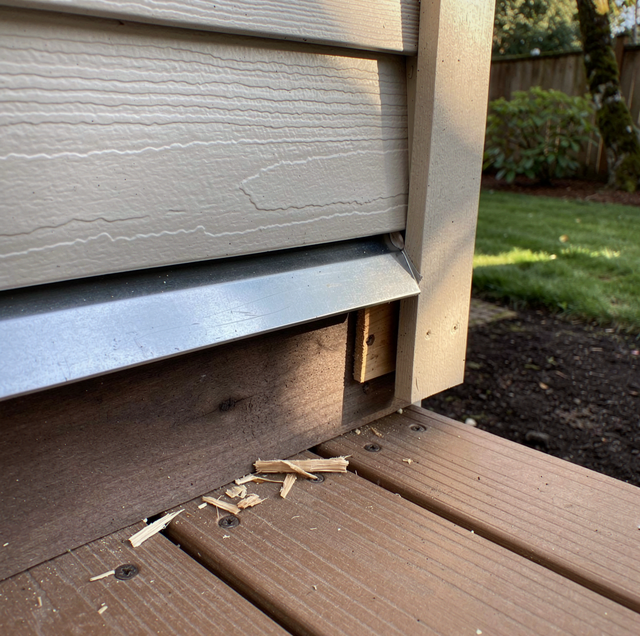
Quick Answer: A deck ledger is the board bolted to the house carrying roughly half the deck's load into the house framing. It fails two ways: fasteners with too little shear capacity, or missing or reversed flashing that lets the framing rot unseen.
A crew re-decking a twelve-year-old deck pulled the last boards near the house and found the ledger sitting exactly where it should be, bolted to the rim joist, with the flashing lapped correctly. Two doors down, on a deck built the same year by a different framer, the same board was toe-nailed to the siding with sixteen-penny nails and never flashed at all. From the yard, both decks looked the same: level, solid underfoot, no visible sag. One was carrying the deck's load into the house framing on bolts. The other was holding a deck up on nails.
A ledger board is the single length of lumber bolted horizontally to the house that the rest of the deck hangs from. That one board typically carries roughly half of everything the deck holds and transfers it into the house's own framing, usually the rim joist behind the siding. It fails in two ways that have nothing to do with each other, even though both hide behind the same trim: the fasteners can be the wrong kind, or the flashing that keeps the connection dry can be missing or reversed. Either alone is enough to bring the connection down. A deck can have perfect flashing over a nailed ledger, or bolts torqued correctly behind flashing lapped the wrong way, and end up in the same place.
What the Ledger Carries Into the House
Every joist on an attached deck runs from the ledger on the house side to a beam supported by posts on the outer side. Each joist splits its load between its two ends, in inverse proportion to its distance from each end, so a load near the house is carried mostly by the ledger. Roughly half of the deck's total load- the decking, the joists, the railing, and everyone standing on the house side of it- travels back through the ledger; the rest goes down through the posts under the outer beam. Multiply that across every joist tied into the ledger, and one connection at the house is carrying a genuine share of the whole deck's weight.
The ledger transfers that load into the house's rim joist, band joist, or the equivalent framing member behind the exterior wall. That framing was built to carry your house. Whether it can also carry a deck's share depends entirely on how well that transfer works, which is where both failure paths start.
Fastening Decides Whether the Connection Is Structural
What holds the ledger to the house determines whether the load transfer actually happens or only appears to. The dominant force on a ledger connection is vertical shear. Your deck's joists hang off the ledger's face in metal joist hangers, so the deck's weight and everyone on it press straight down along the wall, and every fastener through the ledger has to carry its share of that downward load across the joint and into the rim joist. That is why a ledger's fastening is specified from shear tables. Nails and deck screws are not a structural fastening for this connection: each one carries a small fraction of the shear a through-bolt or a structural wood screw carries, so the count needed to match a bolted connection is far beyond what anyone drives, and a nail fired blind through cladding frequently lands in siding rather than the framing behind it, holding nothing structural at all.
Through-bolts or structural wood screws, sized and spaced to a specification written for that particular deck, carry that shear the way nails cannot: a through-bolt passes entirely through the ledger, and the rim joist and bears on a nut and washer on the far side, and a structural screw has a thicker shank and threads engaging both members along their full depth. Withdrawal, the force pulling the ledger straight off the wall, is a real but secondary demand here, and it comes from lateral movement, people swaying in step, wind, seismic shaking, rather than from the deck's own weight; that demand is why a separate lateral hold-down device tying the deck framing back to the house floor framing exists as its own item. Fastener type, spacing, and pattern come from that deck's own structural specification, sized to its size, height, and expected load, and confirming it is a question for your local building authority. It is also the failure an inspector checks first, because a ledger's fastening is invisible once decking and trim go back over it, and a marginal connection gives no visible warning before it lets go.
Nails and deck screws leave a ledger with far less shear capacity than the connection requires, yet it can still carry day-to-day loads for years. A crowd gathered near the house, adding vertical load directly into that joint without warning.
Flashing Is the Only Thing Between the Connection and Constant Wetting
The ledger sits flat against the house at the exact spot where the exterior cladding had to be cut open to make room for it. That cut interrupts whatever was shedding water down the wall before the deck existed, and the flashing over the ledger's top edge has to take over that job: a metal or membrane cap lapping over the ledger and up behind the housewrap above it, so water sheets over the flashing and back out. That is the same shingle-style lapping that governs any horizontal cut in an exterior wall, including at a door sill, though a door threshold's own drainage tray is a separate assembly with its own failure points. Reversed, with the flashing tucked under the housewrap where it should lap over it, or lapped short enough that a gap remains at either end, the detail does the opposite of its job: it funnels water behind the barrier and directly onto the ledger and the framing behind it.
Because that failure sits behind the cladding, no one has a reason to open it, and it can run for years while the deck above looks and feels completely normal. The rim joist or band joist behind the ledger stays wet on a repeating cycle, and wood held above roughly 20 percent moisture content for sustained periods is what wood-decay fungi need to establish and spread. By the time decay has softened the wood enough to feel with a probe, the fasteners are no longer anchored in sound material; they are holding into wood that has lost much of its strength since the deck was built, whatever fastener was actually used.
What You Can See From the Yard and Inside
None of this requires you to open anything up. From the yard, look at the seam where your deck meets the house: a strip of exposed metal flashing running the full width of the ledger is normal, and cladding that runs straight down to the decking with no visible flashing line at all is worth asking about directly. A gap between the ledger and the siding above it, or dark, streaked staining concentrated right above where the deck attaches, both point toward water tracking somewhere it should not be. Underfoot, a section of decking right along the house that flexes more than the boards a few feet out is worth noting, since it can point to a problem at the connection itself.
From inside, if you have an unfinished basement or crawlspace under the deck side of the house, look at the framing already exposed there without moving anything: dark staining, a chalky white residue, or a soft, spongy feel to the rim joist where it lines up with the deck above are all signs that the water meant to shed past the flashing outside is instead reaching the framing from behind it.
A flashlight held at a raking angle along an exposed rim joist in a basement or crawlspace shows a warped or delaminated section through shadow before staining is visible on its own; pointed straight on, the same defect is easy to miss.
What an Inspection Looks At
An inspection of an existing ledger starts with the fastening, because it is both the more dangerous failure and the one least likely to announce itself early. An inspector or structural professional looks for the fastener type visible at any access already available, a basement, a crawlspace, or an area where trim has already come off, and compares what is there against what a deck of that size and height should have. Confirming your ledger's fastening usually requires that kind of access.
Where flashing is the concern, the same access question applies: a professional evaluation means opening a small, targeted section to confirm what is happening at that point of the wall, then closing it back up correctly. That opening is a smaller scale work than either a repair or a rebuild; its only purpose is to answer what is actually there before anyone decides what happens next.
Where a Repair Ends and a Rebuild Begins
A ledger connection with correct through-bolts or structural screws, sound condition, sitting behind flashing lapped the wrong way, is a repair: the flashing gets corrected, any wood it already reached gets addressed, and the fastening underneath does not need to change, because it was never the problem. A ledger fastened with nails or deck screws is an entirely different category of finding, and treating it as something to note for next season understates what is there: the connection never had the shear capacity to carry the load it has been carrying. Correcting it means re-establishing that connection properly, and how that gets done, and how much of the structure above it has to come apart to do it, is a decision made against the specification for that particular deck.
Frequently Asked Questions
Yes. A freestanding deck sits entirely on its own posts and footings on all four sides, with no connection to your house at all. Freestanding construction usually needs more posts and footings and slightly more attention to settling independently from the house, but it removes the house connection from the load path completely.
A connection loaded in bending, like an overloaded floor joist, typically sags visibly before it breaks, because the wood fibers on the stretched side elongate before they rupture. A ledger's fastening does not deform that way. Each fastener carries its share of the deck's shear load, and an undersized one crushes the wood around its shank a little at a time, behind decking and trim that hide it, until the fasteners still holding are carrying more than they can, and the joint goes at once. That is part of why a marginal connection can look completely normal until it fails.
Yes, when it's present. A layer of continuous rigid foam or thick exterior insulation between siding and framing puts real distance between the ledger's outer face and the structural wood it needs to bolt into, and a fastener sized for a wall without that gap will not reach or properly engage the framing. Ledger connections through continuous insulation use longer fasteners and, often, standoff hardware holding the ledger slightly off the wall so the load transfers directly into solid framing across that gap.
Yes. A roof cuts down direct rain at the connection, but wind-driven rain still reaches most covered openings during a hard storm, and deck-board runoff sheeting down the wall face above the ledger is a water source a roof does not address. Condensation inside the wall cavity adds a third source unrelated to the weather outside on a given day. A cover changes how much water the flashing has to handle; the detail keeps doing its job at all three.
Before staining reaches visible wall or ceiling surfaces, water behind a failed ledger flashing detail often collects first at the bottom of the nearest joist hangers, the metal brackets holding the deck joists to the ledger, where moisture sits against the metal and wood pocket longer than on an open, exposed framing face. A hanger showing rust bleed, a white mineral deposit at its base, or wood inside the pocket darker than the framing around it is often the earliest visible sign, before any stain shows on a ceiling or wall finish inside.
No. Carrying its share of the deck's load into the house is the ledger's job whether the deck sits six inches or six feet off the ground; height changes what happens if the connection fails and how visible a fall risk that failure creates. A low deck with a nailed ledger has exactly the same shear problem as a high deck. It's just less likely to be the deck anyone thinks to have inspected.
Get a professional evaluation of your deck's ledger connection — including what it will take to confirm the fastening and flashing behind the trim. VResh Construction serves the Portland metro. CCB #241979. Call (503) 272-6436.
