
5 Fiber Cement Siding Myths That Lead to Expensive Repairs
Fiber cement siding has a reputation for being bulletproof. Install it and forget it for 30 years. No rot, no warping, no insects, no problems. That reputation is partly earned — fiber cement is tough stuff. But it's not invincible, and the gap between what homeowners believe about it and what it actually requires is where expensive repairs come from. Five myths in particular cause the most damage, and all five show up regularly on Portland homes.
Myth #1: Fiber Cement Never Needs Maintenance
The myth says install it and walk away. The reality is different. Fiber cement doesn't rot like wood and doesn't warp like vinyl. But the finish on the surface does wear, and the caulk at every joint does fail over time.
ColorPlus factory-finished HardiePlank has a 15-year finish warranty. That means even the manufacturer expects the finish to need attention eventually. In Portland, where rain, UV exposure, and moss growth all work on the surface, the finish can show wear before the 15-year mark — especially on south-facing walls that take direct sun and north-facing walls where moss holds moisture against the surface.
Caulk at butt joints, corner boards, and trim transitions needs inspection every 3-5 years. Portland's freeze-thaw cycles expand and contract the caulk until it pulls away from the substrate. Once the caulk opens, water enters the joint and reaches the sheathing behind it. The siding looks fine. The wall behind it is getting wet.
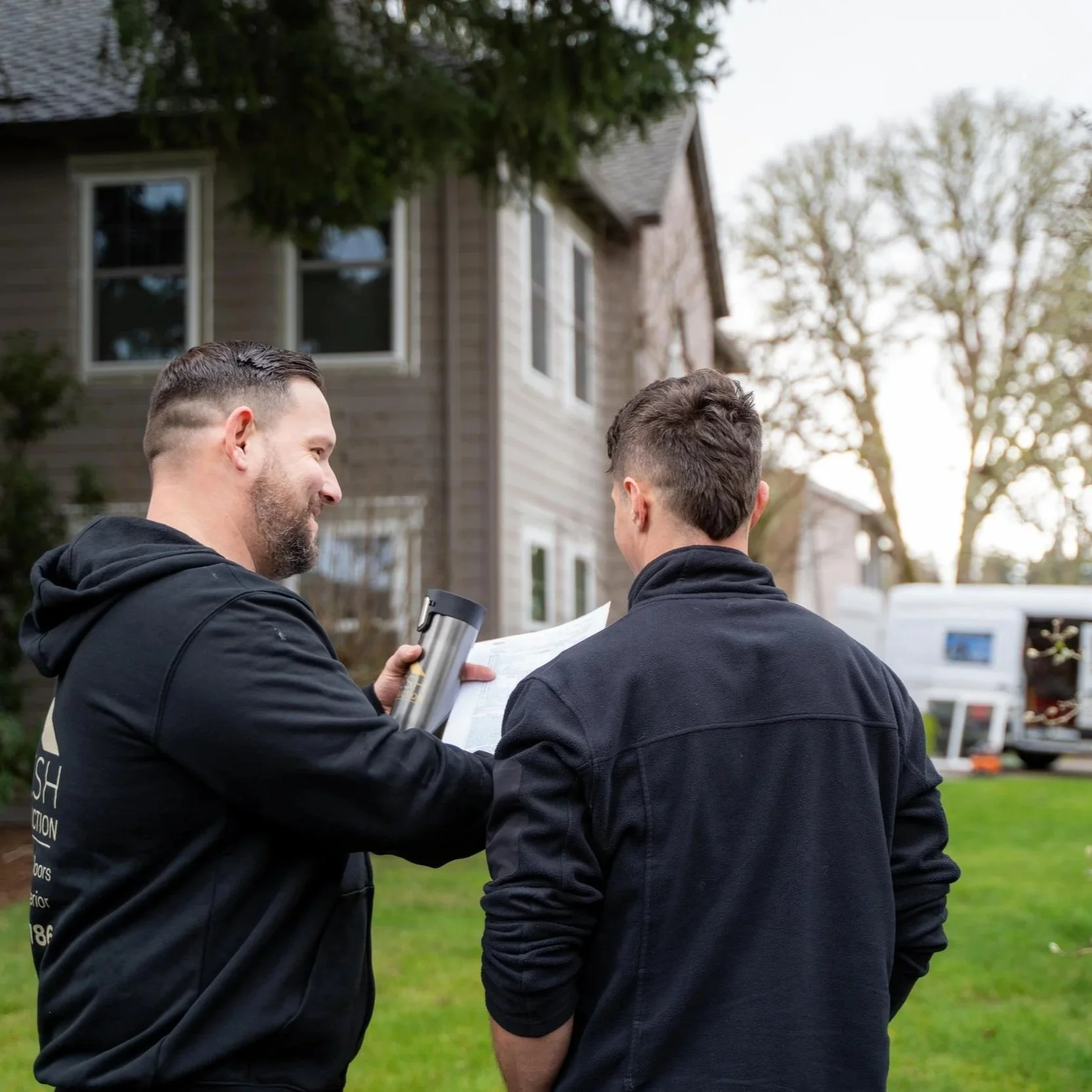
A contractor explains exterior siding details to a homeowner, emphasizing that fiber cement siding still requires maintenance like caulking and cleaning to prevent moisture intrusion and long-term structural damage.
Maintenance isn't annual staining like cedar. But it's not zero, either. Inspect caulk joints every few years. Clean moss and mildew annually on shaded walls. Repaint or recoat the finish when it starts chalking. That level of attention keeps fiber cement performing for 40+ years. Ignoring it leads to failures at the joints by year 10-15.
Myth #2: Fiber Cement Is Completely Waterproof
Fiber cement is water-resistant. It's not waterproof. The distinction matters in Portland's climate.
The material is made from Portland cement, sand, and cellulose fiber. The cement component resists water well. But the cellulose fiber can absorb small amounts of moisture, especially at cut edges where the factory finish doesn't cover the exposed material. Cut ends of HardiePlank — at every butt joint, every window cutout, every corner — absorb water at a higher rate than the finished face.
Hardie recommends priming or sealing all cut edges before installation. Contractors who skip this step in the interest of speed leave exposed fiber cement edges wicking moisture into the board. In Portland, where those cut edges sit in rain for months, the moisture absorption can cause localized swelling and premature paint failure at the joints.
The bigger waterproofing issue isn't the siding itself — it's the system behind it. Fiber cement is the first line of defense. The house wrap, flashing, and drainage plane behind it are the real waterproofing. A fiber cement wall with failed flashing at the windows leaks just as badly as any other siding material.
Myth #3: Any Siding Contractor Can Install Fiber Cement
This is the myth that causes the most expensive failures. Fiber cement requires different tools, different fastening patterns, different joint details, and different handling than vinyl or wood. A crew that installs vinyl siding all year can't switch to Hardie on Monday and do it right.
Specific installation requirements that get missed by inexperienced crews:
Nailing: Hardie requires face-nailing 3/4" to 1" from the edge, into studs, with corrosion-resistant nails. Too close to the edge, and the board cracks. Into sheathing instead of studs, and the board loosens over time. Pneumatic nail guns set too deep blow through the board.
Gapping: Butt joints require a 1/8" gap (about the thickness of a nickel) filled with caulk. Tight butt joints with no gap transfer stress between boards during thermal expansion and cause cracking. Crews used to vinyl (which overlaps instead of butting) don't think about this.
Cutting: Fiber cement must be cut with carbide-tipped tools or shears. Cutting generates silica dust that requires respiratory protection. Crews unfamiliar with the material use standard wood blades that dull instantly and produce rough, chipped cuts.
Flashing integration: Hardie installation requires careful coordination with house wrap, window flashing, Z-bar, and kickout flashing. The siding has to work as part of a system. Crews that install siding in isolation — without tying into the water management system behind it — create leak points that don't show up until years later.
James Hardie maintains a list of Preferred Remodelers and certified installers. Certification doesn't guarantee perfection, but it means the crew has completed Hardie's training on proper installation. Ask for the certification.
Myth #4: Fiber Cement Doesn't Crack
It does. And when it cracks, the cause is almost always an installation error — not a material defect.
The three most common causes of cracking:
Nailing too close to the edge. The minimum distance from the board edge matters. Nails placed too close create stress points that propagate cracks along the board, sometimes months after installation.
No gap at butt joints. When boards are pushed tight against each other with no expansion gap, thermal movement transfers force through the joint. The board cracks at the weakest point — usually near a fastener.
Impact during handling. Fiber cement is brittle. Boards dropped on the job site, stacked improperly, or handled roughly develop hairline cracks that may not be visible during installation but open up after temperature cycling. Proper job site handling is part of proper installation.
Hairline cracks can be sealed with caulk and touched up with paint. Structural cracks — anything wider than 1/16" or running the full height of the board — require board replacement. The fix is straightforward, but the labor isn't cheap because the overlapping course above usually needs lifting or removal to access the damaged board.
Myth #5: Caulk at Joints Is Optional
Some installers leave butt joints uncaulked, claiming the house wrap behind it handles water. In a dry climate, maybe. In Portland, that approach fails.
Wind-driven rain in Portland pushes water sideways and upward. An uncaulked 1/8" gap between two siding boards is an open path for water to reach the house wrap — and if the house wrap has any imperfection (a torn seam, an unsealed staple hole, a poorly lapped overlap), water reaches the sheathing. Every uncaulked joint is a potential leak point.
Hardie's installation guide specifies caulking all butt joints with a flexible, paintable caulk. The caulk fills the gap, bridges the expansion joint, and prevents water entry. In Portland's climate, this isn't a finishing detail — it's waterproofing.
Frequently Asked Questions
What Actually Causes Failures
Fiber cement siding doesn't fail because the material is bad. It fails because the installation was wrong, the maintenance was skipped, or the wall system behind it had gaps. Every myth on this list leads to the same place — a homeowner surprised by a repair bill on a product that was supposed to last forever. The product does last. But only when the details are right from day one.