Best Exterior Paint for Rainy Climates: What Lasts and What Doesn't
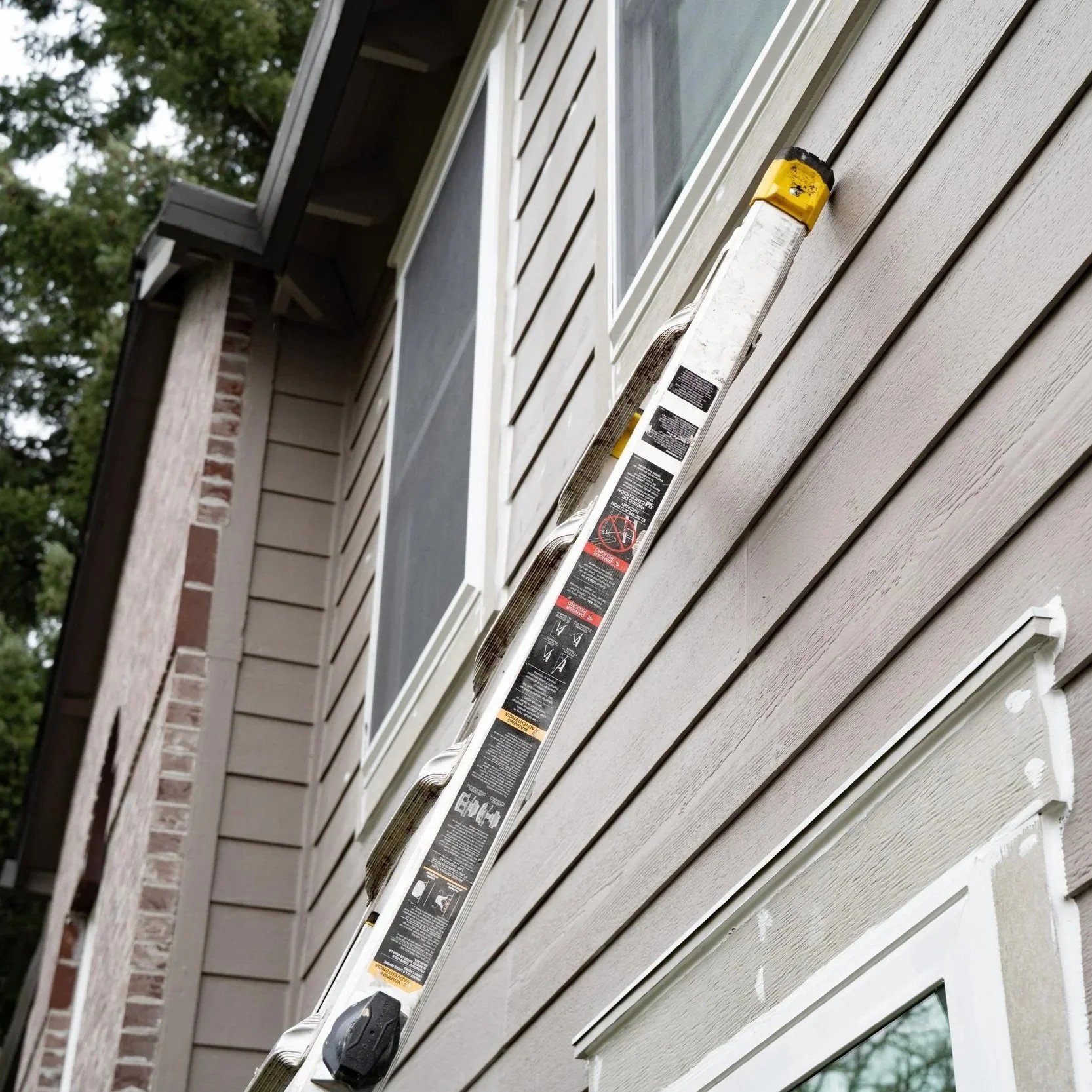
Ladder positioned beside exterior siding during Portland home painting project focused on durable coatings, moisture protection, and surface preparation.
The south wall had been painted three years earlier with a bargain-grade exterior latex. The north wall, painted the same day by the same crew, had been coated with a 100% acrylic product from a different line. Three winters later, the south wall was chalking, the bottom courses were peeling at every cut end, and mildew had colonized the shaded section below the eaves. The north wall looked like it had been painted the previous summer. Same house, same crew, same day, same prep. The only variable was the paint.
That comparison plays out across Portland every wet season. The resin system inside the can — not the brand name on the label — determines how exterior paint performs under 37+ inches of sustained annual rainfall, 7-8 months of continuous wet conditions, and the moss-and-mildew pressure of the Pacific Northwest's extended damp season. Choosing the right product for Portland's climate is a material decision, not a marketing decision.
What Makes Paint Survive Sustained Rain
National paint guides describe exterior paint performance in terms of coverage, hide, and color retention. In Portland, the performance that matters most is moisture management — how the paint film handles water on the surface, water vapor migrating through the substrate, and biological growth fueled by months of dampness.
Resin type is the deciding factor. Exterior paints use one of two primary resin systems: 100% acrylic or vinyl-acrylic (also called vinyl-acrylic latex or PVA-acrylic blends). The resin is the binder that holds the pigment together and bonds it to the surface. In Portland's climate, the resin system determines everything downstream — adhesion, flexibility, breathability, and resistance to moisture and mildew.
100% acrylic resins resist moisture penetration. Acrylic polymers form a paint film that is highly resistant to water absorption. Rain hits the surface, beads, and runs off. The film does not soften or swell with prolonged moisture contact. This property is critical in Portland, where siding surfaces stay wet for days or weeks at a time during the October-through-May rainy season.
Vinyl-acrylic blends absorb more water. Vinyl-acrylic resins are cheaper to manufacture and produce a paint film that is less moisture-resistant than 100% acrylic. In drier climates, the difference is marginal. In Portland's sustained rain, vinyl-acrylic paint absorbs measurably more moisture, chalks faster, and allows more water vapor to pass through the film — accelerating substrate damage behind the paint.
Flexibility matters through temperature cycling. Portland's exterior surfaces expand and contract between cool, wet winters (sustained 35-45°F) and warm, dry summers (75-95°F). A paint film that cannot flex with the substrate cracks at joints, cut ends, and grain patterns. 100% acrylic paint remains flexible across a wider temperature range than vinyl-acrylic, which becomes brittle faster with UV exposure and age.
Breathability prevents blistering. Moisture vapor migrates outward through wood and fiber cement siding, particularly during the transition from wet season to dry season, as trapped moisture in the wall assembly dries toward the exterior. A paint film that blocks this vapor traps moisture against the substrate and blisters. 100% acrylic formulations balance moisture resistance on the exterior face with vapor permeability from the substrate side — the coating sheds rain while allowing the wall to dry.
Products That Perform in Portland
The products listed here are the ones most commonly specified by professional painters and contractors working in the Portland metro area. Each uses a 100% acrylic resin system and has a documented performance record in the Pacific Northwest's sustained-rain climate.
Sherwin-Williams Duration Exterior. Duration uses PermaLast technology — a formulation that builds a thicker film than standard acrylics, increasing durability and moisture resistance. The thicker film is particularly relevant on textured substrates like cedar siding, where thin paint films wear through at high points faster. Duration has been a Pacific Northwest standard for residential and commercial exterior work for over a decade. Application range: down to 35°F, which extends the usable painting season into Portland's marginal months (May and October). Available in flat, satin, and gloss.
Sherwin-Williams Emerald Exterior. Emerald is Sherwin-Williams' premium tier. It cures to a harder, tighter film than Duration, providing superior resistance to dirt pickup and staining — relevant on light-colored Portland homes where rain splash-back and airborne debris darken the paint surface over time. Emerald's self-priming properties reduce the need for a separate primer coat on previously painted surfaces in good condition. The harder film makes Emerald slightly less flexible than Duration, which matters on substrates with significant expansion-contraction movement (old-growth cedar, for example). Application range: down to 35°F. Available in flat, satin, and gloss.
Benjamin Moore Aura Exterior. Aura uses Color Lock technology — a proprietary resin system that provides deep pigment saturation, reduced chalking, and strong UV resistance. The high-build formula deposits a substantial film from the first coat, which is practical on Portland homes where weather windows for painting are narrow and minimizing the number of application days matters. Aura's breathable film formulation resists blistering on moisture-laden substrates — a common failure mode in Portland, where wall assemblies carry elevated moisture content through most of the year. Application range: down to 40°F. Available in flat, low luster, satin, and semi-gloss.
Miller Paint Evolution Exterior. Miller Paint has operated out of Portland since 1890 — longer than any other paint manufacturer in the Pacific Northwest. Evolution Exterior uses a pure acrylic co-polymer resin system formulated specifically for PNW conditions: early moisture resistance (the film resists rain sooner after application than many competitors), enhanced UV protection, and a flexible, fade-resistant finish. Miller's local manufacturing means product formulations are tuned to regional climate data rather than national averages. Evolution is available at Miller Paint stores throughout the Portland metro area. Application range: down to 35°F.
Miller Paint StratusXT Exterior. StratusXT is Miller's all-weather exterior formulation, designed to handle the temperature swings and humidity spikes that characterize Portland's shoulder seasons. The product targets contractors who need to apply paint in marginal conditions — spring and fall days when temperature and humidity hover near the limits of standard exterior products.
| Product | Resin | Min Application Temp | Key Strength for Portland | Approx Price (gallon) |
|---|---|---|---|---|
| SW Duration Exterior | 100% acrylic (PermaLast) | 35°F | Thick film, moisture resistance | $65-$80 |
| SW Emerald Exterior | 100% acrylic | 35°F | Hard film, dirt/stain resistance | $75-$95 |
| BM Aura Exterior | 100% acrylic (Color Lock) | 40°F | High build, breathability, UV resistance | $75-$90 |
| Miller Evolution Exterior | Pure acrylic co-polymer | 35°F | PNW-formulated, early moisture resistance | $55-$70 |
| Miller StratusXT | Acrylic (all-weather) | 35°F | Marginal-condition application | $60-$75 |
Products That Fail in Portland
Not every product sold as "exterior paint" is formulated for sustained-rain climates. Some categories consistently underperform in Portland's conditions.
Vinyl-acrylic exterior latex. The most common budget exterior paint category. Vinyl-acrylic resins absorb more moisture, chalk faster, and lose adhesion sooner than 100% acrylics. In Portland's climate, vinyl-acrylic exterior paint typically lasts 3-5 years on properly prepped surfaces — compared to 7-12 years for 100% acrylic on the same prep. The upfront savings are consumed by the earlier repaint cycle.
Alkyd (oil-based) exterior paint. Alkyd paint was the standard for decades and still has niche applications (bare metal, high-adhesion primer coats). As a finish coat on wood or fiber cement siding in Portland, alkyd paint becomes brittle faster than acrylic, cracks sooner with substrate movement, and does not breathe — trapping moisture behind the film and promoting blistering and substrate rot. Most professional Portland painters have moved away from alkyd finish coats for siding.
Elastomeric coatings on wood siding. Elastomeric paint is designed for masonry — it forms a thick, rubberized film that bridges hairline cracks in stucco and concrete. Applied to wood siding, elastomeric coatings trap moisture behind the film with no pathway for the substrate to dry. The result in Portland's climate is accelerated rot behind paint that looks intact from the outside. Elastomeric coatings on wood siding are a common misapplication that leads to expensive remediation.
Sheen Selection for Portland
Sheen affects more than appearance — it affects moisture performance, dirt resistance, and maintenance.
Flat and low-luster for siding. Flat finishes hide surface imperfections on older siding — waviness, filled nail holes, patched areas — and produce the most uniform appearance across large wall surfaces. The trade-off is that flat finishes are slightly more porous than higher sheens, which means they absorb more surface moisture and are harder to clean. In Portland, flat finishes work well on east and south-facing walls that dry quickly but may develop mildew faster on shaded north-facing surfaces where moisture lingers.
Satin for north-facing and shaded walls. Satin finishes provide a slight sheen that sheds surface moisture faster than flat, and resists mildew attachment more effectively. For north-facing walls, walls under heavy tree canopy, and walls that stay shaded for most of the day, satin is a practical upgrade that extends the time between cleanings and reduces mildew growth.
Semi-gloss for trim, fascia, and doors. Semi-gloss provides the most moisture-resistant surface and the greatest durability at high-wear locations — window casings, door frames, corner boards, and fascia. The higher sheen shows surface imperfections more than flat or satin, so trim surfaces must be smoother and better prepped. Semi-gloss also cleans more easily than lower sheens, which matters on trim surfaces that collect dirt from rain splash-back.
Substrate-Specific Requirements
The substrate determines the product, the primer, and the preparation — not the other way around.
Cedar siding. Cedar's natural oils and tannins interfere with paint adhesion if the surface is not properly prepared. A stain-blocking primer is required on bare cedar to prevent tannin bleed — the brown discoloration that leaches through paint from the wood's natural extractives. On cedar, a penetrating stain sometimes outperforms a film-forming paint because stain absorbs into the wood grain rather than forming a surface film. When the film-forming paint expands and contracts at a different rate than the cedar beneath it, the paint cracks and peels. A quality penetrating stain weathers by fading gradually rather than peeling — a cosmetically different but structurally preferable failure mode.
James Hardie fiber cement. Hardie siding has manufacturer-recommended coating specifications. The factory-applied primer on Hardie primed siding is compatible with most 100% acrylic topcoats, but the finish coat should be applied within 90 days of installation for best adhesion. Hardie's ColorPlus factory-finished siding carries a 15-year fade warranty — the longest factory paint warranty in the siding industry. Homes with ColorPlus may not need repainting for 15+ years, depending on exposure. When repainting Hardie, confirm product compatibility with the existing primer or factory finish.
LP SmartSide engineered wood. LP SmartSide requires all field-cut edges to be primed with LP's recommended primer before installation. The manufacturer's warranty requires this. The face of LP SmartSide accepts 100% acrylic paint and stain. The critical detail is the cut ends: engineered wood absorbs moisture at the edges dramatically faster than through the face, and unprimed cut ends are the primary failure point on LP SmartSide installations in Portland's climate.
Previously painted wood. The condition of the existing paint determines the prep. Sound, well-adhered existing paint can be scuff-sanded and topcoated. Failing, peeling, or chalking paint must be scraped to a sound substrate, feathered at the edges, and spot-primed before the finish coat. Premium self-priming products (like SW Emerald) can serve as their own primer over sound existing paint — but not over bare wood, which always requires a dedicated primer.
When the Paint Season Opens in Portland
Portland's exterior painting window is narrower than most U.S. cities, and the timing of application affects performance as much as the product selection.
Late June through September is the primary painting season. Monthly rainfall drops below 1 inch during July and August, daytime temperatures reach 70-85°F, and consecutive dry days are most likely. These conditions fall within the application range for all products listed above and allow proper curing before the wet season returns.
May and October are marginal months. Rain events are less frequent than winter but still occur. Morning dew and surface moisture delay work start times. Products with lower minimum application temperatures (35°F for Duration, Emerald, Evolution, and StratusXT) provide more usable hours during shoulder-season days than products with 50°F minimums.
November through April is too wet for finish coat application. Emergency spot priming and minor repairs can be done during dry windows, but full exterior paint projects should be scheduled for summer. Paint applied on surfaces that are not fully dry, or in conditions where rain arrives before the film has cured, will fail — regardless of the product quality.
Booking timeline. Most established Portland painting contractors are fully booked by May for summer work. Homeowners planning a summer paint project should get estimates in March or April to secure scheduling.
Get quote — Planning an exterior paint project? VResh Construction uses 100% acrylic products on every project — Duration, Emerald, Aura, or Miller depending on the substrate and exposure. Full prep, back-priming, correct caulk. Free on-site estimate. Call (503) 272-6436.
How Portland's Climate Attacks Paint
Understanding the failure mechanisms explains why product selection and preparation both matter — and why one without the other produces short-lived results.
Sustained horizontal rain drives moisture into every defect. Portland's 37+ inches of annual rain arrive primarily as sustained, wind-driven events. Rain pushes sideways into siding joints, behind trim, through cracked caulk, and against every imperfection in the paint film. A pinhole in the paint, a missed caulk joint, or an unprimed cut end becomes a moisture entry point that stays active for months.
7-8 months of continuous dampness prevents drying. A paint defect in a dry climate gets wet, then dries between storms. The same defect in Portland gets wet in October and may not dry until June. That sustained moisture contact is what allows mildew to establish on the paint surface and rot fungi to consume the substrate behind it.
North-facing walls fail first. The north side of a Portland home receives the least direct sunlight and dries the slowest. Mildew growth, paint chalking, and substrate damage develop on north-facing walls years before the same problems appear on south or east-facing walls. Product selection and sheen selection for north-facing walls should account for this accelerated exposure.
Moss and algae compound the problem. Homes under heavy tree canopy — common throughout Portland's established neighborhoods — develop moss and algae growth on siding, particularly on shaded lower courses. Moss traps moisture against the paint surface, holds it there through rain events and between them, and accelerates both paint deterioration and substrate damage beneath the paint.
Frequently Asked Questions
The Product and the Prep Are Both the Investment
A premium 100% acrylic paint applied over proper preparation — cleaning, scraping, priming bare wood, back-priming all cut ends, replacing failed caulk, and making minor repairs — delivers 7-12 years of protection in Portland's climate. The same product applied over shortcuts delivers 3-5 years and costs more in the long run because the corrective repaint includes the prep that should have been done the first time. The paint is the visible layer. The preparation behind it is what makes it last.
Paint choice is the smallest variable on a wet wall. Pressure-washing, stripping to sound substrate and back-priming the cut ends decide whether any coat lasts — the can is the last decision, not the first. VResh Construction specifies coats in the estimate: exterior painting in Oregon City, exterior painting in Portland. Free estimate: (503) 272-6436.