Contractor Red Flags: 7 Warning Signs Before Signing
The contractor showed up two days after a windstorm. No appointment, no referral — he was driving the neighborhood, knocking on doors, pointing at missing shingles and damaged siding. He had a truck with a magnetic sign on the door and a business card with no Oregon CCB license number. He offered a "storm special" price but said the discount would expire by the end of the week. The scope of work was described verbally: "re-roof the damaged section, fix the siding where the wind got it." No written estimate, no material specification, no mention of permits. He asked for 50% upfront to reserve the crew.
Every element of that encounter — the unsolicited visit, the pressure, the vague scope, the absent credentials, the upfront payment demand — follows a documented pattern. The Federal Trade Commission identifies these behaviors as the primary warning signs in home improvement scams. Recognizing them before signing a contract is the single most effective form of consumer protection in residential construction
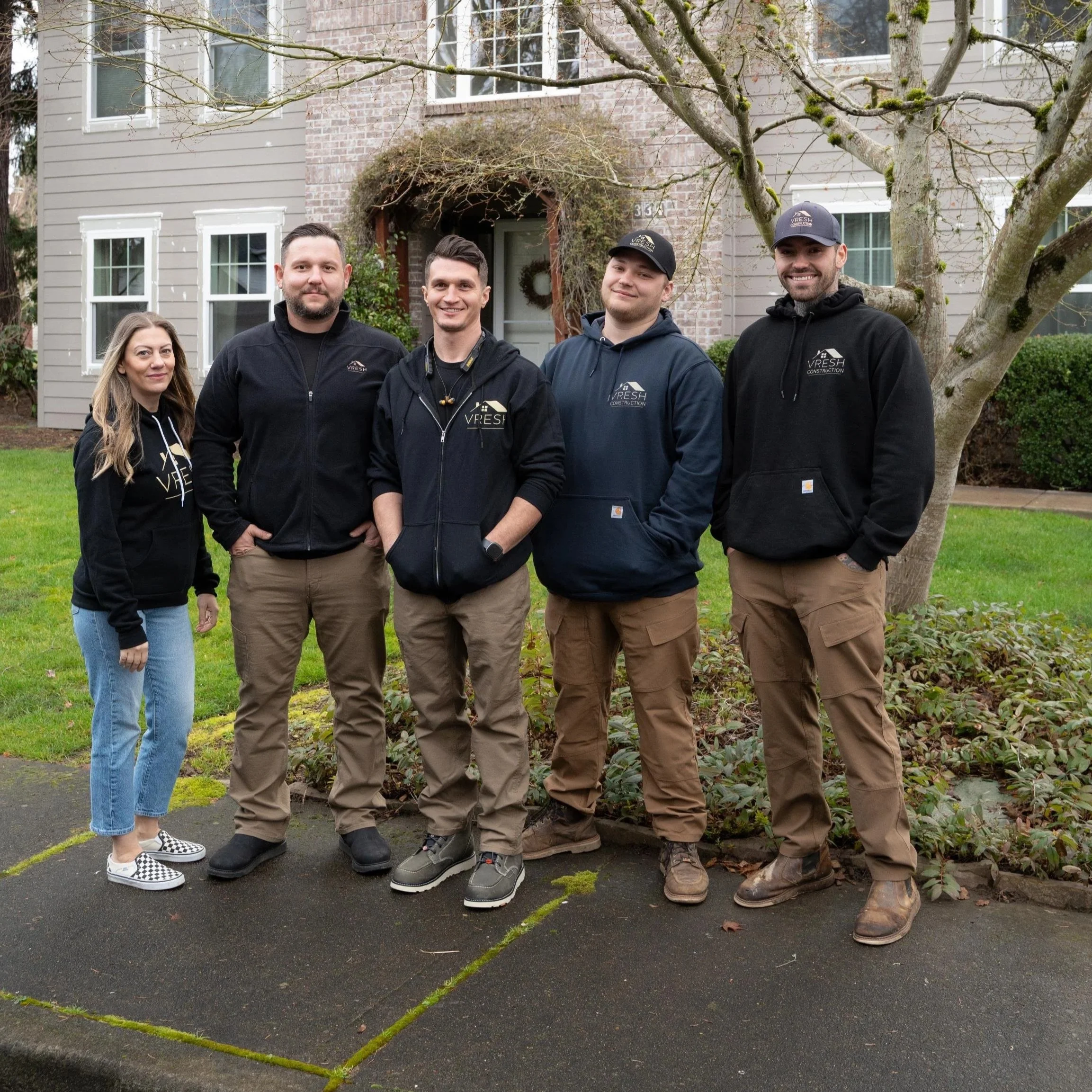
Homeowners meeting licensed contractors outside Portland property while discussing estimates, credentials, payment schedules, and avoiding common contractor warning signs.
1. No Verifiable Oregon Contractor License
In Oregon, any contractor performing work valued at more than $1,000 must hold an active license with the Oregon Construction Contractors Board (CCB). The license confirms that the contractor carries general liability insurance, workers' compensation coverage (if employees are on staff), and a surety bond. The CCB license is the minimum threshold — not a quality endorsement, but a legal requirement.
How to verify. The CCB maintains a public license search at the Oregon Construction Contractors Board website. Enter the contractor's name or license number. The search returns the license status (active, inactive, expired, or revoked), the insurance expiration dates, and any complaints or disciplinary actions on file.
What to look for. An active license with current insurance. A history section showing no unresolved complaints or disciplinary actions. Workers' compensation coverage if the contractor has employees. A contractor who cannot provide a CCB license number, provides a number that does not return results, or whose license shows expired insurance is not legally authorized to perform the work.
Why it matters beyond legality. If an unlicensed or improperly insured contractor is injured on the job, the homeowner's own insurance may be liable. If the work is defective, the homeowner has no recourse through the CCB's dispute resolution process. The CCB bond provides a limited recovery mechanism for consumers — but only when the contractor holds a valid license at the time of the work.
2. Door-to-Door Solicitation After a Storm
Contractors with established customer relationships, referral networks, and scheduled work do not canvass neighborhoods looking for damaged homes. A contractor who appears at the door unsolicited after a storm — particularly one from out of state or with no local office — fits the pattern that the FTC and state consumer protection agencies identify as a storm chaser.
The pattern. Storm chasers follow severe weather events from region to region. They arrive within days of a storm, offer immediate repairs at discounted rates, collect large deposits, and either perform substandard work or leave before completing the project. Their business presence in the area is temporary. When the work fails or the homeowner has a warranty claim, the contractor is in another state.
The indicators. A magnetic sign on the truck rather than a painted company name. A business card with a cell phone number and no local office address. A license from another state with no Oregon CCB license. A claim that insurance will cover the work, with no supporting documentation. A willingness to start immediately — which sounds like responsiveness, but in practice means the contractor has no scheduled work from established clients.
What to do. If a contractor solicits work at the door, ask for the Oregon CCB license number and verify it before any further conversation. If the contractor cannot provide one, the conversation is over.
3. Pressure to Sign the Contract Immediately
A contractor who has inspected the property, prepared a detailed estimate, and presented it to the homeowner expects the homeowner to take time to review the document, compare it with other estimates, check references, and decide without urgency. A contractor who pressures the homeowner to sign the same day is using urgency to prevent that process.
Common pressure language. "This price is only good today." "We have a crew opening this week — if you don't commit now, the next available date is two months out." "Material prices are going up next month." "I'm giving you a special rate because I'm already in the neighborhood." Each of these statements creates artificial urgency. None of them obligate the homeowner to skip due diligence.
Why does the pressure exist? A contractor who does not want the homeowner to compare estimates may know that the estimate will not survive comparison, either because the price is inflated, the scope is vague, or the contractor's credentials will not withstand verification. A contractor who is confident in the work and the company's reputation has no reason to prevent the homeowner from taking time to review and compare.
Standard practice. A written estimate presented to the homeowner with time to review — typically a week or more for larger projects. The contractor answers questions, provides references on request, and follows up without pressure. The estimate speaks for itself.
4. Large Upfront Payment Before Work Begins
A deposit at contract signing is standard in residential construction. The amount and structure of that deposit is where the red flag appears.
Industry standard. 10-15% of the contract price at signing, with remaining payments tied to project milestones — demolition complete, rough-in complete, inspections passed, and project completion. The final payment (typically 25-30% of the total) is due after the homeowner walks through the completed project and confirms that the work meets the agreed scope.
The red flag. A demand for 40-50% or more before work begins. A request for the full project cost upfront. A cash-only payment requirement. A refusal to tie payments to milestones. These patterns shift all financial risk to the homeowner — the contractor receives payment before delivering any work, reducing the incentive to complete the project or correct deficiencies.
Oregon context. Oregon does not impose a statutory cap on contractor deposits for licensed contractors. The absence of a legal cap makes the payment structure a matter of negotiation and professional practice rather than regulation. The industry standard of 10-15% at signing exists because it balances the contractor's need for material procurement with the homeowner's need for financial protection.
What to require. A written payment schedule tied to milestones, included in the contract. Payments by check or credit card, not cash. A final payment that is withheld until the project passes the homeowner's walk-through and any punch list items are addressed.
5. Verbal Estimate With No Written Scope
A verbal estimate is not an estimate — it is a conversation. Verbal pricing lacks a defined scope, material specifications, documented exclusions, and a basis for comparison or dispute resolution.
What a verbal estimate looks like. The contractor walks the property, looks at the work, and says, "I can do this for about twenty-five thousand." No written document follows. No line items. No material descriptions. No timeline. No payment terms. No warranty language. The homeowner's only record of the agreement is a remembered number.
Why it fails. When the project starts, disputes arise over what was included and what was not. "I thought painting was included." "The estimate was for the siding — painting is extra." Without a written scope, these disputes have no resolution because there is no document to reference. Change orders become verbal as well — the project cost grows with no documentation trail.
What is required? A written estimate with line items broken down by trade or phase. Material specifications — brand, product, grade. Labor costs. Permits. A defined payment schedule. Warranty terms. Inclusions and exclusions stated explicitly. The written estimate becomes the basis for the contract — it defines the work, the cost, and the terms.
6. No References, No Portfolio, No Verifiable History
A contractor who has been operating in the Portland area for any meaningful period has completed projects, worked with homeowners, and built a track record. That track record — references from past clients, photos of completed projects, reviews on verifiable platforms — is the most reliable indicator of what the homeowner can expect.
What to ask for. Three to five references from projects completed in the last two years, including the homeowner's contact information and permission to call. Photos of completed projects similar in scope to the proposed work. An online presence that includes reviews on platforms the contractor does not control (Google, Yelp), rather than exclusively on the contractor's own website.
What the absence means. A contractor who cannot provide references may be new to the area, may have left a trail of dissatisfied clients, or may be operating under a different name than a previous business — sometimes to distance from a poor reputation or CCB complaints under the former name. None of these possibilities is confirmed by the absence alone, but the absence is reason enough to proceed with caution or choose a contractor with a documented record.
How to use references. Call the references. Ask specific questions: Was the project completed on time? Were there unexpected costs? How did the contractor handle problems or changes? Would the homeowner hire the contractor again? The answers to these questions are more informative than the estimate itself.
7. The Contractor Asks the Homeowner to Pull the Permit
On projects that require building permits — and most siding replacements, window replacements, roofing projects, structural repairs, and deck construction in Portland do — the contractor should pull the permit. The permit is issued in the contractor's name, meaning the contractor is the responsible party for code compliance and inspection scheduling.
The red flag. A contractor who asks the homeowner to pull the permit is transferring legal responsibility for code compliance to the homeowner. If the work does not pass inspection, the homeowner — not the contractor — is the permit holder and the party responsible for corrections. The FTC identifies this practice as a warning sign because it separates the person performing the work from the person responsible for its compliance.
Why contractors do it. An unlicensed contractor cannot pull a permit — the permit application requires a valid CCB license number. A contractor with a history of failed inspections may prefer to avoid the paper trail. A contractor who does not intend to build to code may not want the inspection process that a permit triggers.
What to require. The contractor pulls the permit in the contractor's name. The permit fee appears in the estimate. The contractor schedules and attends inspections. The permit card is posted at the job site during construction. The homeowner receives a copy of the final inspection approval.
How to Verify a Contractor Before Signing
Verification takes less than an hour and eliminates the most common sources of contractor problems.
Oregon CCB license search. Verify the license is active, insurance is current, and no unresolved complaints exist. Free and available online through the Oregon Construction Contractors Board.
References. Call three to five past clients. Ask about the experience, not just the result — timeline adherence, communication, problem resolution, and whether they would hire the contractor again.
Online reviews. Check Google reviews and other third-party platforms. Look for patterns in negative reviews — repeated complaints about the same issues (communication, timeline, payment disputes) are more informative than individual star ratings.
Written estimate review. Compare the estimate against the standard checklist: scope, materials, labor, permits, timeline, payment schedule, warranty, inclusions, and exclusions. Gaps in the estimate are gaps in the planning.
Contract review. Read the contract before signing. Confirm that the scope, price, payment schedule, timeline, warranty, and change-order process match what was discussed. If the contract differs from the estimate, ask why before signing.
| Verification Step | What to Check | Where to Check | Time Required |
|---|---|---|---|
| CCB license | Active status, current insurance, complaints | Oregon CCB website | 5 minutes |
| References | 3-5 past clients, similar project scope | Phone calls to provided contacts | 20-30 minutes |
| Online reviews | Pattern of feedback, recurring complaints | Google, Yelp, third-party platforms | 10 minutes |
| Written estimate | Scope, materials, labor, permits, warranty | The estimate document itself | 15-20 minutes |
| Contract | Matches estimate, change-order process | The contract document | 15-20 minutes |
Get estimate — VResh Construction provides written, line-item estimates with defined scope, material specifications, permits included, and a written change-order process. Owner-supervised projects with consistent crews. Call (503) 272-6436.
Frequently Asked Questions
The Contractor's Process Is the Product
The quality of a contractor's process — how the estimate is prepared, how the work is documented, how changes are handled, how the project is supervised — predicts the quality of the finished work more reliably than the price. A contractor who presents a detailed written estimate, provides references without hesitation, holds a current CCB license with a clean history, ties payments to milestones, and pulls permits in the contractor's own name is a contractor whose business practices align with the homeowner's interests. The red flags are not obscure — they are visible in the first interaction, the first estimate, and the first conversation about how the work will proceed.
VResh Construction does not give verbal estimates or ballpark figures over the phone. Less a service policy than the clearest filter on any list like this one: a number given without a visit is a number that moves. How a VResh project runs; general contractor in Beaverton. Same day or within 24 hours: (503) 272-6436.