
James Hardie vs Vinyl Siding: Portland Climate Comparison
Two siding quotes on the table. The vinyl number is half the price. The Hardie number makes the budget tight. Both products go on the outside of the house and keep water out — at least that's the pitch. But the way they handle Portland's rain over the next 20 years is where the comparison actually matters. Vinyl is waterproof on its own. Hardie is too. The difference is what happens behind each one, inside the wall, where water damage actually starts.
Portland's 40+ inches of annual rain, freeze-thaw cycles from October through April, and sustained horizontal wind-driven rain create conditions that test every siding material harder than the manufacturer's brochure suggests. The question isn't which one looks better on installation day. It's which one protects the wall behind it for the next three decades?
Side-by-Side Comparison
| Feature | James Hardie Fiber Cement | Vinyl Siding |
|---|---|---|
| Installed cost per sq ft | $9-14 | $4-8 |
| Lifespan | 30-50 years | 20-30 years |
| Moisture absorption | Minimal (cement-based) | Zero (plastic) |
| Rot resistance | High | N/A (doesn't rot) |
| Impact resistance | High | Low-moderate (brittle in cold) |
| Freeze-thaw performance | Excellent | Good (but expansion/contraction) |
| Fire resistance | Non-combustible | Melts at 700°F |
| Maintenance | Repaint every 10-15 years | Wash periodically |
| Wind resistance | Nailed tight, no movement | Can loosen, allow wind-driven rain |
| Color retention | ColorPlus factory finish 15-year warranty | Fades over time, can't be painted easily |
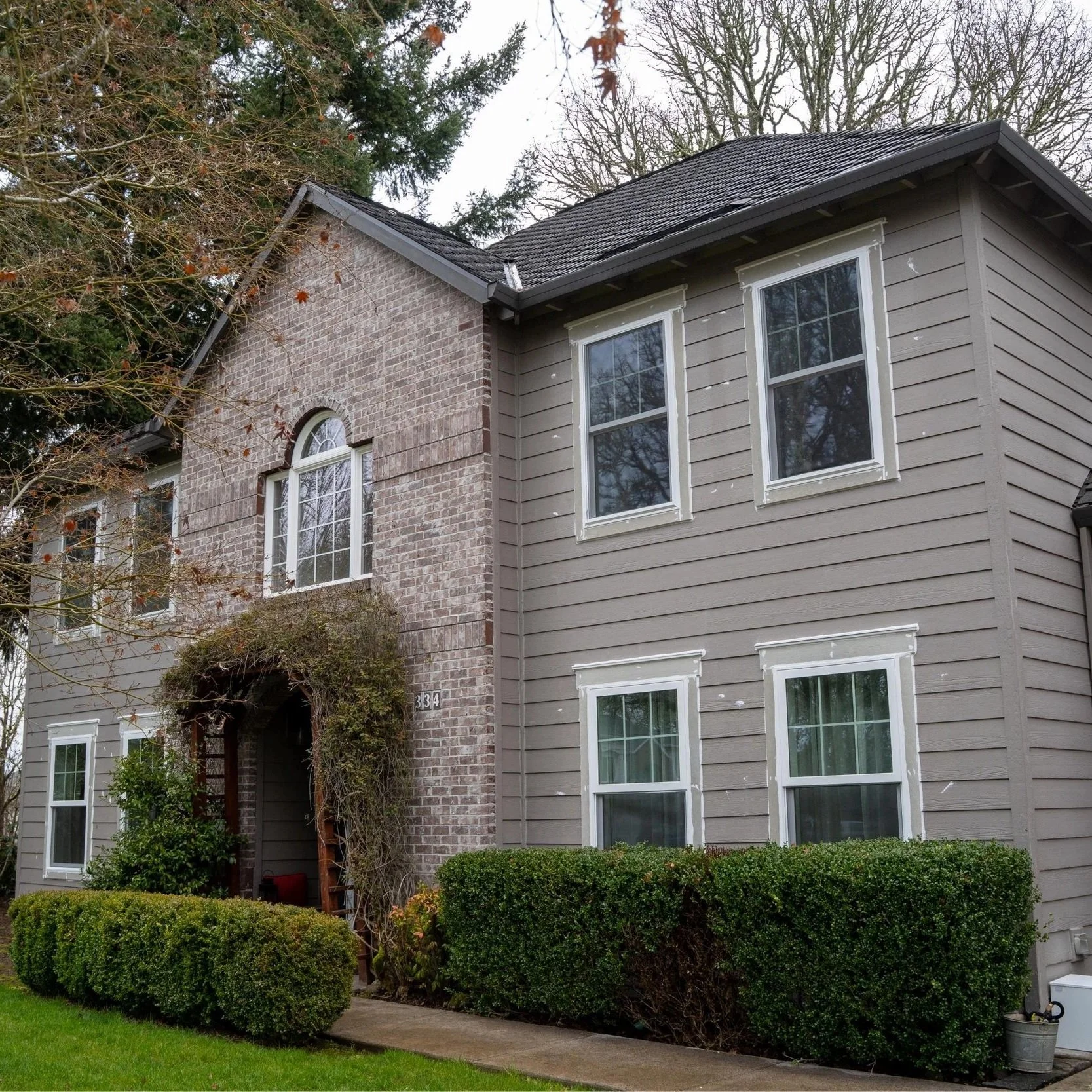
A Portland home finished with James Hardie siding — built to handle the Pacific Northwest's wet winters in a way vinyl siding simply cannot match long-term.
How Portland's Rain Affects Each Material
Vinyl itself doesn't absorb water. Rain hits it and runs off. But vinyl siding is installed as a rain screen — it's designed to let water get behind it. The panels overlap but aren't sealed. Wind-driven rain pushes water through the joints, behind the siding, and onto the house wrap and sheathing underneath. In a dry climate, that moisture evaporates between storms. In Portland, where rain falls for days without stopping, the moisture behind vinyl doesn't get a chance to dry. The sheathing stays wet. The framing stays damp. Rot starts behind siding that looks perfectly fine from the outside.
Hardie fiber cement is nailed tightly to the sheathing with no gaps between courses when properly installed. It doesn't flex in the wind the way vinyl does. Wind-driven rain has fewer entry points. The material itself doesn't absorb meaningful moisture — it's primarily Portland cement and sand. It won't swell, warp, or delaminate in sustained rain.
The critical detail with both materials, the house wrap and flashing underneath, matters as much as the siding itself. Hardie over bad house wrap still leaks. Vinyl over good house wrap with proper flashing and Z-bar detailing performs better than either product alone suggests. The siding is the first layer of defense, not the only one.
Where James Hardie Wins
Freeze-thaw durability. Portland gets 25-40 freeze-thaw cycles per year. Vinyl expands when warm and contracts when cold — that thermal movement loosens fasteners over time and opens gaps at joints. Hardie doesn't move. The cement composition is dimensionally stable across temperature swings.
Impact resistance. A windblown branch hits vinyl and cracks it, especially in cold weather when the plastic becomes brittle. The same branch bounces off Hardie. In Portland neighborhoods with mature trees (which is most of them), impact resistance matters every storm season.
Straight walls, clean lines. Vinyl siding follows the wall it's attached to. If the sheathing has waves, the vinyl shows waves. Hardie's rigidity bridges minor imperfections and produces flatter, cleaner wall surfaces. On older Portland homes where framing isn't perfectly straight, Hardie hides what vinyl reveals.
Resale perception. Buyers and agents in Portland recognize Hardie as a premium material. It appraises higher and sells faster than vinyl. In competitive neighborhoods — inner SE, NE, Lake Oswego, West Linn — Hardie siding is expected on renovated homes. Vinyl can actually reduce perceived value in those markets.
Where Vinyl Siding Wins
Cost. Half the price installed. For a full-house re-side, that gap can be $15,000-$25,000. When the budget is firm, and the house needs siding now, vinyl delivers a functional, waterproof exterior for significantly less.
Zero painting. Hardie needs repainting every 10-15 years ($3,000-$8,000+ for a full house). Vinyl never needs paint. The color is baked into the material. It fades gradually over 15-20 years, but it never peels or flakes.
Lighter weight. Vinyl weighs a fraction of what Hardie weighs. On older Portland homes with questionable sheathing, vinyl puts less structural demand on the wall. Hardie's weight (approximately 2.5 lbs per sq ft) occasionally requires sheathing upgrades before installation.
Forgiving installation. Vinyl is more tolerant of minor installation imperfections. The overlap design allows for thermal movement and slight misalignment. Hardie requires precision — gaps at butt joints must be caulked, nail placement must be exact, and cuts must be clean. A mediocre vinyl installation still functions. A mediocre Hardie installation fails at the joints.
The 25-Year Cost Comparison
For a 2,000-square-foot Portland home:
Vinyl — 25-year total: - Installation: $12,000 (at $6/sq ft) - Washing (every 2-3 years): $600-$1,500 - Panel replacements (impact, fading): $500-$1,500 - Potential sheathing rot repair (behind vinyl): $2,000-$8,000 - Total: $15,100-$23,000
James Hardie — 25-year total: - Installation: $22,000 (at $11/sq ft) - Repainting at year 12-15: $5,000-$8,000 - Caulk maintenance (every 5-7 years): $300-$600 - Total: $27,300-$30,600
Hardie costs more over 25 years in direct expenses. But the potential sheathing rot repair behind vinyl narrows the gap significantly. Homes where vinyl traps moisture face $2,000-$8,000 in hidden damage that Hardie installations rarely encounter.
Frequently Asked Questions
What the Wall Needs
The siding material is one decision. The wall system behind it is what actually keeps water out for 30 years. Proper house wrap, sealed flashing at every window and door, Z-bar at horizontal transitions, and a drainage plane behind the siding — these details determine whether the wall stays dry, regardless of what's on the outside. Pick the material that fits the budget and the home's needs. Then make sure the contractor installs everything behind it the right way.