LP SmartSide vs James Hardie: Which Survives Portland Rain?
The siding estimator left two product samples on the porch. One is a section of HardiePlank — heavy, rigid, gray. The other is LP SmartSide — lighter, with a cedar grain pressed into the surface. Both are supposed to survive Portland's rain for the next 30 years. Both come with long warranties. Both show up on contractor trucks across the metro area every week. But the materials are fundamentally different, and those differences matter more in Portland's climate than they do almost anywhere else in the country.
James Hardie is fiber cement — Portland cement, sand, and cellulose fiber. No wood content. LP SmartSide is engineered wood — wood strands bonded with resin and treated with a zinc borate preservative that LP calls SmartGuard. One material can't rot because it contains no organic material that fungi can digest. The other resists rot through chemical treatment of the wood it's made from. That distinction drives everything else in this comparison.
Side-by-Side Comparison
| Feature | James Hardie Fiber Cement | LP SmartSide Engineered Wood |
|---|---|---|
| Installed cost per sq ft | $9-14 | $6-10 |
| Full home (typical Portland) | $18,000-$45,000+ | $16,000-$28,000 |
| Substrate warranty | 30-year limited | 50-year prorated |
| Finish warranty (factory) | 15-year ColorPlus | 15-year ExpertFinish |
| First 5 years | Material only | Full labor + materials |
| Weight per sq ft | ~2.5 lbs | ~1.2 lbs |
| Material composition | Cement + sand + cellulose | Wood strands + resin + zinc borate |
| Fire rating | Non-combustible (Class A) | Class A (fire-rated, but combustible) |
| Rot resistance method | No organic content | Chemical treatment (SmartGuard) |
| Impact resistance | Brittle — can crack or chip on impact | High — absorbs impact without cracking |
| Expected lifespan | 50+ years (material); 30-year warranty | Shorter track record; 50-year prorated warranty |
| Workability | Requires specialty tools, produces silica dust | Cuts and handles like wood |
The price gap is real. A typical Portland home re-sided with LP SmartSide runs $16,000-$28,000. The same home in James Hardie HardiePlank runs $18,000-$35,000 primed, or $22,000-$45,000+ with the ColorPlus factory finish. That's a $6,000-$17,000 difference depending on the scope — significant money on a project that already stretches most budgets.
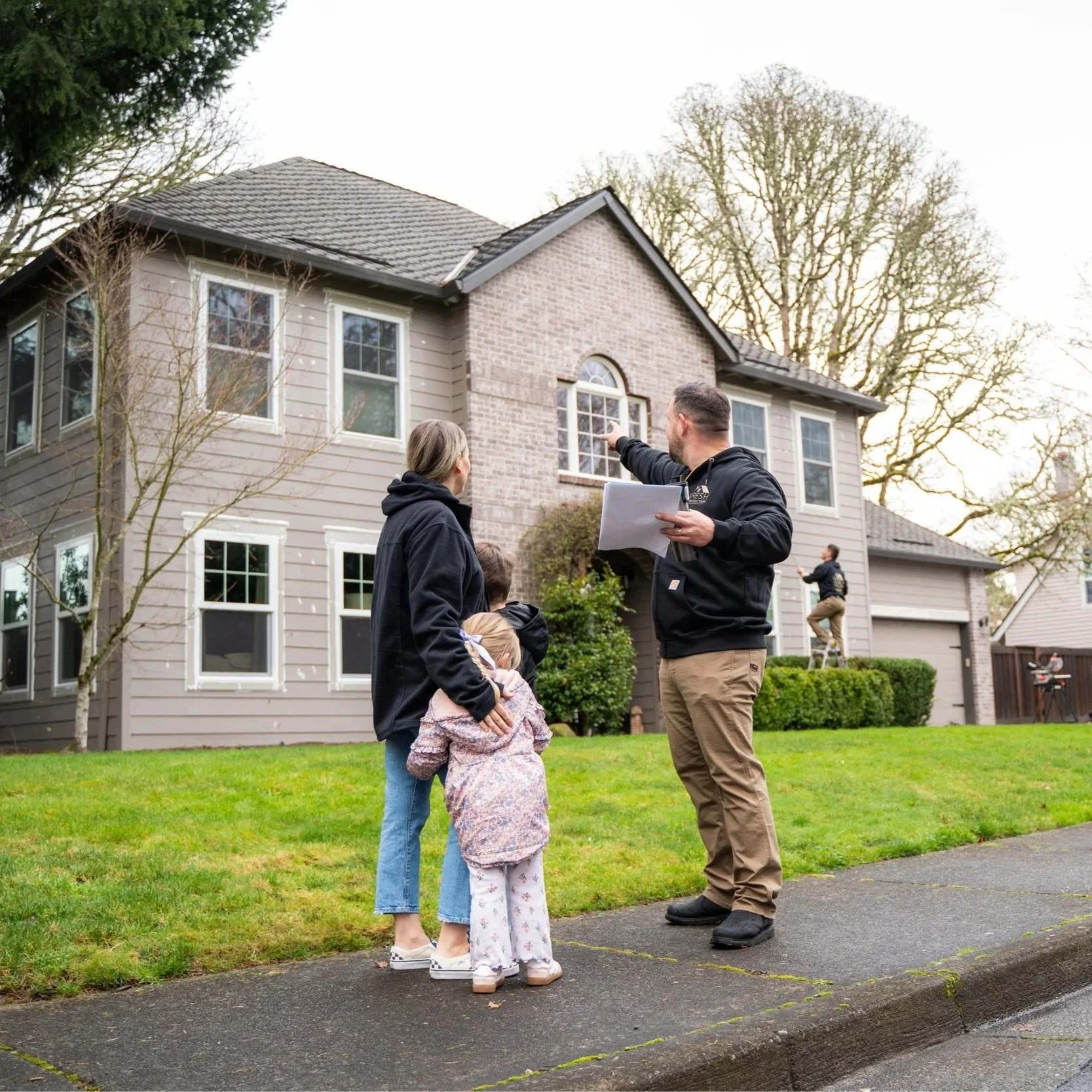
Homeowners discussing siding replacement options with contractor outside Portland home while comparing moisture resistance, durability, warranties, and long-term protection.
How Portland's Rain Hits Each Material
Portland gets 37+ inches of rain annually, most of it arriving as sustained horizontal events from October through May. Siding doesn't just get wet from the top down — wind-driven rain pushes moisture sideways into joints, behind trim, and through every gap in the exterior envelope. The siding material is the first barrier. What matters is how each one handles that moisture over 7-8 months of continuous wet exposure.
James Hardie is cement-based. It doesn't absorb meaningful moisture. Rain hits the surface and either runs off or sits on the paint film until it evaporates. The material underneath doesn't swell, soften, or provide any food source for the fungi that cause rot. In Portland's sustained wet season, that inert quality is a genuine advantage. The material simply doesn't care about moisture the way anything containing wood does.
LP SmartSide is wood-based. The SmartGuard zinc borate treatment protects the wood strands from fungal decay and termite damage. LP's warranty backs this protection for 50 years. But the material is still wood — it can absorb moisture at cut edges, at fastener penetrations, and at any point where the factory treatment has been compromised by field cuts or damage. Proper back-priming of all cut ends and correct installation are critical. The zinc borate works when the treatment is intact. Exposed, untreated wood strands behave like untreated wood.
The critical detail with both materials: the wall system behind the siding matters as much as the siding itself. A proper weather-resistive barrier, sealed flashing at every window and door, and correct clearances from grade and rooflines — these determine whether the wall stays dry regardless of what's on the outside.
Where James Hardie Wins
Moisture indifference. Fiber cement doesn't contain wood. Fungi can't digest it. Moisture can't rot it. In a climate that keeps exterior surfaces damp for months without a break, a material that simply doesn't respond to moisture has an inherent edge. North-facing walls in Portland — the ones that stay wet from October through May without a drying break — are where this advantage shows up most.
Freeze-thaw stability. Portland gets 25-40 freeze-thaw cycles per year. Modern HardiePlank with the ColorPlus finish is engineered for exactly these conditions. The cement composition is dimensionally stable across temperature swings — minimal expansion and contraction compared to wood-based products.
Fire resistance. James Hardie is non-combustible. LP SmartSide carries a Class A fire rating, but is still a combustible material. For homes near wildfire-risk zones in the Portland metro foothills — Corbett, the west hills toward Skyline, parts of Happy Valley — non-combustible siding matters for both safety and insurance.
Resale perception in premium markets. Buyers and agents in inner SE, NE Portland, Lake Oswego, and West Linn recognize Hardie as a premium material. The brand carries weight at appraisal and resale. LP SmartSide is less recognized in these markets, though that gap has narrowed as the product has gained traction.
Where LP SmartSide Wins
Price point. A full home re-side in LP SmartSide runs $16,000-$28,000 — roughly $6,000-$17,000 less than the same home in James Hardie, depending on the Hardie product line. That's real money. For homeowners who need siding now and can't stretch the budget to Hardie pricing, SmartSide delivers legitimate protection at a lower cost.
Warranty structure. LP's 5/50-year warranty covers full labor and materials for the first five years, then prorated substrate coverage through year 50. James Hardie's 30-year warranty is material-only from day one — no labor coverage at any point. For early failures — the ones most likely to be installation-related — LP's full labor coverage provides stronger protection. The warranty is also transferable to the next owner of the home.
Weight and workability. LP SmartSide weighs roughly half what Hardie does per square foot. It cuts with standard woodworking tools instead of requiring fiber cement blades that produce silica dust. For older Portland homes with questionable sheathing, the lighter weight puts less structural demand on the wall. For contractors, easier handling means faster installation and lower labor costs — part of why the installed price is lower.
Hail damage coverage. LP's warranty includes hail damage coverage for hailstones up to 1.75 inches in diameter. Hardie's warranty does not include hail coverage. Portland doesn't get frequent hail, but spring storms occasionally bring it — and the coverage exists regardless.
Wood-grain aesthetics. LP SmartSide's cedar texture is pressed into the surface during manufacturing. The grain pattern is deeper and more realistic than the texture on HardiePlank. On Portland Craftsman bungalows, foursquares, and other homes where the original siding was real wood, SmartSide matches the look more closely than fiber cement does.
The 25-Year Cost Comparison
For a typical 2,000-square-foot Portland home:
LP SmartSide — 25-year total: - Installation: $18,000 (at $8/sq ft average) - Repainting at year 10-12: $4,000-$7,000 - Caulk maintenance (every 5-7 years): $300-$600 - Potential edge moisture repair: $500-$2,000 - Total: $22,800-$27,600
James Hardie ColorPlus — 25-year total: - Installation: $24,000 (at $12/sq ft average) - Repainting at year 12-15: $5,000-$8,000 - Caulk maintenance (every 5-7 years): $300-$600 - Total: $29,300-$32,600
James Hardie Primed — 25-year total: - Installation: $18,000 (at $9/sq ft average) - Initial painting: $3,000-$6,000 - Repainting at year 10-12: $4,000-$7,000 - Caulk maintenance (every 5-7 years): $300-$600 - Total: $25,300-$31,600
LP SmartSide costs less over 25 years in direct expenses. Hardie ColorPlus costs more, but eliminates the separate painting cost at installation and delivers the longest-lasting factory finish. Primed Hardie lands in between — lower upfront material cost but the painting adds up. The real variable is whether LP SmartSide's wood-based substrate develops moisture issues at cut edges or fastener points over that 25-year span. In Portland's climate, installation quality determines that outcome more than the material itself.
Get quote — Choosing between LP SmartSide and James Hardie? VResh Construction installs both and can walk through the trade-offs for the specific home. Call (503) 272-6436 for a free siding estimate.
Durability: Lifespan, Impact, and Long-Term Performance
James Hardie's lifespan track record is longer. Fiber cement siding has been installed on homes since the 1980s, and early installations are still performing after 40+ years. The material doesn't rot, doesn't absorb moisture, and doesn't support biological growth — the primary failure modes that limit other siding materials. The 30-year warranty is the guaranteed minimum. The material itself routinely outlasts that warranty by decades when the paint or finish is maintained on schedule.
LP SmartSide's track record is shorter. The current SmartSide product line with SmartGuard treatment has been on the market since the mid-2000s — roughly 20 years of real-world performance data. LP backs the substrate with a 50-year prorated warranty, which is a strong statement of confidence. But there are no LP SmartSide installations that have actually been in service for 50 years yet. The product's long-term performance in sustained wet climates is an open question that the warranty answers on paper, but only time answers in practice.
Impact resistance favors LP SmartSide. Fiber cement is hard but brittle — a hard impact from a rock thrown by a mower, a fallen branch, or a stray baseball can crack or chip the panel. The damage is visible and requires repair to prevent moisture entry at the crack. LP SmartSide absorbs impact without cracking because the wood-strand substrate has flex. In Portland neighborhoods with large street trees where branches fall during windstorms, the impact resistance difference is practical, not theoretical.
Repair when damage occurs. A damaged SmartSide board can be cut out and replaced with standard woodworking tools, primed, and painted to match. A damaged Hardie board requires fiber cement cutting tools, careful handling due to the weight and brittleness, and more precise fitting. Single-board repairs are faster and less expensive with SmartSide — relevant over a 25-30-year span, during which some damage is inevitable.
Portland's Climate and the Material Decision
Portland's wet season runs roughly from October through May — seven to eight months of sustained moisture. North-facing walls in heavily treed neighborhoods can stay damp for weeks without a drying break. South- and west-facing walls get more sun exposure and dry faster between storms. The moisture exposure isn't uniform around the house.
This matters for the material choice because LP SmartSide's performance depends more on drying cycles than Hardie's does. A north-facing wall that never fully dries is harder on wood-based products — even chemically treated ones — than on cement-based products. Hardie doesn't care whether the wall dries out because the material doesn't absorb moisture in the first place.
The practical approach on many Portland homes: Hardie on the north-facing and most-exposed elevations, SmartSide on the south- and east-facing walls where drying cycles are reliable. Mixed-material installations are common and can save money while putting the premium product where it matters most.
Portland's clay-heavy soil adds a ground-level concern. Soil holds moisture against foundation walls and bottom siding courses. Both manufacturers specify minimum clearances from grade — James Hardie requires a minimum of 6 inches. Siding installed without those clearances wicks moisture from the soil, and that's where LP SmartSide's wood-based composition becomes a liability if the clearance isn't maintained.
Frequently Asked Questions
The Bottom Line on Material Choice
Both products work in Portland when installed correctly. The wall system behind the siding — weather-resistive barrier, sealed flashing at every opening, correct clearances from grade — determines whether either product lasts its full warranty period. LP SmartSide costs less, handles like wood, and carries a longer substrate warranty. James Hardie costs more, contains no wood, and doesn't care about moisture. The right choice depends on the budget, the home's specific exposures, and how much the homeowner values a cement-based material in a climate that stays wet for 7 months of the year.
Get a free siding estimate from VResh Construction. James Hardie, LP SmartSide, vinyl, cedar — full scope installation with proper moisture barriers on every project, from siding replacement in Oregon City to Hillsboro. Call (503) 272-6436.