
Malarkey Shingles Roof Replacement Cost: Portland Guide
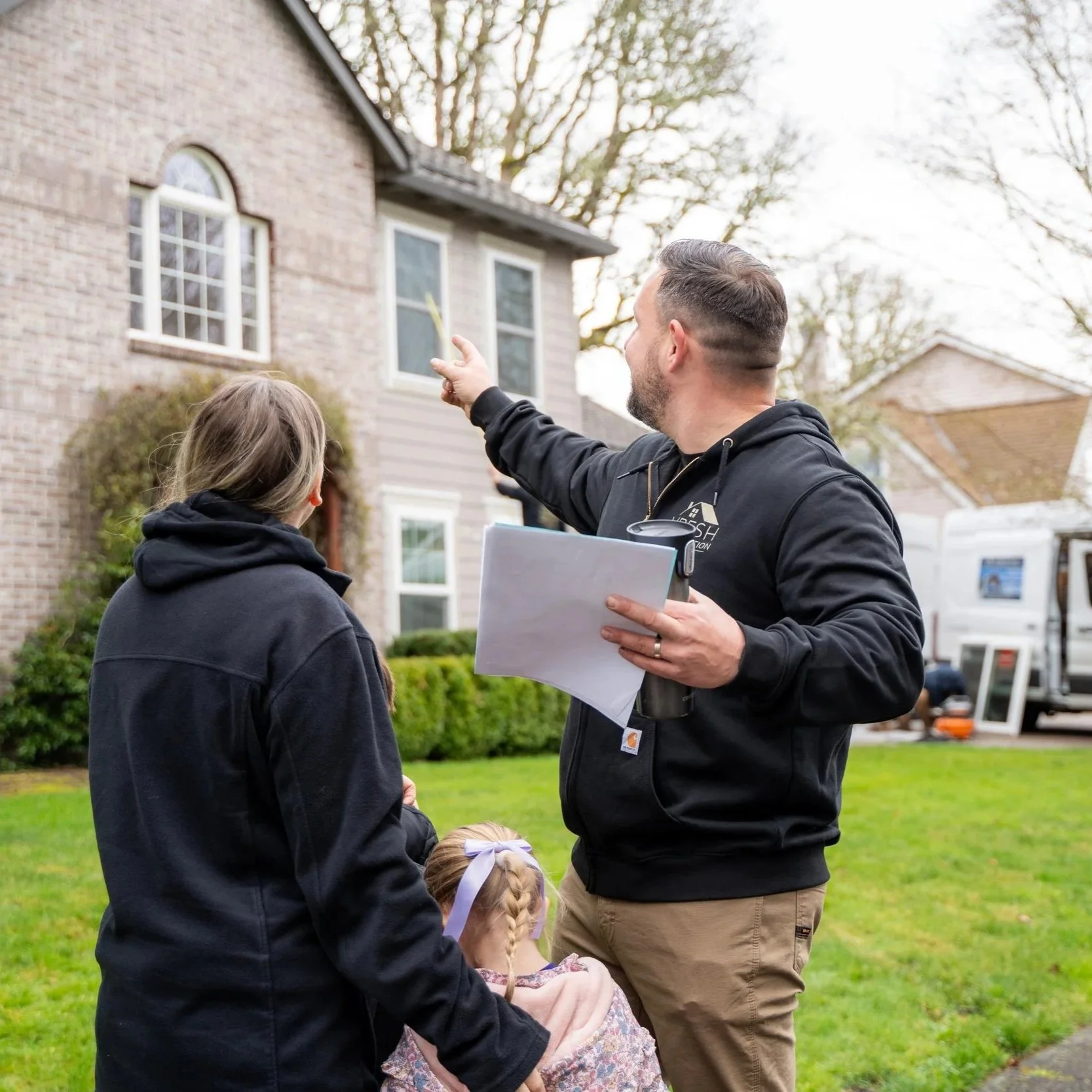
A contractor inspects a home exterior with the homeowner, highlighting early roof warning signs and the importance of evaluating damage before investing in a durable Malarkey shingle replacement in Portland.
It's visible from the ground. Granules collecting in the gutters, shingles curling at the edges, maybe a dark stain on the ceiling that wasn't there last winter. The roof is telling a story, and the longer it gets ignored, the more expensive it gets. The search for what a new roof costs turns up numbers all over the place. That's because they should be — every Portland roof is different.
Malarkey shingles aren't the cheapest option at the supply house. They're built here in Portland and engineered specifically for what our winters do to roofing materials — the relentless rain, the freeze-thaw cycles that crack cheaper shingles, the damp that never lets up. That engineering costs more upfront. But it also means the roof isn't getting replaced again in 12 years.
Malarkey Shingle Roof Costs in Portland: What to Expect
The realistic range: $9,000 to $25,000 or more, labor included. The actual number depends on the home's square footage, how complicated the roofline gets, which Malarkey product gets installed, and what's hiding under the old shingles when they come off.
| Home Type | Typical Cost Range | Timeline |
|---|---|---|
| Standard ranch/bungalow (1,200-1,800 sq ft, simple roof) | $9,000-$16,000 | 1-2 days |
| Two-story/complex roof (valleys, dormers, steep pitch) | $14,000-$25,000+ | 2-4 days |
| Malarkey Legacy premium upgrade | +15-25% over Vista | Standard |
| Deck repairs (minor to moderate) | +$400-$2,000+ | Included |
| Chimney re-flashing | +$400-$800 | Included |
| Skylight re-flashing | +$300-$600 per skylight | Included |
A 1,500 square foot ranch with a simple pitch and clean decking underneath — that's the low end. Now picture a 2,500 square foot house with valleys everywhere, dormers sticking out, a steep pitch that needs harnesses, and soft spots in the sheathing when the old roof comes off. That's the high end. Most Portland roofs fall somewhere in the middle, and the gap between what one neighbor paid and what the next one pays can easily be $4,000, depending on what the crew found under the old shingles.
What Drives the Cost of a Malarkey Roof
The quote isn't random. Here's what's actually behind the number.
Square footage and roof shape do the most damage to the budget. More square feet means more shingles and more labor hours — that's obvious. But shape is what really bends the price. Valleys where two roof planes meet require careful flashing work that takes time to do right. Dormers add transitions. A steep pitch slows the crew down and puts them in harnesses and staging. All of that is labor time, and labor is where most of the money goes.
Shingle grade matters too. Malarkey makes two main lines: Vista and Legacy. Vista uses their Nexgen asphalt that stays flexible when Portland's spring freeze-thaw hits — cheap shingles get brittle and crack when temperatures swing back and forth, but Nexgen stays flexible. Legacy adds smog-reducing granule technology and stronger adhesion on top of that. Both lines cost 15-25% more than off-the-shelf shingles at a big box store. In Portland's climate, that premium buys a 25-30 year roof instead of one that starts failing around year 12.
The wildcard nobody can predict until the old roof comes off: deck damage. Sometimes the sheathing is fine. Sometimes it's soft and rotted. A few bad boards run $400 to $800 to replace. But if rot has spread across a section, the cost jumps to $1,000, $2,000, or more. This is exactly why a full tear-off matters — nobody can see what's happening to the wood from the ground. Without pulling the old shingles, it's all guesswork.
And flashing — all the metal pieces that protect transitions and penetrations on the roof. Drip edge, step flashing, kickout flashing, pipe boots, chimney flashing, skylight flashing. None of it is optional. Chimney re-flashing alone runs $400-$800. Each skylight adds $300-$600. Contractors skip flashing detail work to save time on a bid, and two years later, the homeowner has water coming in at every transition. A new roof is only as good as the flashing holding it together.
Malarkey Roof Cost by Home Size and Scenario
Here's how it breaks down for four different Portland homes.
First: A 1,400 square foot single-story bungalow. Simple roof, standard pitch, nothing complicated. When the crew tears off the old shingles, they find some minor soft spots but nothing structural. Vista shingles. Total cost: $9,500-$12,000. Materials run $3,500-$4,500. Labor takes $5,500-$6,500. Spot deck repairs add $400-$500. Permits and debris hauling: $500-$800. Done in a day, maybe a day and a half.
Second: A 2,000 square foot two-story with two valleys, a dormer, three roof vents, and a steeper pitch. They find rot in one valley section during the tear-off. Chimney and skylight both need new flashing. Legacy shingles for the extra durability. Total: $16,500-$21,000. Materials are $6,500-$7,500. Labor jumps to $8,000-$10,000 because of the complexity. Valley section deck rot: $1,200-$1,500. Chimney work: $500-$700. Skylight: $400-$500. Permits: $600-$900. Two to three days on-site.
Third: A 3,000 square foot home with multiple stories and serious complexity — valleys, two dormers, skylights, aggressive pitch. History of leaks that suggest older deck damage hiding underneath. Legacy shingles. Budget $21,000-$28,000 or more. Three to four days of work.
How to Evaluate Roofing Quotes in Portland
Three estimates landed in the inbox, and none of them match. Here's how to figure out what's actually there.
Start with the shingles. Which Malarkey line is being installed — Vista or Legacy? Not "Malarkey premium shingles," which means nothing. Vista has Nexgen asphalt and Scotchgard granules. Legacy adds extra granule technology and tougher adhesion. They perform differently and cost differently. Ask the contractor directly: "Which line is going on, and why?" A contractor who can't give a straight answer tells the whole story.
Read the underlayment and flashing section like a checklist. It should include synthetic underlayment, ice and water shield (24 inches minimum at eaves, plus all valleys — Oregon code requires this), drip edge, step flashing, kickout flashing, pipe boots, chimney flashing, skylight flashing. If the estimate just says "standard flashing" and leaves it at that, stop. Make them list every piece. Vague flashing language usually means they're planning to cut corners somewhere.
Pay attention to how they handle deck work. The right language looks like: "Full tear-off. Deck inspection included. Estimate covers minor repairs. Major damage gets quoted separately with written approval before we proceed." The wrong language: no mention of deck inspection at all. Or "We'll call when we find something." That's a blank check. After the old roof is off, the homeowner is committed — and the contractor knows it.
Warranty needs to be on paper. Malarkey covers the product for 25-30 years. But the contractor's labor warranty matters just as much — that's what covers a flashing failure or bad installation. Ask what they warrant, for how long, and get it written into the contract. A handshake isn't a warranty.
One more thing most people skip: Oregon requires roofing contractors to be licensed. Ask for the license number and check it yourself through the Department of Consumer and Business Services — takes about a minute online. Liability insurance and workers' comp insurance too. Ask to see proof of both. If they can't produce it, walk away. They're not a real contractor.
When to Call a Professional
Don't do this yourself. Homeowners who treat a roof replacement like a weekend project end up hurt or with a botched job. Falls off pitched roofs cause serious injuries. Oregon building code has specific requirements for ice and water shielding, ventilation, flashing sequences, and permits. Malarkey won't honor the warranty on DIY work. Not any of it.
Even a simple 1,200 square foot roof takes a full day or more. Tear-off, deck inspection, installation, flashing detail work — there's no shortcut through any of it.
The financial side is worth thinking about too. Most roofers find wood damage during tear-off that wasn't visible from the ground. A $12,000 estimate becomes $18,000 because the decking is worse than anyone expected. That's just how it goes. But waiting another year doesn't save money — it lets the water damage spread deeper into the wood, and that turns a manageable repair into a much bigger one.
Frequently Asked Questions
What Matters Most
A roof either protects the home, or it doesn't. The decision made now determines which one. Cheap shingles fail sooner — that's not opinion, it's what happens in this climate. A contractor who understands flashing and does it properly means 25-30 years without worrying about the roof.
Most Portland roofs that need replacing show up the same way: granule loss in the gutters, curling edges, maybe water stains on the ceiling. That's the signal. Waiting another year doesn't buy time — it lets water damage spread into the wood, and that turns a $15,000 job into a $25,000 one.