Dry Rot and Selling a Portland Home: What Sellers Need to Know
The seller had owned the Portland home for 22 years. When she met with her listing agent, the agent asked about the condition of the exterior. The seller mentioned that a contractor had replaced some trim around a window eight years earlier and had mentioned "a little rot behind the siding." The agent asked if the contractor had opened the wall. The seller said no — he had replaced the trim, caulked the joints, and repainted. The agent walked the exterior and found soft wood at three window corners on the north elevation, peeling paint along the bottom two siding courses on the east side, and a dark stain below the roof-to-wall intersection above the garage. The seller had not noticed any of it. The agent explained that Oregon law required disclosure of what the seller knew — including the contractor's comment about rot behind the siding — and recommended a professional dry rot assessment before listing. The assessment found rot in the rim joist behind the window where the trim had been replaced, rot at two additional window corners, and compromised sheathing at the roof-to-wall intersection. The repair estimate was $11,400. The alternative — disclosing the known rot and the assessment findings without repairing — would have invited buyer negotiation that, in the agent's experience, would reduce offers by $20,000 to $35,000 on a home in that price range.
That calculation — repair cost versus negotiation discount — is the central decision for Portland sellers who discover dry rot before or during the listing process. The disclosure obligation is not optional. The financial question is whether to repair and disclose the completed work, or to disclose the condition and let buyers price the repair into their offers.
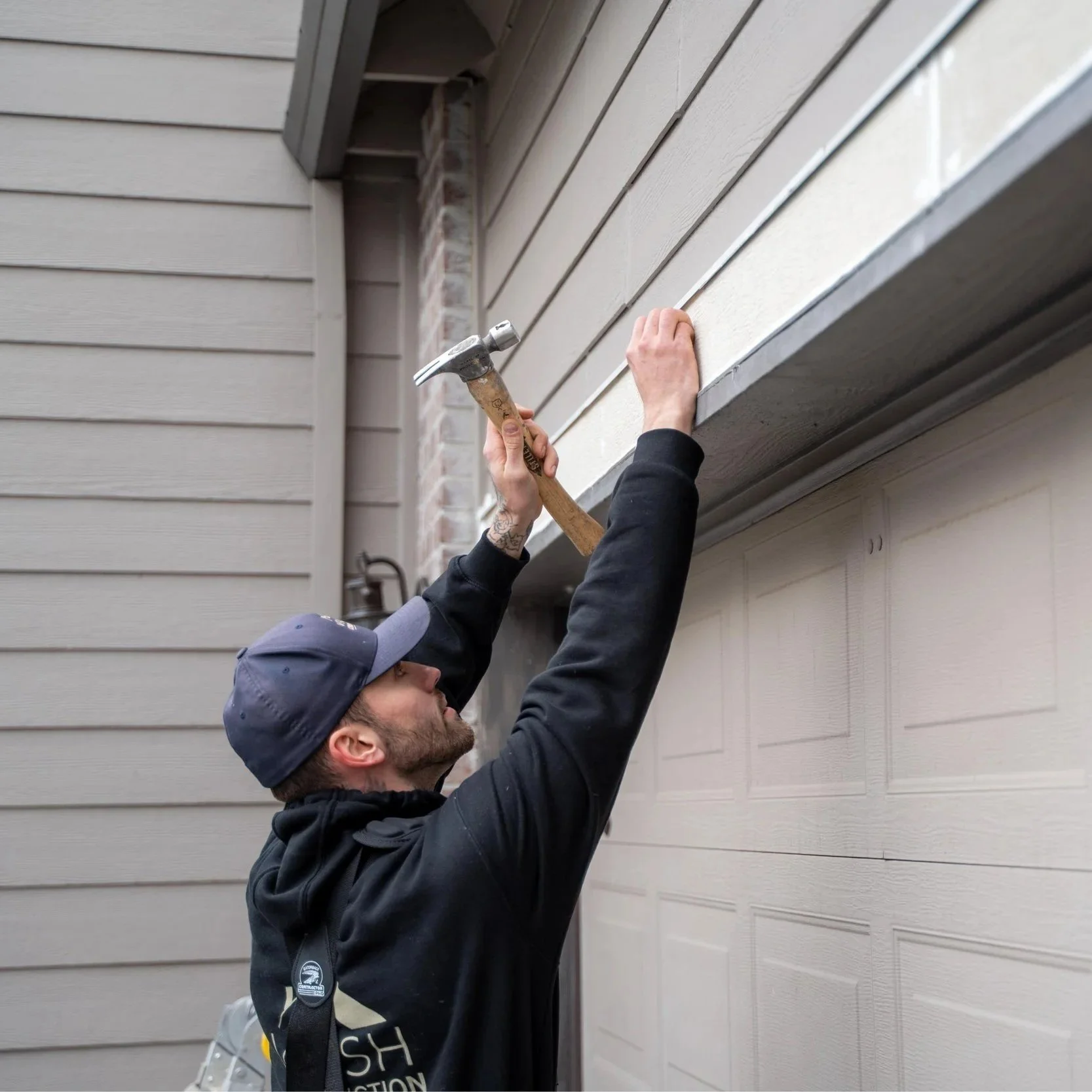
Contractor inspecting garage trim for dry rot damage while discussing repair disclosures, moisture issues, and Portland home sale preparation.
Oregon's Seller Disclosure Requirements
Oregon law establishes specific disclosure obligations for residential property sellers. The statute governing these obligations is ORS 105.464 through 105.490.
What the law requires. Under ORS 105.465, sellers of residential property must deliver a completed property disclosure statement to each buyer who makes a written offer. The disclosure form is prescribed by ORS 105.464 and requires the seller to answer each question as "Yes," "No," or "Unknown." No questions may be left blank.
Disclosure items relevant to dry rot. The Oregon disclosure form includes several categories that directly apply to dry rot conditions:
Section 5 (Dwelling Structure), Item F asks whether a "pest and dry rot, structural or 'whole house' inspection" has been done within the last three years. If the seller has had a dry rot inspection — or if a contractor mentioned rot during other work — this question requires a "Yes" answer with details.
Section 5, Item A asks whether the roof has leaked. Roof leaks are a primary moisture source for dry rot at roof-to-wall intersections and in attic framing.
Section 5, Item G asks about "moisture problems, areas of water penetration, mildew odors, or other moisture" issues. Active or past moisture penetration that has caused or could cause dry rot falls under this question.
Section 10, Item A is a catch-all: "Are there any other material defects affecting this property or its value that a prospective buyer should know about?" Known dry rot — whether active, repaired, or suspected based on a contractor's comment — is a material defect.
What "known" means. The disclosure obligation covers what the seller actually knows. If a contractor mentioned rot, if an inspector flagged moisture, if the seller has seen peeling paint at window corners or felt soft wood at a door frame, those observations are known conditions that must be disclosed. The disclosure form does not require the seller to hire an inspector or to investigate areas they have not observed. But once the seller is aware of a condition — through personal observation, a contractor's comment, or an inspection report — it must be disclosed.
Consequences of non-disclosure. Under ORS 105.475 through 105.490, buyers can pursue legal remedies for material misrepresentations or omissions in the disclosure statement. If a seller knows of dry rot and fails to disclose it, the buyer may seek damages, including the cost of repairs, diminished value, and, in some cases, attorney's fees. Oregon courts have held that the disclosure obligation extends to conditions the seller was aware of, even if the seller did not fully understand their significance.
Exemptions. Under ORS 105.470, certain sales are exempt from disclosure requirements: new construction that has never been occupied, sales by financial institutions or through foreclosure, transfers by government agencies, and sales by court-appointed receivers, personal representatives, or trustees.
How Dry Rot Affects Sale Price
Dry rot affects the sale price through two mechanisms: the direct repair costs and the uncertainty discount that buyers apply when the full scope is unknown.
The direct repair cost. Dry rot repair costs in the Portland market range from $400 to $1,200 for a single window corner, $2,000 to $6,000 for multiple window and door locations, and $8,000 to $15,000 or more for structural repairs involving rim joists, sill plates, or deck ledger connections. These ranges reflect the actual cost of professional repair — identifying the moisture source, removing all compromised material, replacing with sound wood, correcting the moisture pathway, and reinstalling the exterior surfaces.
The uncertainty discount. When dry rot is disclosed but not repaired, buyers do not estimate repair costs the same way a contractor would. Buyers estimate high — because they do not know the full scope, they do not know what the contractor will find behind the siding, and they factor in contingency for the unknown. A seller who discloses $8,000 of documented dry rot damage will typically see buyer offers reduced by $12,000 to $24,000 — the repair cost plus a risk premium for the possibility that the damage is more extensive than disclosed. This uncertainty discount is consistently larger than the actual repair cost.
The buyer pool effect. Disclosed dry rot reduces the buyer pool. Buyers using FHA or VA financing may face lender-required repairs — their loan programs require the property to meet minimum condition standards, and active dry rot or structural damage may trigger repair requirements before the loan can close. Cash buyers and conventional borrowers have more flexibility, but many will avoid properties with disclosed structural issues rather than take on the repair themselves. A reduced buyer pool means fewer competing offers and lower final sale prices.
The appraisal impact. If dry rot is visible or documented at the time of appraisal, the appraiser may note it as a condition that affects value. In some cases — particularly with FHA and VA appraisals — the appraiser may require the condition to be remediated before the appraisal can support the contract price. A completed, documented repair removes this variable from the appraisal process.
Repair Before Listing vs. Disclose and Adjust
The decision to repair before listing or to disclose unrepaired dry rot depends on several factors specific to each situation.
When repair before listing makes financial sense. Repairing dry rot before listing is typically the better financial decision when the repair scope is defined, and the cost is within the ranges above ($400 to $15,000 for most residential dry rot projects). The seller pays the actual repair cost — the contractor's price for defined work. The buyer pays nothing — and the listing presents a home with completed, documented repairs rather than an active defect. The net effect is that the seller recovers the repair cost (and often more) through a higher sale price, a broader buyer pool, and a faster time to close.
When disclosure without repair may be appropriate. Disclosing without repairing may be appropriate when the repair scope is very large (exceeding $15,000-$20,000 and involving extensive structural work), when the timeline to listing does not allow for repair completion, or when the seller is selling "as-is" due to estate, financial, or other circumstances. In these cases, providing a professional assessment with a defined scope and repair estimate gives buyers the information they need to make informed offers — and reduces the uncertainty discount compared to disclosing without any professional documentation.
The worst position: undisclosed, unrepaired rot. The worst financial and legal position is knowing about dry rot and neither repairing nor disclosing it. Oregon law requires disclosure of known material defects. A buyer who discovers undisclosed rot after closing has legal remedies, including repair costs, diminished value, and attorney fees. The cost of a non-disclosure claim — in repair expenses, legal fees, and potential damages — exceeds the cost of disclosure and repair by a wide margin.
| Approach | Seller Cost | Buyer Pool Impact | Price Impact | Risk |
|---|---|---|---|---|
| Repair before listing | Actual repair cost ($400-$15,000+) | No reduction | Neutral to positive | Low — documented, completed work |
| Disclose with assessment | Assessment cost ($200-$500) | Reduced — some buyers avoid | Negative — 1.5-3x repair cost in offers | Moderate — uncertainty discount |
| Disclose without assessment | None | Significantly reduced | Negative — largest discount (unknown scope) | High — maximum uncertainty |
| Do not disclose | None upfront | No initial reduction | Neutral initially | Very high — legal liability |
What a Seller's Pre-Listing Dry Rot Assessment Covers
A professional dry rot assessment before listing provides documentation to support either a repair decision or an informed disclosure. A thorough assessment includes:
Exterior visual inspection. Every elevation inspected from grade to roofline — paint condition, caulk integrity, flashing condition, grade clearance, gutter function, and visible signs of moisture damage.
Probing at vulnerable locations. Screwdriver probing at all window and door corners, bottom siding courses, trim-to-siding joints, roof-to-wall intersections, deck connections, and any location showing surface signs of moisture or decay.
Moisture readings. Pin-type moisture meter readings at suspect locations and reference locations. Readings document the current moisture level of the wood and distinguish between wet (and at risk) and dry (and sound) areas.
Scope of damage. Where probing reveals rot, the assessment documents the location, the extent of softening, and the likely scope of damage behind the surface. The assessment may recommend opening specific areas of cladding to verify the full extent.
Moisture source identification. For each rot location, the assessment identifies the probable moisture source — failed flashing, failed caulk, grade contact, gutter overflow, or another pathway. This is critical: a repair that does not address the moisture source will fail, and buyers and their inspectors look for evidence that the source has been addressed.
Written report with repair estimate. The assessment produces a written document listing all findings, the recommended repair scope, and a cost estimate. This document can be attached to the seller's disclosure as supporting documentation — demonstrating that the seller investigated, documented, and either repaired or disclosed the condition with professional specificity.
How Buyers and Their Inspectors Evaluate Dry Rot
Understanding how the buyer's side evaluates dry rot helps sellers anticipate the negotiation and prepare accordingly.
The buyer's home inspection. Most Portland home sales include a buyer's inspection contingency. The inspector will check the exterior for signs of rot — peeling paint, soft wood, staining, moss, grade clearance issues — and will probe suspect areas. A competent inspector will identify the same conditions that a pre-listing assessment would find. Sellers who have not assessed or repaired lose the advantage of controlling the narrative.
WDI/WDO inspections. Wood-Destroying Insect/Wood-Destroying Organism inspections are common in the Portland market, particularly for FHA and VA transactions. A WDI/WDO inspection specifically evaluates for wood decay fungi, termites, carpenter ants, and other wood-destroying organisms. A positive finding — active decay or evidence of prior infestation — can trigger lender-required remediation before closing.
How buyers price rot findings. Buyers who receive a home inspection report showing dry rot typically respond in one of three ways: request that the seller repair before closing (with the buyer specifying the contractor or approving the repair scope), request a price reduction equal to the estimated repair cost plus a contingency, or withdraw from the transaction. Sellers who have already completed repairs eliminate the first two responses and significantly reduce the likelihood of the third.
What buyers look for in completed repairs. Informed buyers and their agents evaluate completed dry rot repairs for three things: Was the moisture source corrected (not just the damaged wood replaced)? Was the repair permitted if it involved structural work? Is there documentation — a written scope, before and after photos, and a contractor's warranty? Repairs that address only the cosmetic damage without correcting the moisture source are viewed skeptically — because the buyer knows the rot will return.
Portland-Specific Considerations
Several factors are specific to selling a home with dry rot in the Portland market.
The prevalence of dry rot in Portland's housing stock. Dry rot is common in Portland. The combination of 37 or more inches of annual rainfall, 6 to 8 months of sustained humidity, and a housing stock dominated by wood-frame homes built between 1940 and 1990 means that many homes on the market have some degree of moisture damage. Buyers and their agents expect it — the question is not whether the house has any rot, but whether the seller has identified it, addressed it, and documented the work.
Pre-1978 homes and lead considerations. On homes built before 1978, dry rot repair that disturbs painted surfaces triggers EPA Lead Renovation, Repair, and Painting (RRP) Rule requirements. Contractors performing the work must be EPA Lead-Safe Certified, and the work must follow lead-safe work practices. This adds cost and regulatory requirements to the repair, but it also means the work is performed by certified contractors following documented protocols. Sellers should verify that any contractor performing dry rot repair on a pre-1978 home holds current EPA Lead-Safe Certification.
Insurance considerations. Most homeowner's insurance policies do not cover dry rot caused by long-term moisture exposure or deferred maintenance. Insurance typically covers sudden and accidental damage — a pipe burst or storm damage. Dry rot resulting from failed flashing, degraded caulk, or insufficient maintenance is classified as a maintenance issue and is generally excluded from coverage. Sellers should not assume insurance will offset repair costs.
Seasonal timing for repair before listing. Portland's climate creates a practical window for exterior dry rot repair: April through October, when rain is infrequent enough to allow exterior work, and the repaired surfaces can dry and cure properly. Sellers planning a spring or summer listing should schedule dry rot assessment and repair in the months leading up to listing — not during the wet season when exterior work is difficult, and moisture conditions complicate the repair.
Frequently Asked Questions
The Disclosure Is Not the Problem
Sellers sometimes view disclosure as a liability — an obligation that reduces their sale price. The disclosure is not the problem. The dry rot is the problem. The disclosure is the legal and practical framework for addressing it. A seller who discovers dry rot, assesses the scope, repairs the damage with documented work, and discloses the completed repair is in a stronger position than a seller who hides it — and in a stronger position than a seller who ignores signs until the buyer's inspector finds them during the transaction. The cost of addressing dry rot before listing is measurable and controllable. The cost of not addressing it — in reduced offers, lost buyers, extended time on market, and potential legal liability — is higher and less predictable.
Get pre-listing assessment — A professional dry rot assessment before listing identifies the scope, documents the condition, and provides a repair estimate that supports the seller's disclosure and pricing decisions. VResh Construction provides written dry rot assessments for Portland homes, with repair estimates tied to defined scope and documented moisture source identification. Call (503) 272-6436.