Siding Repair vs Replacement: How to Know Which One in Portland
The siding on the south side of the house looked worse than the north. The paint was chalking, the bottom course had soft spots, and two boards near the bathroom window had visible rot at the corners. The homeowner assumed the south wall needed to be replaced, while the north wall was fine. Then the contractor pulled three boards on the north side during the repair and found the sheathing behind them saturated — no visible damage on the surface, but the building paper had failed years ago, and moisture had been soaking the wall assembly behind the siding, which still looked intact.
That's the pattern in Portland. The visible condition of the siding is a poor predictor of the condition behind it. Repair-or-replace decisions made solely from the curb miss the most important variable — the substrate. The right call depends on what a contractor finds when the wall is opened, not on what a homeowner sees from the outside.
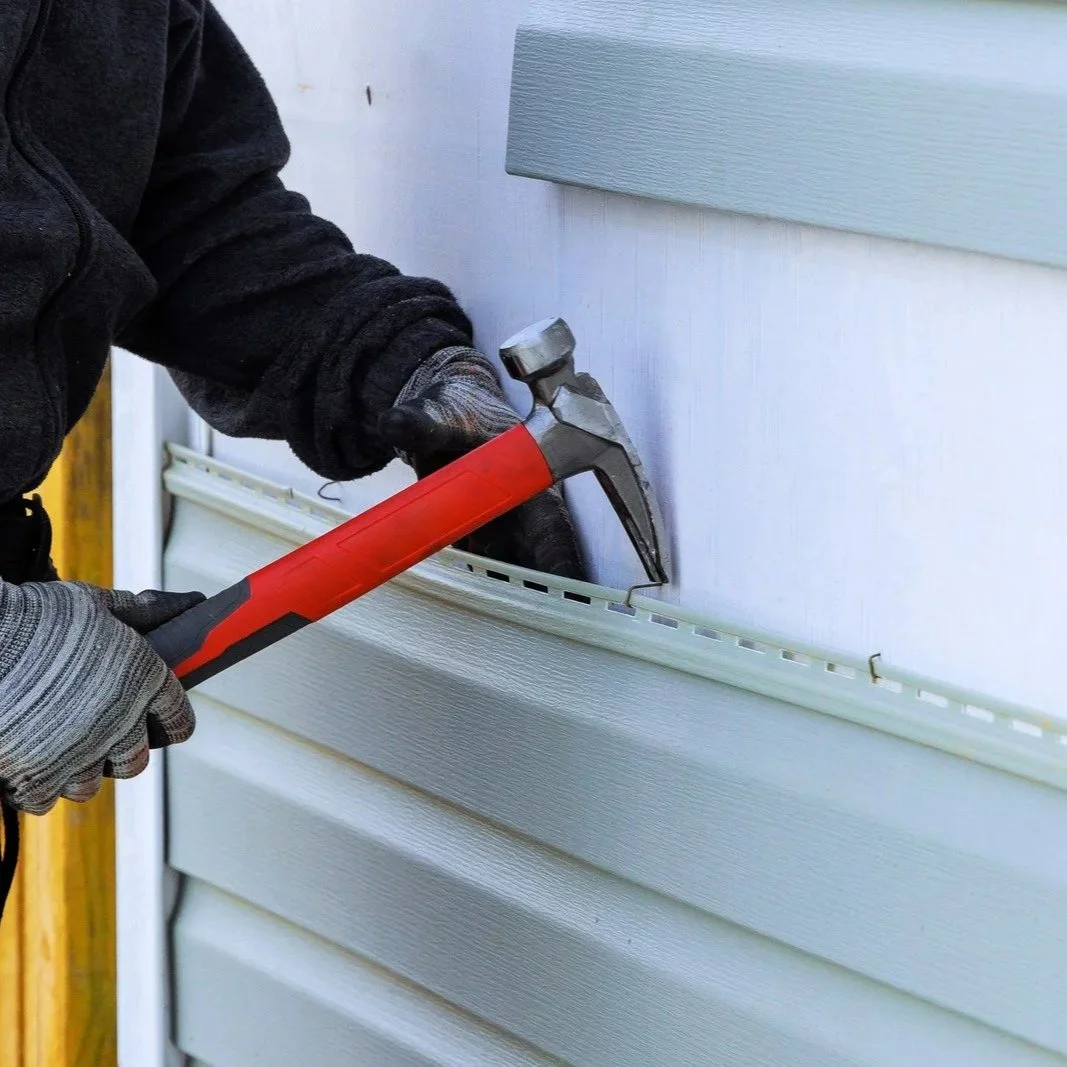
Worker installing vinyl siding panels with a hammer during residential exterior wall repair and home siding replacement project.
When Repair Is the Right Call
Targeted repair is the right approach when the damage is confined to specific locations, the rest of the siding is performing, and the substrate behind the damaged area is either sound or can be addressed as part of the repair scope.
Localized rot at one or two window or door corners. This is the most common siding repair call in Portland. Head flashing above the window has failed or was never installed, caulk at the trim-to-siding joint has cracked, and water has been entering the rough opening for years. The rot shows up at the bottom corners of the window casing and the adjacent siding boards. A targeted repair removes the damaged material, inspects the rough opening and framing, corrects the flashing, and reinstalls new boards and trim. Cost: $600-$2,000 per location.
Bottom-course damage from splash-back or soil contact. Siding installed too close to grade — less than the manufacturer-specified 6-inch minimum clearance — wicks moisture from the soil and rots from the bottom up. Rain splash-back from hard surfaces compounds the problem. Repair involves removing the damaged bottom-course boards, inspecting and repairing any compromised sheathing or sill plate framing behind them, correcting the clearance, and reinstalling new boards at the proper height. Cost: $800-$2,500 for a 3-6 linear foot section.
Impact or storm damage to a small area. A fallen branch, a ladder strike, or hail damage that breaks or cracks a few boards without damaging the substrate behind them is a targeted repair. The damaged boards come off, the sheathing is inspected, and new matching boards go on. Cost: $300-$800 per section.
Caulk failure at trim joints. Exterior caulk has a service life of 7-15 years depending on the product, sun exposure, and location. Failed caulk at window perimeters, corner boards, and trim joints is an active water entry point during every rain event. Repair involves removing the old caulk, inspecting for damage behind the joint, and reinstalling with the appropriate product. This is the lowest-cost maintenance repair — but only if the flashing behind the joint is intact. If the caulk failure masks a flashing problem, the scope expands.
| Material | Typical Lifespan | Maintenance Cycle | Common Failure Mode in Portland |
|---|---|---|---|
| Cedar | 20-30 years | Stain/paint every 5-7 years | Rot at bottom courses, window corners, under-trim |
| Vinyl | 20-25 years | Minimal (wash only) | Fading, brittling, impact damage, hidden moisture behind |
| James Hardie fiber cement | 30-50 years | Repaint every 10-15 years | Cracking from impact, caulk/flashing failure at joints |
| LP SmartSide engineered wood | 30-50 years (50-year warranty) | Repaint every 10-15 years | Edge absorption if cut ends not properly primed |
| Masonite hardboard | 15-25 years | Paint every 5-7 years | Edge swelling, delamination, widespread bottom-course rot |
When Replacement Makes More Sense
Replacement becomes the better investment when the cost and frequency of ongoing repairs approach or exceed the cost of solving the problem permanently, or when the condition behind the siding is too far gone for targeted fixes.
Damage to three or more walls. Widespread damage across multiple elevations indicates a systemic failure — the siding, the moisture barrier, or both have reached the end of their service life. Patching individual areas on a system that is failing everywhere becomes an exercise in chasing problems. Each repair fixes one location while three more develop.
The siding has reached the end of it’s life. Every material has a lifespan. Cedar siding typically lasts 20-30 years with consistent maintenance — regular staining or painting every 5-7 years. Vinyl lasts 20-25 years before fading, brittling, and losing impact resistance. James Hardie fiber cement lasts 30-50 years with repainting every 10-15 years. LP SmartSide engineered wood carries a 50-year limited warranty. When siding is approaching or past its expected lifespan and showing multiple symptoms, replacement is the practical path.
Moisture has reached the sheathing or framing in multiple locations. If rot has penetrated beyond the siding into the sheathing, weather-resistive barrier, or structural framing in more than one or two locations, the wall needs to be opened up to address the more serious damage. At that point, the labor required to repair the substrate properly is a significant portion of the labor required for a full replacement — and a full replacement also delivers a new weather-resistive barrier, new flashing at every penetration, and new siding with a full manufacturer's warranty.
The material can no longer be matched. Older vinyl siding profiles are frequently discontinued. Original cedar bevel siding may require custom milling to match the profile and dimensions. Masonite hardboard siding — common on Portland homes built in the 1980s and 1990s — is no longer manufactured and known for widespread failure. When the existing material can't be matched for repairs, the options narrow to partial or full replacement.
Repair costs have accumulated. A $1,500 repair this year, another $2,000 repair in two years, and a third $3,000 repair the year after adds up to $6,500 — money that could have been applied toward a replacement that delivers decades of protection rather than a series of patches on an aging system.
The Partial Replacement Option
Full replacement isn't the only alternative to repair. Partial replacement — re-siding one or two elevations while leaving the rest intact — is a practical middle ground that many homeowners overlook.
When it works. Portland homes take unequal weather exposure. North and west-facing walls absorb the most sustained rain and dry the slowest. South and east-facing walls dry faster and often show significantly less damage. When deterioration is concentrated on the weather-exposed sides, replacing those elevations completely — with full removal, substrate inspection, new weather-resistive barrier, new flashing, and new siding — addresses the worst problems without the cost of a full-house project.
Cost range. Partial elevation re-siding runs $4,000-$12,000 per elevation, depending on the material, the square footage, and whether structural repairs are needed behind the siding. A two-elevation partial replacement at $8,000-$24,000 covers the most damaged walls at 40-60% of the full-house replacement cost.
The matching challenge. New siding on one or two walls may not visually match weathered siding on the remaining walls — particularly with cedar, which changes color significantly over time. Painting the entire home after partial replacement creates a uniform appearance. With James Hardie ColorPlus (factory finish), the new sections may closely match the existing ones if the original installation used the same color.
What Drives the Cost — Repair vs. Replacement
| Scenario | Typical Cost Range | Timeline |
|---|---|---|
| Single window/door corner repair | $600–$2,000 | Half day to 1 day |
| Bottom-course rot repair (3–6 LF) | $800–$2,500 | 1–2 days |
| Multiple location repairs | $2,000–$6,000 | 2–4 days |
| Partial elevation re-side (one face) | $4,000–$12,000 | 3–5 days |
| Full house — vinyl | $12,000–$22,000 | 5–10 days |
| Full house — James Hardie primed | $18,000–$35,000 | 7–14 days |
| Full house — James Hardie ColorPlus | $22,000–$45,000+ | 7–14 days |
| Full house — LP SmartSide | $16,000–$28,000 | 7–12 days |
| Structural framing repair (if found) | Add $500–$4,000+ | Variable |
These ranges include labor, materials, and finishing. They do not include extensive structural repair behind the siding — that's an additional cost driven by the extent of damage found when the wall is opened. In Portland homes older than 30 years, finding some level of moisture damage behind the siding is more common than not finding any.
What Portland's Climate Does to Siding
National siding repair guides treat moisture as one of many factors. In Portland, moisture is the factor — the one that accelerates every failure mode and determines whether a repair lasts 15 years or 3.
37+ inches of sustained horizontal rain. Portland's rain doesn't just fall down. Wind-driven rain pushes sideways into siding joints, behind trim, through cracked caulk, and against every imperfection in the exterior envelope. That sustained horizontal moisture pressure is what separates Portland siding failure patterns from those in drier climates.
7-8 months of continuous wet conditions. A siding defect in Denver gets wet, then dries between storms. The same defect in Portland gets wet in October and may not dry out until June. That extended moisture contact is what allows rot fungi to establish and consume structural wood. The fungi require wood moisture content above 20%, and Portland's framing stays above that threshold for most of the wet season once a moisture entry point exists.
North-facing walls fail first. The north side of a Portland home receives the least direct sunlight and dries the slowest. Bottom-course rot, sheathing damage, and trim failure develop on north-facing walls years before the same problems appear on the south side. West-facing walls take the most direct rain exposure but dry faster when the weather clears. On most Portland homes, the north and west elevations are the first candidates for partial or full replacement.
Missing weather-resistive barriers on older homes. Many Portland homes built before the 1990s have degraded building paper or no weather-resistive barrier at all behind the siding. When the siding itself begins to fail — cracked caulk, failed flashing, loose boards — there is no secondary defense against moisture entering the wall cavity. A repair that addresses only the siding without upgrading the WRB behind it leaves the wall assembly exposed.
Get quote — Not sure whether to repair or replace? VResh Construction provides free on-site siding assessments with written documentation of all damage found — including what's behind the siding. Call (503) 272-6436.
The Inspection Behind the Surface
The repair-or-replace decision depends on information that is not visible from outside the house. A proper assessment includes opening the wall at the worst-looking locations and probing every adjacent piece of wood.
What a proper inspection reveals. The contractor removes siding and trim at the most visibly damaged locations, probes the sheathing and framing behind it, and evaluates the condition of the weather-resistive barrier. The inspection answers three questions: how far has the damage traveled beyond what's visible, is the moisture pathway still active, and is the WRB intact or failed?
Why surface-only estimates miss the scope. A contractor who quotes siding repair without removing any boards is estimating from the outside — a guess at best. Rot travels along wood grain and behind paint that still looks solid. The visible surface damage is almost always the leading edge of more extensive damage behind it. A quote based solely on a surface inspection often increases once the wall is opened and the full scope becomes clear.
What to ask for in a quote. A siding repair or replacement quote should include a contingency allowance for additional damage found behind the siding, or a clear explanation of how additional scope will be handled and priced when discovered. A quote that assumes the sheathing and framing are fine without inspecting them is a quote that will grow mid-project.
Frequently Asked Questions
The Decision Comes Down to What's Behind the Wall
A few rotted boards on one wall is a repair. Widespread damage across multiple elevations with moisture in the sheathing and framing is a replacement. The gray area between those two extremes is where most Portland homeowners land — and where the inspection behind the surface determines the right call. The cheapest option is always the one that addresses the moisture source, fixes the substrate, and prevents the problem from coming back.
Ask the bid one question: how much of the wall comes off. "Repair as needed", priced from the driveway, becomes a change order the moment the sheathing is visible. VResh Construction opens the wall first and prices what is there — siding replacement in Hillsboro, siding repair in Portland. Free on-site estimate: (503) 272-6436.