The trim around the front window looks fine from the sidewalk. The paint is holding. Nothing seems wrong. Then a screwdriver goes into the corner of the casing and sinks in like it's pushing through wet cardboard. That soft wood isn't just cosmetic damage — it's rot that has been eating the framing behind the trim for years, fed by moisture that found a path past the flashing and never dried out.
Dry rot repair costs in Portland vary widely because the damage itself does. A small patch at one window corner is a half-day job. Rot that has spread through sill plates, jack studs, and sheathing across multiple openings is a week-long structural project. The rot is almost always worse than what's visible from the outside — the fungus travels along the wood grain, consuming material behind paint that still looks solid.
Cost by Repair Scope
| Repair Type | Typical Cost Range | Timeline |
|---|---|---|
| Single window or door corner | $400-$1,200 | Half day to 1 day |
| Bottom siding course (one wall) | $800-$2,500 | 1-2 days |
| Multiple window/door locations | $2,000-$6,000 | 2-4 days |
| Sill plates and jack studs (localized) | $2,500-$5,000 | 2-3 days |
| Rim joist or band joist section | $3,000-$8,000 | 2-4 days |
| Deck ledger connection failure | $4,000-$10,000 | 3-5 days |
| Multi-stud-bay structural repair | $8,000-$15,000+ | 1-2 weeks |
| Full wall rebuild (extensive rot) | $12,000-$25,000+ | 2-3 weeks |
These ranges include identifying the moisture source, removing all compromised material, structural repair with new lumber, correcting the flashing or moisture pathway, and reinstalling the exterior cladding. A quote that only covers patching the visible damage without addressing the source isn't a repair — it's a delay.
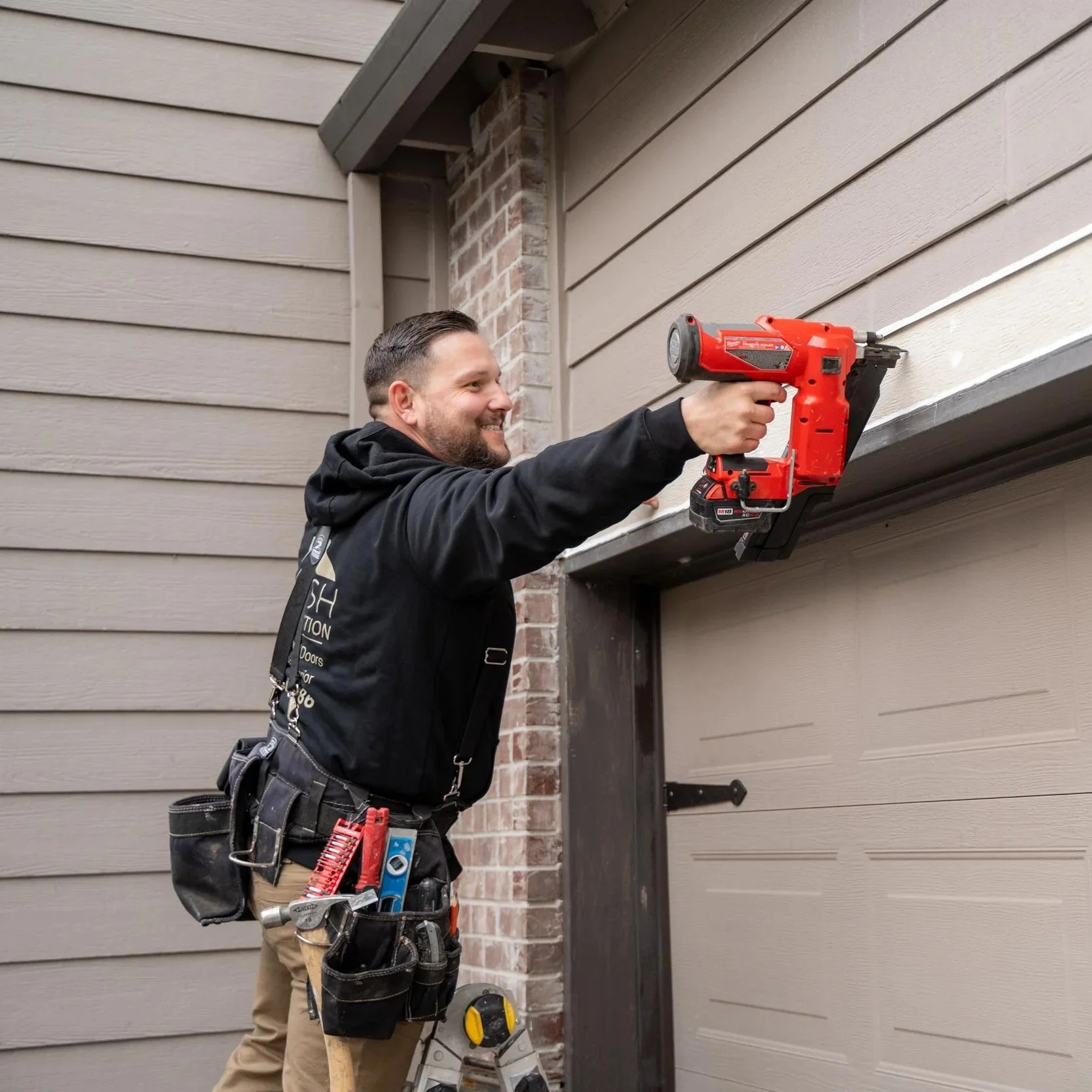
Contractor repairing garage trim while discussing Portland dry rot repair costs, structural framing damage, moisture intrusion, and exterior restoration.
What Drives the Cost
How far the rot has traveled. Surface damage at a window corner might mean the trim is soft, but the framing behind it is still sound. Or it might mean the rot has moved through the trim into the jack stud, across the sill plate, and into the sheathing below. The only way to know is to open the wall and probe every piece of adjacent wood until sound material shows up on all sides. The scope of removal determines the cost, and the scope isn't fully knowable until the wall is open.
Number of locations. One rotted window corner is a targeted repair. Four rotted window corners, two sections of bottom siding, and a failing deck ledger are a project with mobilization costs, scaffolding, multiple days of labor, and significant material. The per-location cost drops slightly on multi-location projects, but the total climbs fast.
Structural involvement. Replacing a piece of trim costs less than replacing the framing behind it. Trim is decorative — it can be cut, matched, and nailed back on. Framing is structural. Replacing a rotted sill plate means shoring the wall above, cutting out the damaged section, sistering or replacing with new lumber, and tying the repair into the existing structure. That's a different skill set and a different price point.
Access and height. Ground-level repairs are straightforward. Second-story work requires scaffolding or ladder jacks. Tight spaces between houses, overgrown landscaping blocking the work area, and limited equipment access all add labor time. Scaffolding alone adds $500-$1,500 depending on the scope.
Lead-safe compliance. Homes built before 1978 in Portland — a large share of the housing stock — likely have lead paint on the surfaces that dry rot repair disturbs. EPA RRP rules require Lead-Safe Certified contractors to follow containment and cleanup protocols. Compliance adds $300-$800 to the project. It's federal law, not optional.
Where Dry Rot Shows Up Most in Portland
Portland's 37+ inches of annual rain, most of it arriving sideways from October through May, puts moisture pressure on every exterior detail. The rot shows up wherever the moisture defense breaks down — and those failure points are consistent across the city's housing stock.
Window and door corners are the most common location. The head flashing above the window either wasn't installed, has deteriorated, or was lapped incorrectly. Water runs down the wall, hits the top of the window frame, and instead of being directed to the exterior, enters the rough opening. The jack studs and sill plate absorb that water for years. By the time the paint starts bubbling at the corner, the framing damage is already well along.
Bottom siding courses are damaged by two sources — rain splashing off the ground below and moisture wicking up from soil contact. The bottom edge of siding should sit at least 6 inches above grade. On older Portland homes, that clearance has often been reduced by landscaping, mulch buildup, or concrete patio additions. Soil sitting against the bottom of the siding holds moisture against the wood and keeps it wet through Portland's 7-8 month damp season.
Roof-to-wall intersections fail when kickout flashing is missing. Kickout flashing sits at the bottom of a roof-to-wall junction and directs water from the roof surface away from the wall below. Without it, every rainstorm dumps concentrated roof runoff directly into the wall cavity. The damage starts at the top and works down through the framing — often two or three stud bays wide before anyone notices a problem from the outside.
Deck ledger connections are another chronic failure point. The ledger board bolts through the siding into the rim joist, and the connection point between the deck and the house needs a flashing system to prevent water from migrating behind the ledger. On Portland homes where deck flashing was never installed or has failed, the rim joist behind the ledger is almost certainly soft. That rot compromises the structural connection between the deck and the house — which is also the most common cause of deck collapses.
Under-trim locations — the spaces behind fascia boards, corner boards, and rake trim — trap water against the sheathing. North-facing walls are the worst because they dry the slowest. Portland's overcast winters mean these surfaces can stay damp for months without a break, and the fungus that causes rot does well in exactly those conditions.
The Real Repair vs. The Cover-Up
Not all dry rot repairs are the same, and the difference between a real repair and a cover-up determines whether the money spent actually fixes the problem.
A real repair follows a specific sequence. The moisture source that caused the rot gets identified first — failed head flashing, missing kickout flashing, deteriorated caulk, soil contact, whatever allowed water to reach the wood. Then all structurally compromised material is removed, leaving sound wood on all sides. New framing lumber goes in — kiln-dried dimensional lumber for most repairs, pressure-treated where code requires it. The moisture pathway gets corrected with proper flashing, a weather-resistive barrier, and sealant. The exterior cladding is reinstalled with details that prevent the problem from recurring.
A cover-up skips most of those steps. The visible rot gets scraped out, filled with Bondo or wood hardener, sanded smooth, and painted. Maybe the new trim goes on over the damaged framing without anyone opening the wall to check what's behind it. The surface looks fixed. The moisture source hasn't changed. The rot behind the patch keeps going.
The math on cover-ups is predictable. An $800 patch that ignores the moisture source becomes a $6,000 structural repair 3-7 years later — because the rot has had years to spread into framing members that were still sound at the time of the original patch. The cheapest repair is almost always the one that gets done right the first time.
Portland's Climate and the Rot Cycle
Portland doesn't just get rain — Portland gets sustained, wind-driven, horizontal rain for 7-8 months of the year. That distinction matters for dry rot because the moisture doesn't just land on horizontal surfaces and drain away. It pushes sideways into vertical joints, behind trim, through cracked caulk, and into every imperfection in the exterior envelope.
The rot cycle works like this. Rain enters through a failed detail — a cracked caulk joint, a missing piece of flashing, a siding board sitting too close to the roof below. The water reaches the wood framing or sheathing. Portland's cool, overcast conditions from October through May prevent that wood from drying out. Wood moisture content stays above 20% — the threshold where the fungi that cause rot can grow. The fungus starts digesting the cellulose and lignin in the wood, breaking down its structural integrity. By spring, the damage has progressed. By the following fall, another 6 months of moisture feed the cycle further.
Wood that has been wet long enough doesn't recover. Even if the moisture source is eventually corrected, wood that has been structurally compromised by rot doesn't regain strength when it dries. The damaged material needs replacement — drying it out just stops the rot from getting worse. It doesn't undo what's already happened.
Portland's clay-heavy soil adds a ground-level problem. Clay holds moisture against foundation walls and sill plates, especially on the downhill side of sloped lots. Homes on Portland's west hills, in the Sellwood-Moreland area, and in older inner-southeast neighborhoods frequently show rot at the sill plate level where soil moisture meets the bottom of the framing.
Frequently Asked Questions
The Cost of Waiting
Dry rot doesn't stop on its own. The fungus continues consuming wood as long as the moisture content stays above 20% — which, in Portland's climate, means as long as the moisture source remains active. A $1,200 repair at one window corner today becomes a $4,000 repair across three stud bays in two years, and an $8,000-$15,000 structural project in five years when the rot reaches the rim joist. The most expensive dry rot repair is always the one that got postponed.
Ask any bid what happens when the wall opens and the rot runs further than the estimate assumed. VResh Construction stops, shows you, and issues a written change order — the quoted price is not adjusted quietly. Dry rot repair in Beaverton and dry rot repair in Lake Oswego. Free on-site estimate: (503) 272-6436.