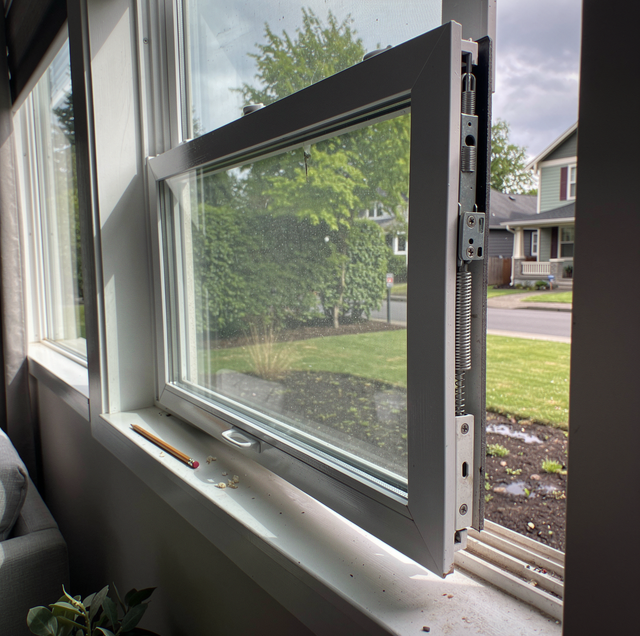
The sash you just raised is held up by a spring in the jamb beside it. That spring pulls upward with close to the sash's weight, and the small difference left over is absorbed by friction in the channel the sash runs in. Take your hand away and nothing else is holding the window. A sash that settles an inch and stops has a weakened spring. A sash that runs all the way to the sill has one that has given out, or one no longer joined to the sash. Both faults sit in the same few inches of jamb liner, and so does the complaint that looks like their opposite, from a window that will not move at all.
The Load in a Sash and the Spring Against It
Start with the glass in your sash. The estimated weight of glass is 7.5 kilograms per square meter for a three-millimeter lite, doubled for a double-glazed sash. Three pounds per square foot of glazed area is the working number, so a sash twenty-eight inches by thirty-two carries about nineteen pounds of glass before you count the frame.
The balance in your jamb pulls upward with close to that figure. The remainder is a small residual force, and the sash stays where you leave it for as long as friction against the channel exceeds that residual. The channel is a jamb liner, a molded strip holding the sash square while the balance holds it up.
A balance is a spring, and a spring loses force. As it does, the residual grows until it exceeds the friction available at any point along the sash's travel. Nothing about the glass has changed and nothing in the frame has moved. One number on one side of a comparison has fallen, and a window you have opened for years behaves differently.
Why Does a Weak Balance Let a Sash Creep Instead of Fall?
Friction is not a single number. It takes more force to start your sash moving than to keep it moving, and the gap between them explains a partly failed balance. While the sash is still, the larger value is available, and a weakened spring can still sit inside it. Push your sash up and let go, and the residual now exceeds the smaller value, so the sash moves, slowly, because the balance still carries most of the weight.
A balance that has failed outright behaves differently. With no spring force at all, the whole sash weight bears on the liner, and that friction alone does not hold nineteen pounds, so the sash runs to the sill in one movement. The speed of the descent scales with how much force the balance is still returning. A sash that settles an inch over a minute has a spring near the edge of its range; a sash that drops the instant you release it has a broken or detached spring.
A Sash That Binds Fails the Other Way
The same window presents the reverse complaint, and your repair runs the other way. Friction in the liner climbs when a wood stile swells with moisture, or when a racked frame pinches the liner against the sash. Past a point, the sash stops moving under hand pressure, while the balance behind it stays sound, still pulling the weight it was fitted for.
The two faults separate on effort rather than on position. A sash whose balance has weakened lifts easily and holds nowhere. A sash whose liner is gripping is hard to start and then stays wherever it stops. Lift your sash a few inches, let go, and watch: if it holds, the balance still has range, and the trouble is friction.
Once a sash has slipped, it can drop the moment your hand leaves it, so keep your fingers clear of the sill while you test it.
Getting these backward wastes your repair. A balance placed on a binding window leaves the binding in place, and the new spring works against the same excess friction, shortening its life. A liner cleaned and freed on a window whose balance has gone flat gives back a sash that slides easily and still will not hold its position.
One Operable Sash or Two, and Where Balances Sit
On a single-hung window, only one sash operates. The upper light is fixed and carries no balance, so the mechanism sits behind the lower half of the liner. A double-hung operates both, which puts two pairs of balances in one liner, because the sashes need not weigh the same. They also do not ride in the same place: the upper sash's brake levers ride in the outer channel of the side jamb and the lower sash's in the inner channel, so a liner that has bowed inward can grip one sash and leave the other alone.
That gives a double-hung a control a single-hung lacks. The sash that still works differs from your failed one in exactly one thing: it sits in the same frame and the same liner, on a different balance. If your lower sash holds and the upper one will not, the liner is not the variable. If both have gone soft in one season, they were fitted together and aged together.
The Draft and Lock Trouble Behind a Slipping Sash
The trouble starts before the sash reaches the sill. A quarter of an inch is enough. Your lower sash closes onto the sill and meets the upper sash at the check rail, and both contacts are cut for the sash sitting where the frame puts it.
Take the sash down a quarter of an inch and the check rail no longer bears on the weatherstrip between the two sashes. The lock's cam still swings, because a cam has reach, and it pulls the sash back into contact when you throw it, so your window seals when locked and leaks when it is not. That reach is now spent on weight. With a working balance, the sash already sits at the right height, and the cam closes the last fraction of an inch; with a failed balance, it lifts the sash's residual weight every throw, and the load lands on the keeper and screws. The keeper works loose, the cam stops reaching, and the window that at least sealed when locked gives that up.
None of that is visible from inside your room. The sash looks shut. The air comes in at the check rail, at eye level, where nobody looks for a draft.
The second consequence is the opening itself. A sash that will not hold its position will not hold an opening, and a window propped with a stick rests on something that can be knocked out. Leaving an open window unattended when children are present is a known hazard. Any question about what your bedroom opening has to measure belongs to the local building authority.
Two Springs, Two Ways to Let Go
Which way your sash let go tells you which of the two springs is behind the liner. The spiral is an oil-tempered torsion spring sealed in a tube, driven by a rod of varying pitch. The spring winds tighter as the sash comes down and unwinds as it rises, so the force it stores depends on where the sash sits, and torque leaks out gradually. The sash then creeps. A block-and-tackle balance runs a cord over pulley wheels inside a channel, and when a cord or pulley lets go, it goes at once.
A balance is supplied in weight ranges rather than in one size, and a mismatch shows in the direction it misses. One whose range falls short leaves your sash sliding, the fault you started with. One whose range is too strong drives the sash upward on its own, and you meet the same problem inverted: a window that will not stay shut, and a sash you have to hold down instead of holding up.
Frequently Asked Questions
Some can. A spiral balance is available with adjustable spring tension, changed with a tension key, and the turns to wind at installation run between three and eight depending on the balance number and your weight range. If your balance has lost a turn or two, winding it back may give you your sash. If the spring inside has snapped, winding will not restore it, and you are replacing it.
Identification runs in a set order, starting with length. Block-and-tackle balances run from seven inches to fifty-nine, and balance size equals channel size minus one, so a thirty-three-inch channel takes a number thirty-two balance. Then the end-guide configuration, which suits the balance to your jamb, and last the cord terminal. Capacity across that range spans two to fifty-three pounds, and the stamp on your balance narrows it.
More than the part suggests. On older double-hung windows, the procedure needs a high level of construction skill, and anyone without it should go to a service provider. The sequence tilts your sash into ninety degrees onto a chair, locks the balance cord with a hex screw, and only then unscrews the cord clips from your jamb. Your sash leaves the frame before your balance leaves the sash.
They work as a pair carrying one sash, so a new balance beside a worn one loads it unevenly. The strong side lifts its corner first, the sash goes out of square in the liner, and friction that held nothing suddenly holds one edge hard. The sash then binds and slips within the same travel, which looks like a second fault and is one balance carrying more than its share of your window's weight.
Because you are carrying the share the balance stopped carrying. The effort in your arm is sash weight minus whatever force the spring still returns, so as the spring fades your side of that subtraction grows. You notice it long before the sash slides, so lifting effort is the earliest sign you get. On a double-hung, a reference sits in the same frame: try the sash you are not worried about, and compare.
No. Friction in the jamb liner pins a stuck sash. The opposite fault sits lower, in the order your sash's weight reaches it: the pivot bar at the bottom corner, then the balance shoe holding it. A pivot pin out of its shoe makes your sash slide without holding. Your tilt latch, at the top rail, only stops the sash tilting.
Have the sash's weight and height taken before a balance is ordered — a replacement of the right length and the wrong weight range carries the sash no better than the one that failed. VResh Construction serves the Portland metro. CCB #241979. Call (503) 272-6436.