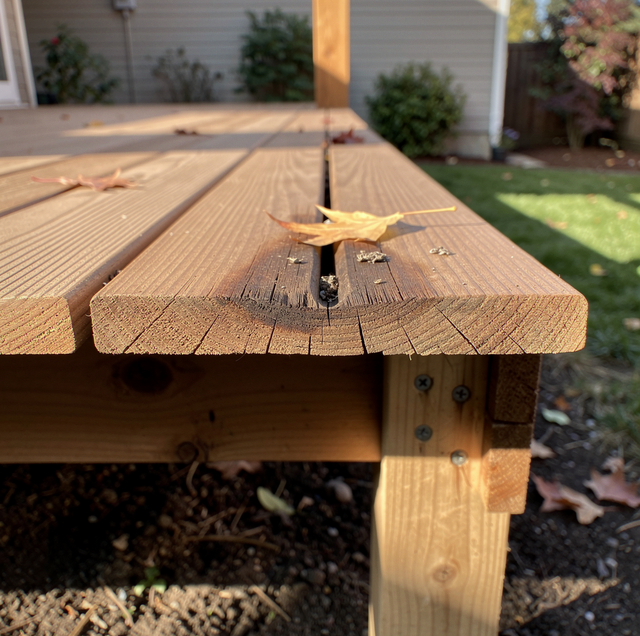
Quick Answer: Cupping is a board's edges sitting higher than its center, with the underside holding more moisture than the top face. A mild cup can ease toward flat as that gap narrows; a board cupped through repeated cycles can keep the shape.
A deck board that cups has its two edges sitting higher than the center, so a hand run across its width feels a shallow trough rather than a flat plane. The shape comes from a moisture difference between the board's two faces: the underside, pressed close to the joists and shielded from sun and open air, stays wetter and swells more than the top face, which sees direct sun and dries down further between rains. Wood expands and contracts across its width more than along its length, so when one face holds noticeably more moisture than the other, the wetter face effectively grows wider than the drier one, and the board bends to accommodate the difference.
That moisture difference comes from how the deck is built and where it sits, and in some cases it narrows once the underlying cause changes; in others the shape holds.
Several conditions widen or narrow that moisture gap between a board's two faces, and each one calls for a different fix.
| Condition | What It Does to the Moisture Balance | What Changes It |
|---|---|---|
| A low deck with little air moving underneath | Humid air stays trapped against the underside, so it can stay wetter than the top between rains | Raising clearance or adding venting lets the underside dry closer to the top face |
| Boards laid tight with no gap | Water held in the tight seams keeps the board edges wet, and air under the deck has no path up between boards | Leaving a consistent gap between boards lets the seams drain, and air move up through the decking |
| A new deck built with wet lumber | The whole board starts saturated, then dries unevenly as the top and edges lose moisture to sun and air long before the shielded underside does | The gap narrows as the board sheds that construction moisture and settles into its surroundings |
| A shaded deck that stays damp | Neither face dries down fully, but the top still loses more moisture to open air than the sheltered underside does | Opening up sun and air narrows the gap; deep, constant shade keeps both faces wetter without closing it |
| Boards finished on the top face only | The finish film slows how fast the top gains or loses moisture, while the bare underside keeps responding quickly to what's beneath it | Coating every face before the boards go down lets both faces respond at closer to the same rate |
| Cupping only near a downspout or planter | Water concentrated at that one spot keeps the underside wetter there specifically, not across the whole deck | Redirecting the water source narrows the gap at that spot without changing the rest of the deck |
How Uneven Moisture Bends a Board Across Its Width
Solid wood decking swells and shrinks with moisture across its width and thickness and very little along its length, so two faces at different moisture levels bend the board across its width.
Each face gains or loses moisture at whatever rate its exposure allows, and the two faces of a single board are locked together as one piece of wood. When one face holds more moisture than the other, that face swells while the drier face does not, and the board bends toward the drier face to accommodate the difference: the edges rise away from the wetter face, and the board cups. When the underside is the wetter face, the top edges lift.
Composite decking is made from different materials with varying moisture responses, so this cupping mechanism is characteristic of solid wood.
Airflow and Drainage Under the Deck
How much air moves under a deck sets how quickly the underside can dry after every rain. A deck with generous clearance above the ground and open sides lets air pass freely beneath the boards, so the underside dries down close to what the top achieves between wettings. A low deck, one built close to grade or boxed in along its sides, traps humid air against the underside instead, and that trapped air stays near-saturated during stretches when the open top face is already dry.
Standing water, dense ground cover, or planting beds pressed right against a low deck's perimeter add to that trapped humidity without adding anything the deck itself can shed. Raising a deck's clearance, opening vents at its skirting, or grading the ground beneath it to drain narrows the moisture gap between the two faces by giving the underside a faster path to dry.
Gaps Between Boards and Wood That Was Wet When Laid
A gap between boards lets rainwater drain off each board's edges and allows air to rise between them, so the edges and underside can dry alongside the top. Boards laid tight against each other hold water in the seams, and the underside then dries only through the air beneath the deck, more slowly than a top face exposed along its entire width.
How wet the lumber was when it went into the deck adds a second, separate source of the same imbalance. A board milled or stored without a cover can retain moisture before a single board goes down, and once installed, its top and edges start losing that moisture to the open sun and air long before its shielded underside does. That board starts with the same face-to-face gap from the day it goes down, on top of whatever the deck's own airflow and drainage add afterward.
Laying a straightedge flat across a board's width shows the cup's depth more clearly than eyeballing it, and checking the same board again once conditions around the deck have stayed drier shows whether that depth is narrowing or holding steady.
Finish on One Face and Not the Other
A sealer, stain, or paint film slows how quickly the underlying wood gains or loses moisture; it does not stop the movement. Decking, once built, gets its top and edges finished only, since the underside sits against the framing once the boards are down. That leaves the top responding to moisture more slowly than the bare underside, which keeps reacting at its own pace to whatever conditions sit beneath the deck. The mismatch in how quickly each face responds adds to the cupping caused by the moisture difference itself.
Whether a Cupped Board Can Flatten
Cupping caused by a moisture gradient can reverse. As the gap between a board's two faces narrows, whether from airflow opened up underneath, a redirected water source, or the board settling into the conditions around it, a board with a mild, recent cup can ease back toward flat, because the wood fibers on each face have not been pushed past the point where they can return.
A board that has gone through repeated cycles of swelling wet and shrinking dry while cupped is a different case. Those repeated cycles can compress the fibers on the swollen face and stretch the ones on the dry face far enough that the shape holds even after the moisture gap that caused it narrows. Whether a given board eases back or keeps its shape depends on how deep the cup went and on the wet-dry cycles it has already been through.
A raised board edge can catch a shoe or bare toe, and a soft, spongy, or split board can give way under a person's weight. A section with boards like that stays off-limits to foot traffic until a crew checks it.
When Re-Decking With New Boards Is the Fix
Boards that have stayed cupped long after the conditions around them changed, deep enough that water collects in the trough or edges catch underfoot even once the deck around them has dried out, are the ones worth replacing rather than waiting on. New boards start flat, and re-decking is also the point where board gaps and a coating on every face can be set from the start.
Pulling the old decking also opens the framing to a close look from above, including the connection where an attached deck ties into the house, which carries its own separate set of failure points worth checking whenever it's accessible.
Frequently Asked Questions
Spot-replacing only the boards that stayed cupped is possible where the framing underneath each one is sound; a face-fastened board comes out without disturbing the boards beside it, whereas boards held by hidden clips may require more work around the neighbors. A new board next to older, already weathered boards shows a visible difference in color and surface texture at first, since it has not undergone the same weathering as the rest of the deck; that difference can fade as the new board weathers alongside the others and does not affect whether the repair holds.
Only where the board has the same profile on both faces. A board milled with a profiled top, a hidden-fastener groove on one side, or an eased edge on one face only is made to go down one way. Where both faces match, flipping puts a different face into the same conditions that caused the cup, so the deck's airflow, gaps, and finish decide what shape develops next.
For the same percentage difference in moisture between the two faces, yes, the total edge lift is greater on a wider board. Swelling accumulates across the entire width, so spreading the same per-inch difference over more inches results in a larger gap between the center and the edges on a wide board than on a narrow one. The per-inch swelling of each face is the same on both boards; the extra width is what adds to the lift.
It can. A board that rocks or shifts when stepped on is one where the fastening no longer holds flat against the framing, due to a fastener that has loosened as the board moved, or to a joist top sitting out of line with its neighbors. That movement is a separate problem from how deep the cup is.
No, they are opposite shapes. Cupping is when edges are higher than the center; crowning is when the center is higher than the edges, and it comes from a reverse moisture pattern, with the top face holding more moisture than the underside. Water standing on the top surface of a board while the underside stays dry is one way a board crowns.
They can. End grain, the open cross-section of wood fibers exposed at a board's cut ends, absorbs and releases moisture faster than the long faces do, so the cup at a board's end can differ from the cup at its middle even when both are cut from the same piece of lumber and installed the same way. An uncapped or unsealed end at a deck's perimeter is exposed to that faster moisture movement with nothing slowing it down, which is part of why cupping can show up right at a deck's outer edge.
Bring in deck installation to re-deck the cupped section — remove the old boards and lay new decking in their place. VResh Construction serves the Portland metro. CCB #241979. Call (503) 272-6436.