Deck Repair vs. Rebuild: When to Save and When to Start Over
The deck boards were gray and splitting. A few had cracked through. The railing wobbled when pushed. From the top, the deck looked like it needed replacement — 15 years old, pressure-treated, never sealed. Then the contractor crawled underneath and inspected the framing. The joists were solid. The beams were solid. The posts showed no rot at the base. The ledger board — the critical connection where the deck attaches to the house — had been properly flashed with metal flashing integrated into the siding. The rim joist behind it was dry and structurally sound.
The deck needed new boards and a new railing. It did not need a rebuild. The structural framing had another 10-15 years of service life. Replacing the surface and the railing at $2,500-$4,000 saved the homeowner $10,000-$15,000 compared to a full rebuild, and the result was a deck that looked and performed like new on a structural foundation that was still sound.
That's the question every Portland homeowner with an aging deck should ask before committing to a rebuild: Is the structure failing, or is the surface failing? The answer determines whether the project is a $2,000 repair or a $15,000+ construction project.
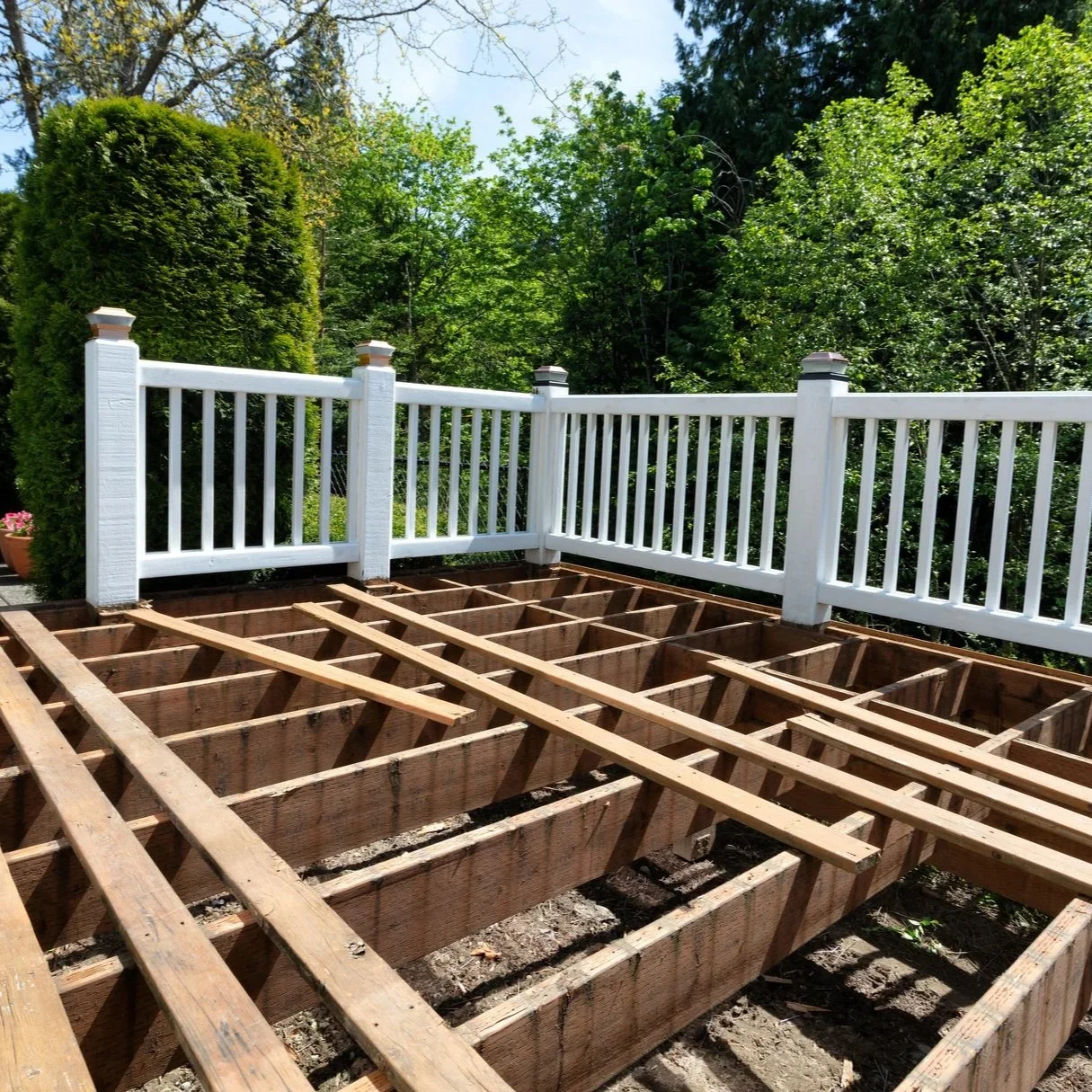
Exposed wooden deck joists and framing beneath white railings in a backyard during deck repair and rebuilding process.
When Repair Is the Right Call
Deck repair is the right approach when the structural framing is sound and the problems are confined to the surface, the railing, or a localized area of damage.
Weathered or damaged surface boards on solid framing: The most common deck repair scenario. Surface boards show wear — graying, splitting, cupping, splintering — while the structural framing underneath is sound. Replacing surface boards on an existing structural frame costs $500-$3,000, depending on the deck size, decking material, and the number of boards to be replaced. A full deck re-surfacing — removing all existing boards and replacing with new decking on the same frame — runs $2,000-$6,000 for a typical 200-300 square foot Portland deck in pressure-treated lumber, or $3,500-$9,000 in composite.
Railing replacement: Railings deteriorate faster than decking because they have more exposed end grain, smaller cross-sections that dry and shrink faster, and constant hand contact that accelerates finish wear. A railing that wobbles, has loose or missing balusters, or no longer meets current code (36-inch minimum height for decks under 30 inches above grade, 42-inch for higher decks, balusters spaced no more than 4 inches apart) can be replaced independently of the rest of the deck. Railing replacement runs $1,000-$4,000 depending on the length and material.
Localized rot at one or two locations: A single joist with rot at one end, a post that has softened at the base, or a section of decking over a debris trap where moisture has accumulated — these are targeted repairs, not rebuild triggers. The damaged member gets replaced with new material, the cause gets corrected (debris cleared, post base elevated, drainage improved), and the rest of the deck continues in service. Cost: $300-$2,000 per location.
Stair replacement: Deck stairs take more physical abuse than any other component — foot traffic, rain exposure on horizontal treads, and often inadequate attachment hardware. Stairs that have become unsafe can be rebuilt without touching the rest of the deck. Cost: $500-$2,500, depending on the rise, the material, and whether the landing needs work.
When Rebuild Makes More Sense
Rebuild becomes the right call when the deck's structural integrity has been compromised beyond the point where targeted repairs can restore it — or when the cumulative cost of repairs approaches the cost of starting over with a new structure.
Ledger rot and rim joist damage: The ledger board is the horizontal framing member that bolts the deck to the house. An improperly flashed ledger — or one with no flashing at all — allows water behind the connection and into direct contact with the rim joist and floor framing of the house. This is the most structurally consequential form of deck damage because it affects both the deck structure and the house structure. Repairing a rotted ledger requires removing the deck from the wall, replacing the ledger and, if necessary, the rim joist behind it, installing proper through-wall flashing, and reattaching the deck. In many cases, the labor required for a ledger repair is substantial enough that a full rebuild — with proper flashing from the start — is comparable in cost and delivers a complete structural reset. Ledger and rim joist repairs alone run $3,000-$8,000+.
Multiple posts with rot at grade: Posts that have softened or rotted at grade level — where the wood contacts or is close to the concrete footing or the soil — indicate that the structural foundation of the deck is compromised. Replacing multiple posts requires temporarily supporting the deck, removing each post, and installing new posts on properly sized footings. When three or more posts show rot, the labor approaches the cost of a full rebuild, and the age of the remaining framing raises questions about how long it will last.
Joist failure — sag, bounce, or visible rot: Joists that sag visibly, bounce noticeably underfoot, or show rot along their length have lost structural capacity. Joist replacement on an existing deck is labor-intensive: the decking above must come off, the damaged joists get removed, new joists get installed, and the decking goes back on. When multiple joists are failing, the labor cost of joist-by-joist replacement approaches the cost of a complete rebuild.
Code compliance issues: Portland's building code has evolved over the decades. Decks built under older code versions may have inadequate post-to-beam connections, undersized footings, railings that do not meet current height or baluster spacing requirements, stairs with non-compliant rise and tread dimensions, or no permit on record. A rebuild provides an opportunity to bring the entire structure into compliance with current code, which affects both safety and the home's ability to sell without disclosure issues.
The deck no longer fits the intended use: A 10-by-10 platform that was adequate when built may not serve a household that wants space for outdoor dining, grilling, and entertaining. A rebuild allows reconfiguration — larger footprint, multiple levels, integrated stairs, built-in seating, or a connection to an indoor living space. Repair preserves what exists; rebuild creates what the homeowner actually wants.
The Cost Comparison
| Scenario | Typical Cost Range | Timeline |
|---|---|---|
| Board replacement (partial — 20-30% of surface) | $500-$2,000 | 1-2 days |
| Full re-surfacing (new boards, same frame) — PT lumber | $2,000-$6,000 | 2-4 days |
| Full re-surfacing — composite | $3,500-$9,000 | 2-4 days |
| Railing replacement | $1,000-$4,000 | 1-2 days |
| Stair rebuild | $500-$2,500 | 1 day |
| Localized structural repair (1-2 joists or posts) | $300-$2,000 per location | 1-2 days |
| Ledger and rim joist repair | $3,000-$8,000+ | 3-5 days |
| Full rebuild — PT lumber (12x16 single level) | $8,000-$15,000 | 3-5 days |
| Full rebuild — cedar | $12,000-$22,000 | 3-7 days |
| Full rebuild — composite (Trex, TimberTech, Fiberon) | $15,000-$30,000 | 3-7 days |
| Multi-level or elevated deck rebuild | $20,000-$40,000+ | 5-10 days |
These ranges include labor, materials, and hardware. They do not include structural repair to the house framing behind the ledger — that is an additional cost if an improperly flashed ledger connection has damaged the rim joist or floor framing.
What Portland's Climate Does to Decks
Portland's wet climate attacks decks through the same mechanisms that affect every other exterior wood structure — sustained moisture, slow drying, and the biological activity that moisture supports.
Surface weathering is accelerated: Untreated or under-maintained wood decking in Portland weathers faster than the same material in drier climates. Rain saturates the wood, sun dries the surface while the interior stays damp, and the resulting differential moisture cycling causes cupping, checking, and splitting. Pressure-treated lumber that receives no sealer or stain application after installation will show visible weathering within 2-3 years in Portland's conditions.
Moss, algae, and mildew colonize deck surfaces: Portland decks — particularly those under tree canopy or on north-facing exposures — develop moss and algae growth on horizontal surfaces that stay damp. Moss traps moisture against the wood, accelerates surface decay, and creates a slip hazard when wet. Annual cleaning and maintenance extend the surface life of the decking, but do not address structural issues developing below.
Debris traps accelerate joist rot: Leaves, needles, and organic debris that accumulate between deck boards and on top of joists trap moisture against the wood. The debris holds water long after the rain stops, creating localized high-moisture conditions on framing members that would otherwise dry. Portland homes with deciduous trees or conifers overhanging the deck are particularly susceptible to joist rot in debris-trap locations.
The ledger connection is the critical failure point: The single most important factor in Portland deck longevity is whether the ledger board — the connection between the deck and the house — was properly flashed at installation. A properly flashed ledger with through-wall flashing integrated into the weather-resistive barrier behind the siding prevents water from entering the wall cavity at the connection point. An improperly flashed or unflashed ledger allows water to collect behind the connection during every rain event, saturating the rim joist and potentially the house's floor framing. Improperly flashed ledger connections are the leading cause of structural deck failure in the Pacific Northwest and the leading cause of rot damage to the house framing adjacent to the deck.
Deck Materials — Repair and Rebuild Options
Material choice affects both upfront costs and long-term maintenance requirements.
Pressure-treated lumber: The most common deck material in Portland. Current pressure treatment (ACQ or CA-B) resists decay and insect damage. Pressure-treated decking requires sealing or staining every 2-3 years for appearance and surface protection. All fasteners must be rated for use with pressure-treated lumber — hot-dip galvanized, stainless steel, or approved coated fasteners. Standard steel fasteners corrode in contact with ACQ-treated wood. Material cost: $2-$4 per linear foot for decking boards. Lifespan: 15-25 years with maintenance.
Cedar: Western red cedar is naturally rot-resistant, visually attractive, and common on higher-end Portland decks. Cedar costs more than pressure-treated and requires regular maintenance (sealing or staining every 2-3 years) to maintain appearance and prevent surface checking. Cedar's natural rot resistance applies to the heartwood — the lighter-colored sapwood has less resistance. Structural framing under cedar decking should still be pressure-treated where near grade or in moisture-prone locations. Material cost: $4-$7 per linear foot. Lifespan: 15-25 years with maintenance.
Composite decking (Trex, TimberTech, Fiberon): Composite decking is made from wood fiber and recycled plastic. It does not require sealing, does not splinter, and resists staining and fading better than natural wood. The higher upfront cost is offset by near-zero maintenance over its service life. Capped composite — with a polymer cap over all four sides of the board — is the premium option, with 25-30 year fade and stain warranties. Composite adds 30-50% to the material cost versus pressure-treated lumber. Material cost: $5-$12 per linear foot. Lifespan: 25-50 years.
| Material | Material Cost/LF | Maintenance | Lifespan | Best For |
|---|---|---|---|---|
| Pressure-treated | $2-$4 | Seal/stain every 2-3 years | 15-25 years | Budget-conscious users, willing to maintain |
| Cedar | $4-$7 | Seal/stain every 2-3 years | 15-25 years | Appearance priority, committed to maintenance |
| Composite (standard) | $5-$8 | Periodic cleaning only | 25-35 years | Low maintenance, moderate budget |
| Capped composite | $8-$12 | Periodic cleaning only | 25-50 years | Lowest maintenance, highest durability |
Permits and Code Requirements
Deck construction and major structural repair in Portland require building permits.
New deck construction: Virtually all attached decks require a building permit in Portland. Ground-level platforms under 30 inches above grade and detached from the house are sometimes exempt, but the rules vary by jurisdiction in the Portland metro area. The permit covers structural design, footing depth and size, framing connections, railing and stair compliance, and the ledger attachment detail.
Deck repair scope determines permit need: Replacing surface boards and railings on an existing permitted deck structure does not typically require a new permit. Structural repairs — replacing joists, posts, beams, or the ledger — may require a permit depending on the scope and jurisdiction. A repair that involves removing and reattaching the deck from the house (for ledger replacement) is essentially new construction at the attachment point and typically requires a permit and inspection.
Unpermitted decks at resale: A deck built without a permit creates a disclosure issue at resale. Buyers and their inspectors check permit records. An unpermitted deck may need to be permitted retroactively — which can require bringing the entire structure into compliance with current code — or demolished. The cost of retroactive permitting or demolition at the time of sale typically exceeds the cost of permitting at the time of construction.
Frequently Asked Questions
The Structure Determines the Decision
A deck that looks worn on top but is structurally sound underneath is a repair. A deck with compromised framing — rotted ledger, failed posts, sagging joists — is a candidate for a rebuild. The surface condition is what the homeowner sees. The structural condition determines the appropriate scope of work and investment. The fastest way to determine which project the homeowner actually needs is to inspect underneath the deck, not to discuss what color the new boards should be.
Boards are the cheap part. The decision sits underneath: a ledger lag-screwed rather than bolted, or joists toe-nailed rather than hung, is a rebuild whatever the surface looks like. VResh Construction opens it up before quoting — deck installation in Beaverton, deck repair in Portland. Free written estimate: (503) 272-6436.