Sliding Door Leaking in Portland Rain? What's Letting Water In
Quick Answer: A leaking sliding door is rarely defective. Tracks let a little water in and drain it out, so water sitting in the track alone is normal. A real leak usually traces to a missing sill pan or head flashing.
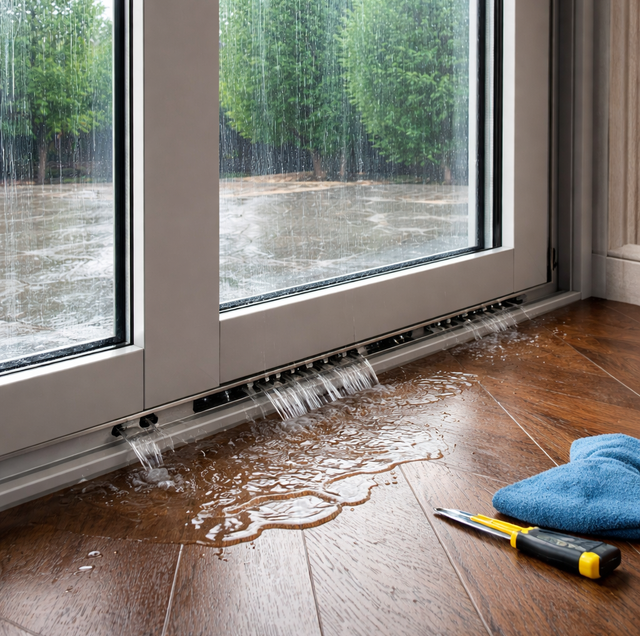
The water showed up along the bottom edge of the door track about twenty minutes into a hard rain, a thin dark line spreading across the floor a few inches from the threshold. It hadn't been there during the last storm, or the one before that. The door looked fine: it closed flush, the lock caught, the glass wasn't fogged. There was no obvious crack, no visible gap, nothing about the door itself that explained where the water was coming from.
That gap between what the door looks like and what it's doing is where most sliding door leak calls start. Homeowners check the obvious things first: the seal around the glass, the lock, the weatherstripping, because those are the parts they can see and touch. The part that actually failed is usually somewhere they can't see at all, in the flashing and drainage detail built into the wall opening before the door was ever set. The likely answer, in most cases, is that it isn't the door. It's what's behind it.
What the Track Is Actually Designed to Do
A sliding door's bottom track is not meant to be watertight. Manufacturers cut small drainage openings, usually three to six per door, into the outer rail of the track for exactly this reason: wind-driven rain and condensation get past the outer weatherstripping in normal use, and the track is built to catch that water and route it back outside rather than let it accumulate.
Drained systems versus barrier systems: Building science guidance from the Building Science Corporation splits door and window installation into two approaches: a barrier system, which relies entirely on sealants and gaskets to keep water out and offers no backup if that seal fails, and a drained system, which assumes some water will get past the primary seal and gives it a planned path back to the exterior. Nearly every sliding door sold today is a drained system by design. Water sitting briefly in the track after a storm, then draining out through the weep holes over the following hour or two, is the system doing its job.
When drainage becomes a leak: The track's drainage only works if the weep holes stay open and the track itself hasn't developed a low spot that traps water short of the drain path. Debris, paint overspray, or a track that has sagged out of level can turn a functioning drainage system into a standing pool. That's a real cause of leaks, and it's a door-hardware problem, not a wall problem. But it accounts for water pooling inside the track. It doesn't explain water reaching the subfloor or the drywall a few feet from the door, and that distinction matters for what follows.
The Sill Pan Most Budget Installs Skip
Below the track, inside the rough framing the door sits in, is a second and more consequential drainage detail: the sill pan.
Where the pan sits: The sill pan sits underneath the door track, inside the rough opening, catching anything that gets past the door and the track drainage and carrying it back outside before it reaches the subfloor. It's installed before the door ever goes in, as part of preparing the rough opening itself.
What a proper sill pan requires: The Building Science Corporation lists four characteristics a sill pan needs to actually work: a continuous waterproof surface with no holes or wrinkles, a back dam or slope directing water toward the exterior, end dams at both sides to stop water running laterally into the wall framing, and a lap over the water-resistive barrier below the opening so water draining off the pan runs over the barrier instead of behind it. Miss any one of the four and the pan can hold water against the sill instead of shedding it.
The back dam, specifically: A back dam is a raised lip, often a strip of wood or beveled siding nailed along the interior edge of the rough opening before the pan membrane goes in, that stops water from draining toward the house instead of away from it. Building science education materials from the U.S. Department of Energy describe installing this dam first, then pressing formable flashing membrane over it and into the corners, working from the center of the sill toward each side so the membrane doesn't bridge the corner and tear later during window or door installation. Skip the back dam and the pan has no slope: water sits flat, finds the lowest point, and that point is usually the seam where the sill meets the subfloor.
A useful comparison: A sill pan does for a door opening roughly what a shower pan does under tile: the visible surface above it, tile in one case, door track and threshold in the other, was never expected to be perfectly watertight on its own. The pan underneath is the actual water barrier, sitting out of sight and doing the job the visible surface usually gets credit for.
Why this step gets skipped: A sill pan adds labor time and material cost to an install that a homeowner can't see once the door is set and trimmed out. On a fixed-bid installation, it's the step most likely to get shortened to a bead of caulk under the threshold instead of a formed pan. Caulk fails on its own timeline. A properly detailed pan doesn't rely on an unbroken adhesive seal to keep water out; it relies on gravity and a drainage path, which keeps working even after the caulk around it has cracked.
Caulking over a failing sill pan or gap without correcting the drainage detail traps water against the sill plate instead of stopping it, often accelerating rot rather than preventing it.
Head Flashing and the Wall's Drainage Plane
The sill pan handles water that gets past the door at the bottom. Head flashing handles a different, larger volume of water: everything running down the face of the wall above the door opening.
How wall drainage is supposed to work: Modern wall assemblies rely on a water-resistive barrier, a housewrap or building paper layer installed behind the siding, to catch anything that gets past the exterior cladding and direct it downward and outward. That barrier is installed in a shingle-lap sequence, each course overlapping the one below it, the same way roof shingles overlap so water is always running onto a surface rather than up under an edge. A door opening breaks that continuous plane, and head flashing is what restores it: a strip of flashing installed above the opening, lapped under the water-resistive barrier above it and over the door's nailing flange or trim below it, so wall water runs down the face of the flashing and back onto the barrier rather than behind the door frame.
What happens when the sequence is wrong: Flashing installed out of order, jamb flashing applied after the door is set, or head flashing that sits on top of the water-resistive barrier instead of under it, creates a pocket where water can be directed behind the barrier instead of over it. The failure isn't visible from the exterior. It shows up later as staining on the interior header trim or a soft spot at the top corner of the jamb, and by the time it's visible, the header and the top of the jambs have usually been wet for a long time already.
Installed as part of the wall assembly: No door product, regardless of brand or price point, includes its own head flashing. Flashing is field-installed by whoever sets the door, using the wall's water-resistive barrier as the drainage plane it laps into. A high-end door installed without integrated head flashing carries the same vulnerability at the top of the opening as a budget one.
When the Door Itself Really Is the Cause
Flashing and sill pan failures explain most water intrusion at sliding doors, but not all of it. Two door-side failures are common enough to rule out before assuming the wall opening is at fault.
Worn or compressed weatherstripping: The weatherstripping along the door's meeting rail and jambs seals against wind-driven rain in addition to air. Vinyl and foam weatherstripping compresses and hardens with age and UV exposure, and once it stops making full contact with the panel, wind-driven rain can push past it directly into the track, adding more water than the track's drainage was designed to handle. This is a door-hardware repair, not a wall repair, and it's usually inexpensive to correct.
A dropped or misaligned panel: Rollers wear down over years of use, and as they wear, the panel gradually drops out of alignment with the frame. A gap of even a few millimeters at the top or bottom is enough for wind-driven rain to bypass the weatherstripping entirely during a hard storm, even though the same door sheds a light rain without issue. Roller wear is progressive and often goes unnoticed until a storm with sustained wind exposes the gap.
Frequently Asked Questions
No, and the fastest way to tell the difference doesn't require waiting for a storm: run a slow trickle from a hose into the track on a dry day and time how long it takes to drain. A few minutes is normal for the small volume a hose trickle puts into the track. Water still standing two hours or more after a full storm, when far more volume has gone through the track, points to blocked weep holes or a track that's developed a low spot. Clearing a blocked weep hole is usually a matter of running a soft pick or a blast of compressed air through the opening from the outside; a drill bit or anything metal and rigid risks enlarging the hole or damaging the track's finish, so it's worth avoiding even though it seems like the obvious tool for the job.
Location is the clue. Water confined to inside the track, especially near the ends where the weep holes sit, points to the door's own drainage or weatherstripping. Water appearing at the base of the door frame itself, staining on interior trim above the door, or a soft spot in the flooring a few inches out from the threshold rather than directly under it, points to the flashing behind the wall finish rather than the door. Confirming which requires removing a section of interior trim to inspect the framing directly, which isn't something a homeowner can diagnose from the outside.
Sometimes. If the panel, rollers, and weatherstripping are sound and the water traces to a flashing or caulk failure at the wall opening, removing the interior and exterior trim, correcting the flashing, and resealing can resolve the leak without replacing the door. If the leak has been active long enough to soften the sill plate or subfloor framing, that structural repair has to happen regardless of whether the door is reused, and at that point replacing an older door at the same time is usually more practical than reinstalling it into repaired framing.
Yes, and it's a common mix-up. Interior condensation forms on the glass or the aluminum threshold when warm, humid indoor air meets a cold surface, and it can run down and pool at the base of the door in a pattern that looks identical to a rain leak. The distinguishing detail is timing: condensation shows up on cold, still mornings regardless of whether it rained, while a flashing or sill pan leak appears during or shortly after active rain and tracks with storm activity rather than temperature.
Water that reaches the sill plate or subfloor doesn't dry out the way a puddle on hardwood does: trapped between the flooring and the framing, in a location with little airflow, it can keep that wood's moisture content well above normal for weeks after a single storm. Wood that stays saturated long enough, generally sustained moisture content above roughly 20 percent, is what allows wood-decay fungi to establish, and the damage typically isn't visible until the flooring near the door starts to feel soft underfoot, by which point the framing damage usually extends further than the visible soft spot suggests.
Less than the installation does, but there are real differences. Multi-panel and lift-and-slide systems, which use wider structural openings, require a correspondingly wider sill pan and a structurally engineered header, and the flashing detail across that wider span is more failure-prone if it isn't done correctly. Manufacturer warranties, including the full lifetime coverage some brands offer on their sliding systems, typically cover product defects in the door itself but not water damage traced to how the opening was flashed.
Two Systems, One Symptom
A sliding door and the wall opening it sits in are built by different people, on different days, sometimes years apart if the door has already been replaced once before. The door manufacturer tests and warrants the unit on its own, on a test rig, not embedded in a real wall with its own flashing history. That's part of why diagnosing a leak has to look at both systems rather than assuming the newer, more visible one is where the water is getting in. A new door set into a poorly flashed opening will eventually show the same symptom the old one did, on roughly the same schedule, regardless of how well the new unit itself performs.
Get the leak diagnosed — a written inspection traces water intrusion to its actual source, whether that's the sill pan, head flashing, weatherstripping, or the drainage plane behind the wall finish, before any repair work starts. VResh Construction serves the Portland metro. CCB #241979. Call (503) 272-6436.