Sliding Glass Door Materials: Which One Survives Portland Rain?
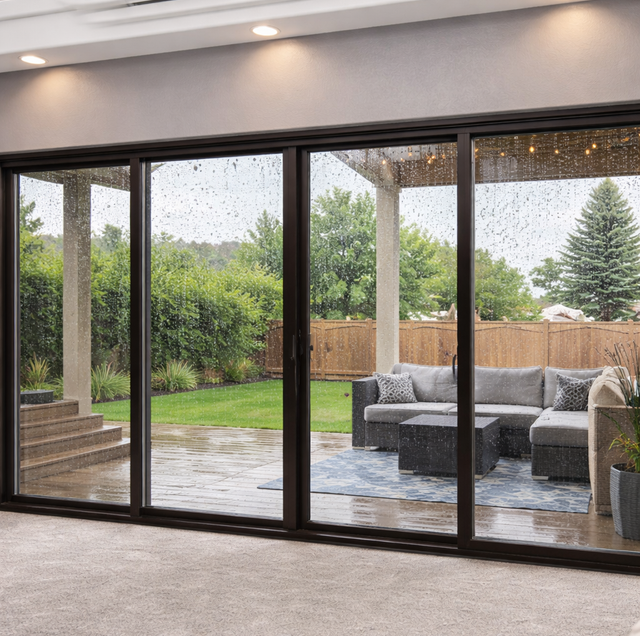
Quick Answer: Frame material affects how a door handles the wet season: vinyl resists moisture but can warp in dark colors, aluminum needs a thermal break, and fiberglass is the most stable of the three. Sun and rain exposure matter more than brand.
The bottom rail of the wood-clad slider came apart in gloved hands during tear-out, not from a pry bar, but on its own. The exterior face still looked fine from six feet away: painted, uniform, no obvious crack in the finish. Underneath the aluminum cladding, the wood core had been trapping condensation against an old-style aluminum spacer bar between the glass panes for close to twenty years, and by the time the unit came out, a chunk of that bottom rail crumbled into damp, dark fibers instead of splintering the way dry wood does.
Nothing about that door's material choice was unusual for its era. What it shows is that the material printed on the spec sheet only tells part of the story. How a frame handles years of cold, wet mornings followed by hot, UV-heavy afternoons determines whether it is still square and weathertight at year fifteen or already showing the kind of quiet failure that hides behind a good paint job. The rest of this walks through vinyl, aluminum, fiberglass, and wood-clad frame materials specifically for that kind of exposure, not for a generic climate.
Why Frame Material Matters More at a Patio Door Than Anywhere Else
A sliding door is usually the largest single opening in an exterior wall, which means more surface area exposed to wind-driven rain, more glass exposed to solar heat gain, and a wider frame that has to stay dimensionally stable across a full range of seasonal temperature swings without binding on its track.
Thermal movement: Fiberglass expands and contracts at close to the same rate as glass itself, which is a large part of why fiberglass seals tend to stay tight over decades. Vinyl moves considerably more than fiberglass with temperature change, and that movement is cumulative: two decades of daily expansion and contraction can gradually loosen weatherstripping and shift hardware alignment. Aluminum sits in between on pure expansion, but its real limitation is thermal conductivity: building-science sources put it at roughly 1,000 times more conductive than vinyl or fiberglass, meaning heat and cold pass through an untreated aluminum frame almost instantly.
Moisture exposure: A wet season that runs roughly October through May puts nearly every patio door in the region under sustained wind-driven rain for months at a stretch, while summer brings long stretches of direct, unshaded sun on south- and west-facing walls. Water intrusion at a slider is overwhelmingly a flashing and sill pan problem rather than a frame material problem: sliding doors are built with drainage holes in the sill track specifically to handle minor water intrusion, and when water actually reaches the interior, the wall flashing has usually failed rather than the door itself.
UV and heat exposure: Exposed wood finishes break down faster under direct UV than they do under rain, and standard vinyl is rarely offered in dark exterior colors because dark surfaces absorb enough extra heat to bow or warp the frame. A useful physical comparison is a plastic ruler left on a dashboard: it doesn't crack outright; it just slowly loses its straight edge, and a vinyl frame under repeated heat cycling behaves the same way over enough summers.
Vinyl: The Affordable, Moisture-Inert Default
Durability: Vinyl doesn't rot, corrode, or need paint, and it resists moisture well on its own. Its main weakness is heat: unshaded, dark-colored vinyl frames are the most prone of the four materials to warping under direct summer sun.
Thermal performance: A well-built vinyl frame performs adequately in this climate, but it expands and contracts more than fiberglass or aluminum with every temperature swing, which is the mechanism behind loosened seals and stiffer operation as a vinyl slider ages past the fifteen- to twenty-year mark.
Moisture and rot resistance: The material itself is inert to water. Whether a vinyl-framed door actually stays dry depends almost entirely on the sill pan and head flashing behind it, not on the vinyl.
Maintenance: Essentially none beyond occasional cleaning. Milgard's vinyl sliding door lines, among the most commonly installed patio doors in the region, carry a Lifetime Limited Warranty as standard, with an optional Full Lifetime Warranty upgrade available on select series.
Aluminum: Dimensionally Stable, but Unforgiving Without a Thermal Break
Durability: Aluminum forms a thin oxide layer that resists corrosion and doesn't rot or attract pests, which is why it holds up structurally for 20 to 25 years or more. It's a poor fit for salt-air coastal exposure, which isn't a factor for most inland patio door installations.
Thermal performance: This is aluminum's real limitation. Without a thermal break, a poured foam or polyamide strip that separates the interior metal from the exterior metal, an aluminum frame conducts outdoor cold straight through to the interior surface. In a climate with many cool, damp mornings, that shows up as visible condensation on the interior frame and glass, the same basic mechanism that destroyed wood window sashes built with older-style aluminum spacer bars decades ago.
Moisture resistance: The metal itself doesn't absorb water or rot, but an untreated aluminum frame can generate its own interior moisture through condensation, which then drips onto the sill and can saturate surrounding wood trim over years if it isn't managed.
Maintenance: Low. No paint required. Scratches and dents in the frame typically require replacing the affected section rather than a simple spot repair.
Fiberglass: The Most Dimensionally Stable, at a Price Premium
Durability: Fiberglass resists warping, rot, corrosion, and pests, and it's substantially stronger than vinyl for a given frame thickness, which lets manufacturers build narrower sightlines without sacrificing structural rigidity.
Thermal performance: Because fiberglass expands at close to the same rate as glass, the seal around the glazing stays tighter for longer than it does in a material that moves more. Marvin's Ultrex fiberglass, used in its Infinity line, is described in the manufacturer's own published specifications as roughly eight times stronger than vinyl and expanding about 87 percent less; treat that figure as a manufacturer claim rather than an independent lab result, but the underlying material behavior (fiberglass moving far less than vinyl) is consistent across independent building-science sources as well.
Moisture and rot resistance: Fiberglass doesn't support rot or absorb moisture into the frame material itself.
Maintenance: Low. Factory-applied finishes can typically be repainted years down the line if a homeowner wants a different exterior color, something standard vinyl generally can't do.
Fiberglass costs roughly 20 to 40 percent more than comparable vinyl up front. In a wet marine climate specifically, that premium tends to buy meaningfully longer service life, since fiberglass frames are generally expected to outlast vinyl in this exposure. Actual lifespan always depends on installation quality and glass seal performance as much as on frame material.
Wood and Wood-Clad: Traditional Character, the Highest Maintenance Burden
Andersen's 400 Series Frenchwood, with a wood interior and a vinyl-clad exterior, and similar wood-clad lines from Pella and Jeld-Wen remain popular on Craftsman-style and historic homes where an all-vinyl or all-fiberglass frame would look out of place next to original wood trim.
Durability: Cladding, whether aluminum, vinyl, or fiberglass, protects the exterior face of a wood-core door, but the wood is still exposed wherever the cladding is cut, joined, or penetrated by hardware. That's the exact failure mode described at the top of this article: condensation trapped at an unprotected wood surface, invisible from the outside until the cladding comes off.
Moisture resistance: Lowest of the four materials if finish and caulk maintenance lapses. A gap in the exterior seal that goes unnoticed through a full wet season can let enough water reach the wood core to start a rot cycle well before any visible symptom appears indoors.
Maintenance: Highest of the four. Exposed or interior wood surfaces need periodic sealing, staining, or painting to prevent moisture penetration, and skipped maintenance cycles are a common contributor to wood-frame rot claims on this frame type.
Ask any installer for the frame's published linear expansion rate, not just its warranty length. A wide multi-slide door amplifies small per-panel movement into real binding at the track over time.
Reading the Wall Before Choosing a Material
An unshaded south- or west-facing wall sees the most UV and heat cycling in the house, which is exactly where dark-colored vinyl is most likely to warp and where wood finishes fade fastest; fiberglass or a lighter vinyl color generally holds up better in that exposure. A covered patio or deep roof overhang cuts direct rain and UV exposure enough that most materials, including aluminum, can perform reasonably well there. An uncovered opening taking direct wind-driven rain benefits most from fiberglass's dimensional stability, since a seal that isn't constantly working to compensate for frame movement stays tighter for longer.
Configuration affects the budget as much as material does: moving from a two-panel slider to a French-door or multi-slide configuration is typically a bigger jump in installed cost than moving from vinyl to a premium material within the same configuration. Fiberglass and premium aluminum systems tend to land toward the higher end of whichever configuration's price range applies; standard vinyl tends toward the lower end.
None of that changes the fact that installation quality, specifically a properly formed sill pan and integrated head flashing, determines whether water stays out of the wall assembly regardless of which frame material sits in the opening. A fiberglass door installed without a sill pan is exposed to the same rot cycle as a budget vinyl door installed the same way. Material choice affects longevity and thermal performance; flashing quality affects whether the wall behind the door survives the door's lifespan.
Frequently Asked Questions
Not directly. Roller and track wear is driven by usage cycles, debris in the track, and roller quality, not by whether the frame is vinyl, aluminum, fiberglass, or wood-clad. A worn roller assembly on a door under 20 years old typically runs $150 to $400 to replace rather than requiring a full unit swap. Frame material becomes relevant mainly on wider aluminum-framed multi-slide systems, where repeated thermal movement can gradually misalign the track itself.
Some manufacturers now offer laminate or co-extruded dark-color vinyl built specifically to resist the warping risk of a solid dark extrusion, though it often carries a shorter, separate finish warranty than the standard white or tan options carry on the base frame. Fiberglass and aluminum both handle dark exterior colors with less risk of frame distortion if color matters more than the material category, which is one reason dark frames show up more often in those two materials than in vinyl.
Yes, mainly on covered patios or enclosed sunrooms, and on contemporary architecture where a narrow sightline matters more than thermal performance. Even on a thermally broken frame, condensation can still form at the edge of the glass unit itself rather than on the frame, since the metal spacer bar between the two panes of glass is a separate thermal path from the frame's own break. Asking specifically for a warm-edge (non-metal) spacer bar closes that remaining gap.
Yes. Fiberglass and thermally broken aluminum both allow narrower stiles and rails for a given structural load than vinyl does, meaning more visible glass and fewer frame lines across a wide multi-panel opening. Vinyl's lower rigidity means manufacturers build thicker profiles to prevent panel sag, which becomes more noticeable on openings wider than roughly 12 feet. This is one reason premium multi-slide systems in the $8,000 to $28,000-plus range are more often built in fiberglass or aluminum than in standard vinyl.
Yes. Caulk joints and cladding seams should be inspected before the wet season starts each fall, since a gap that lets water reach the wood core early in the rainy months can sit undetected through months of rain before any softening trim becomes visible. In summer, the priority shifts to checking south- and west-facing finish for UV fading or cracking, since sun exposure breaks down exterior coatings faster than rain alone does.
Yes, and the differences go beyond stated years. Some brands' standard coverage stays with the original purchaser only, while others (Andersen's Owner-to-Owner warranty, for instance) transfer to whoever buys the house next. Certain fiberglass lines cover the frame separately from the insulated glass unit's seal, meaning a failed glass seal years later can fall under a different warranty claim than a cracked or damaged frame. Reading which components a warranty actually covers, and whether it moves with the house at resale, matters as much as comparing the number of years across brands.
What the Rough Opening Tells You That the Brochure Doesn't
A material comparison can't tell a homeowner whether the framing behind an existing slider is actually dry. Pulling the old unit is the only reliable way to see whether the sill plate, subfloor, and jambs are sound before a new frame material gets bolted into the same opening. A vinyl, aluminum, fiberglass, or wood-clad door installed over hidden rot fails on roughly the same timeline no matter which brochure it came from, which is why the tear-out inspection is worth treating as part of the material decision rather than a separate step that happens after it's already been made.
Get a material recommendation for your opening — a written estimate covers frame material, glass package, and the sill pan and flashing detailing your specific rough opening needs. VResh Construction serves the Portland metro. CCB #241979. Call (503) 272-6436.