
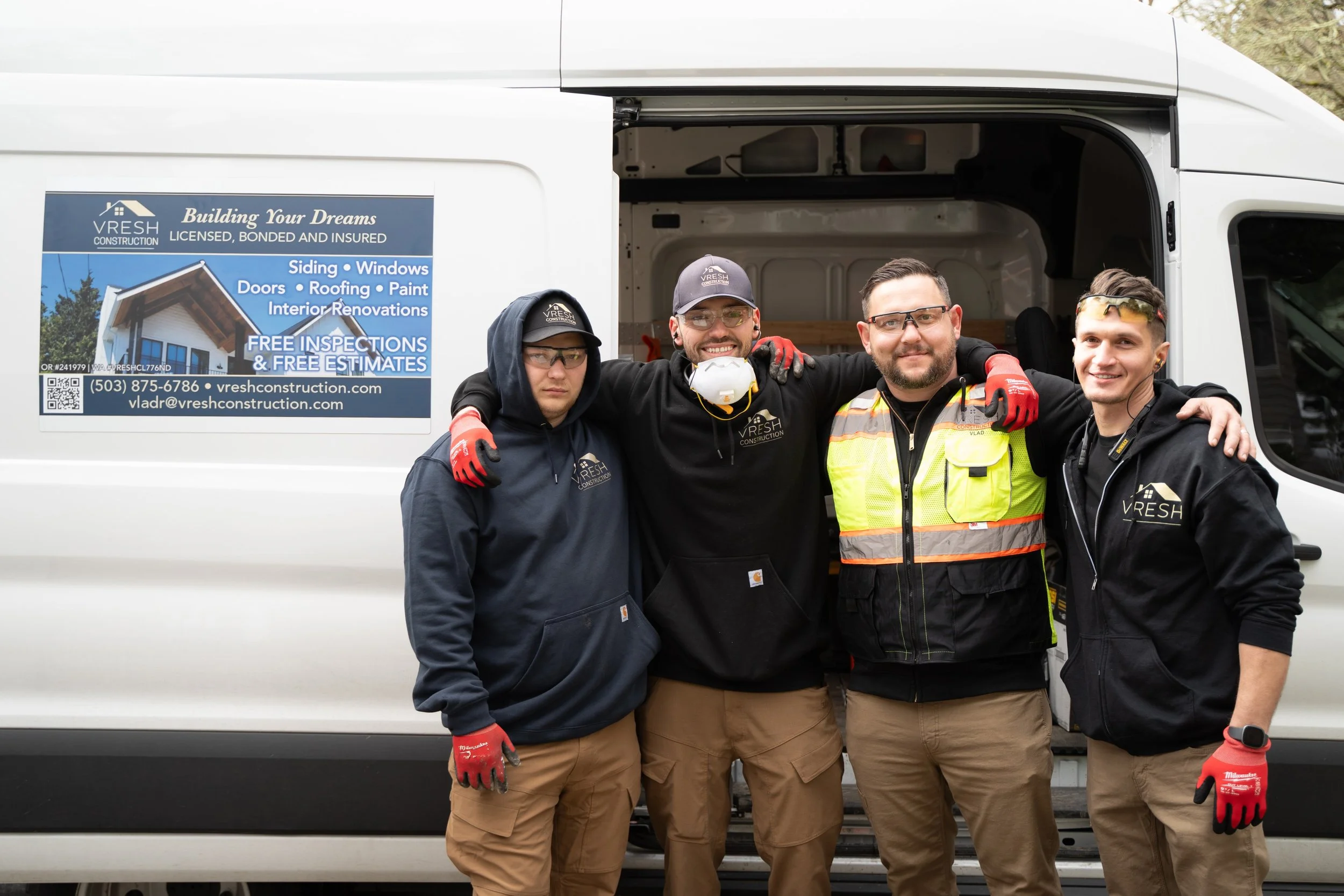
Gresham Siding Replacement Contractor That Fixes the Rot Before the New Siding Goes On
Most Gresham siding failures are not a siding problem — they are a moisture problem hiding behind failing siding for years.

VResh removes everything, finds the rot, fixes the structure, installs a proper drainage plane and correct flashing at every opening, then puts the new siding on top. Not the other way around. James Hardie fiber cement, LP SmartSide, cedar, and vinyl — all installed correctly. EPA Lead-Safe Certified. Licensed OR #241979 | WA #VRESHCL776ND. Free written estimates. (503) 272–6436.
VResh is an owner-operated general contractor. Founder Vlad personally oversees every Gresham siding project — you know who is coming to your home and who is accountable for the outcome.
Why Gresham Homeowners Are Replacing Siding Now
Gresham's housing stock tells the siding story directly. With a median construction year of 1981, approximately 43% of Gresham homes were built during the era when three siding materials dominated the market — wood lap siding, Masonite hardboard, and early LP siding — all of which have reached or exceeded their practical lifespan. The wave of Gresham homes built between 1960 and 1990 is now hitting its first full siding replacement cycle. VResh replaces all three of these materials regularly throughout Gresham and East Multnomah County.
Masonite Hardboard — The Most Common Failed Material in Gresham
Masonite hardboard siding was installed on enormous numbers of Gresham homes built in the 1970s and 1980s. Masonite was a cost-effective material when installed, but it absorbs moisture at the edges and bottom courses, swells, cracks, and eventually crumbles from the outside in.
Once bottom-course Masonite begins to fail, the moisture that gets behind it reaches the framing — and dry rot at the bottom plates and mudsill follows. Homes with Masonite on the wall today need assessment: how far has the damage progressed? VResh inspects for substrate damage on every Masonite project before any new siding is specified.
Early LP Siding — A Recall Material Still on Many Gresham Walls
LP SmartSide is a well-performing contemporary product. But the original Louisiana-Pacific Inner-Seal siding installed in the late 1980s and 1990s is a different story — it was the subject of a class-action settlement and is known to fail in damp climates.
Gresham's rain profile is exactly the environment where original LP siding deteriorates fastest. If your home's siding has a heavily textured or striated face, is showing swelling and cracking at the edges, and was installed before 2000, it may be original LP Inner-Seal. VResh identifies and replaces original LP siding and assesses the substrate for moisture damage beneath it.
Gresham's Moisture Environment — What It Means for Siding Life
Gresham sits at the eastern edge of the Portland metro, where Johnson Creek runs westward and Columbia Gorge wind events reach from the northeast. The combination of Willamette Valley rain, Johnson Creek corridor moisture, and Gorge wind-driven rain events creates a moisture environment that accelerates exterior material failure on the east side.
Homes that face west or southwest are exposed to the prevailing storm track. Homes near the Sandy River or lower in the Gresham topography see higher ambient moisture year-round. VResh accounts for Gresham's specific exposure when making material recommendations and installation decisions.
What VResh Actually Does on a Gresham Siding Project
Walk-in siding contractors give you a number and schedule a crew. VResh gives you an honest assessment of what is on your wall, what is behind it, and what it will take to fix it properly. Here is what that looks like from start-to-finish on a Gresham home.
Full Removal and Substrate Inspection
Full siding removal — not installation over existing material. Once the old siding is off, we inspect every inch of the substrate: sheathing, perimeter framing, sill plates, and the framing behind every window and door. We document what we find in writing before any new material is ordered.
What We Find on Most Gresham Homes
- Bottom-course sheathing saturated from insufficient grade clearance or splash-back — extremely common on Gresham ranches from the 1970s and 1980s.
- Dry rot in the framing behind window corners — caused by missing or failed head flashing that has allowed water to run into the rough opening for years. Often invisible from the exterior until the siding comes off.
- Absent or completely degraded building paper — original 1960s–1980s kraft paper that has lost all moisture-resistance. Without this layer, any moisture that gets behind the new siding goes directly into the sheathing.
- On pre-1978 homes: lead-based paint on the existing siding, trim, and window surrounds — requiring EPA RRP protocols from the first day of demo.
We Fix What We Found Before Any New Siding Goes On
This is the step most contractors skip, patch, or bill you for separately at the end. VResh builds it into the project scope from the start. If the substrate assessment found rot, we remove all compromised material back to sound wood — no Bondo, no epoxy filler, no working around it. If we found it under Masonite that was wicking moisture for 15 years, the framing repair may be significant. We tell you the full scope before we touch the wall.
Dry rot repair on Gresham projects most commonly involves: replacing sheathing panels at the bottom two or three courses; sistering or replacing jack studs at window rough openings; and occasionally replacing a section of mudsill or bottom plate where grade clearance was inadequate and soil moisture has been in direct contact with the framing for an extended period.
We Build the Moisture Management System the Right Way
New siding on a wall without a proper drainage plane and flashing is a problem with a paint job on top of it. Every VResh siding project includes:
The Three Steps Most Gresham Siding Contractors Skip
- Weather-Resistant Barrier (WRB): New housewrap installed over the full wall, lapped correctly so any moisture that gets behind the siding — and some always does — drains outward rather than into the sheathing. Most Gresham homes VResh re-sides have absent or degraded original building paper. Installing new WRB is not optional.
- Window and door head flashing: A kickout piece above every window and door opening that directs water from the wall surface to the exterior rather than into the rough opening. This is the single most commonly skipped step in budget contractor siding work. It is also the source of the water staining above windows that homeowners see on their interior walls years later.
- Kickout flashing at roof-to-wall intersections: Where a sloped roof surface meets a sidewall — at dormers, over garage doors, and at additions — a kickout diverter must direct roof runoff away from the wall. Without it, every rain event sends roof water directly into the wall cavity at that intersection.
Installation Per Manufacturer Specification
Once the substrate is repaired and the moisture management system is in place, the new siding goes on. VResh installs James Hardie fiber cement per Hardie's published installation requirements: correct clearance from grade (minimum 6 inches — one of the most common failures on Gresham homes where original installation did not maintain this), correct fastener type (hot-dip galvanized or stainless — not standard zinc-coated), correct fastener pattern, correct exposure, and correct back-priming of all field cuts before installation. Deviations from the Hardie installation guide void the 30-year manufacturer warranty. VResh follows it.
After siding: corner trim, window and door trim, frieze board, caulking per the manufacturer's caulking guide (not every joint — over-caulking traps moisture in fiber cement applications), and a walkthrough with the homeowner before we leave. We schedule and attend the City of Gresham permit inspection. Written workmanship warranty issued at project completion.
Siding Materials — What Works in Gresham's Climate
Not every siding material performs equally in Gresham's moisture environment. Here is VResh's straightforward assessment of each material's suitability for East Multnomah County conditions.
James Hardie Fiber Cement — Recommended for Most Gresham Homes
James Hardie is the leading siding product for Pacific Northwest homes, and VResh recommends it on approximately 43% of Gresham projects. Fiber cement does not rot, does not warp, resists insects, resists fire, and holds paint for 10–15 years. The 30-year limited manufacturer's warranty, when installed by a certified installer, covers the product on Gresham's exposure conditions.
James Hardie's ColorPlus factory-finish option — a baked-on finish with a 15-year fade warranty — eliminates the need for field painting and is particularly well suited to Gresham homes that will be sold within the next decade, where the pre-finished appearance holds up better at listing than field-painted siding.
LP SmartSide — Strong Alternative for Wood Character
LP SmartSide (the contemporary product, not the recalled original LP Inner-Seal) is an engineered wood siding with a 50-year limited warranty that accepts paint readily and provides wood-grain character. It is generally priced between vinyl and James Hardie and is an excellent choice for Gresham homes where the homeowner wants the look of wood without the maintenance demands of cedar. VResh installs LP SmartSide with the same moisture management protocol as James Hardie.
Vinyl Siding — Cost-Effective for the Right Application
Vinyl is a cost-effective choice for Gresham rental properties, budget-constrained projects, and applications where long-term low-maintenance cost is the primary driver. Important: vinyl does not rot, but the sheathing behind improperly installed vinyl does. VResh installs vinyl with a proper WRB and correct flashing — the same standard as fiber cement.
Cedar Siding — For Committed Homeowners
Clear western red cedar is visually distinctive and appropriate for Gresham homes where the owner is committed to regular maintenance — repainting or staining every 5–7 years. Cedar that lapses in maintenance in Gresham's damp climate deteriorates faster than in drier regions. VResh installs cedar with the same substrate preparation and moisture management as any other material.
Siding Replacement Requirements for Gresham Homes
Lead Paint — What Gresham Homeowners Need to Know
With a median construction year of 1981, approximately 43% of Gresham's housing stock was built before 1978 — the federal threshold for lead-based paint regulation. Pre-1940 homes in Gresham's historic downtown core represent approximately 2.7% of the city's housing stock and have the highest lead paint concentration. Federal law — the EPA's Lead Renovation, Repair, and Painting (RRP) Rule — requires contractors who disturb painted surfaces on pre-1978 homes to hold EPA Lead-Safe Certification, follow specific containment and work practice protocols, and provide written documentation. Violations reach $37,500 per day per violation.
⚠️ Before Hiring Any Siding Contractor in Gresham for a Pre-1978 Home
Ask directly: "Are you currently EPA Lead-Safe Certified under the RRP Rule?" Then ask to see the certificate.
A contractor without current certification cannot legally disturb painted surfaces on a pre-1978 home, cannot provide required compliance documentation, and exposes your family to lead dust contamination.
VResh Construction holds current EPA Lead-Safe Certification and provides written documentation at project completion.
Building Permits for Siding Replacement in Gresham
Siding replacement in Gresham requires a building permit. Permits are handled through the Gresham City Hall, Building Permits Division — 1333 NW Eastman Pkwy, Gresham, OR 97030; phone: 503–618-2845; hours: Monday–Friday, 8:00 am–4:00 pm. Gresham uses an online permit submission portal; one-stop permits for siding are typically processed within a few business days. Inspections are available Monday–Friday, submit online before midnight for next-day scheduling. VResh handles the Gresham permit process on your behalf.
What Siding Replacement Costs in Gresham, OR
Siding replacement cost depends on total wall area, material selection, trim complexity, and the extent of dry rot repair discovered after removal. General planning ranges:
| Siding Replacement — General Cost Ranges (Labor + Materials) | Estimated Cost |
|---|---|
| Vinyl siding — full home (standard Gresham ranch) | $12,000–$22,000 |
| LP SmartSide — full home | $16,000–$28,000 |
| James Hardie HardiePlank (primed) — full home | $18,000–$35,000 |
| James Hardie ColorPlus (factory finish) — full home | $22,000–$45,000+ |
| Partial siding replacement (one or two elevations) | priced per sq. ft. — request estimate |
| Dry rot structural repair (after removal) | $2,000–$12,000+ depending on extent |
| Seasonal offer | $500 off projects over $8,000 + free moisture & dry rot inspection |
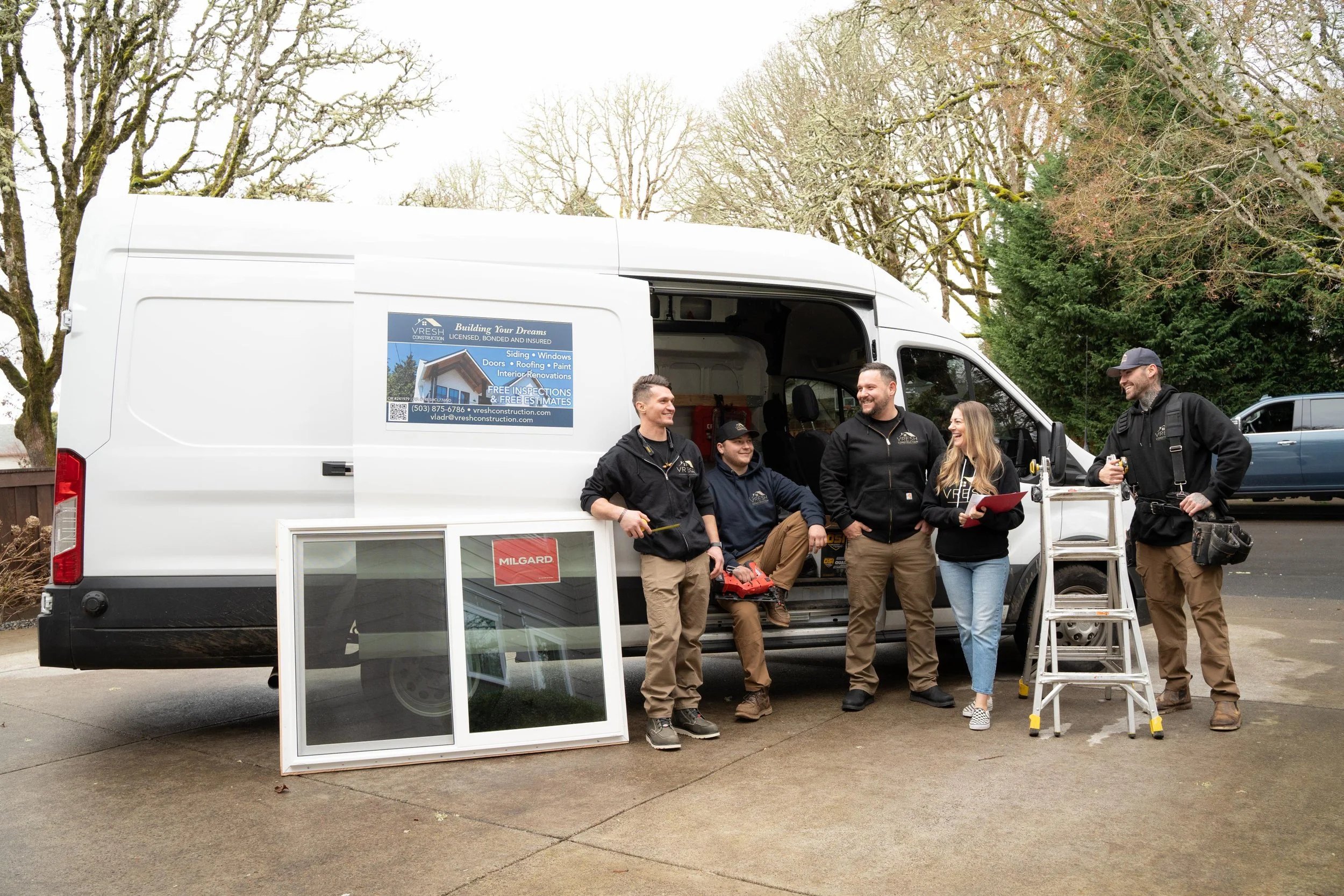
(503) 272-6436 — Call or Text, Available 24/7
We answer calls and texts at any hour. For storm damage, active leaks, or structural emergencies, calling directly is the fastest path to a response.
Siding Replacement FAQs — Gresham, OR


Client's Talk
We have a wealth of experience working as main building contractors on all kinds of projects, big and small, from home maintenance and improvements to extensions, refurbishments and new builds.

Areas We Serve
VResh Construction provides window replacement, siding installation, roofing, dry rot repair and full exterior renovation services throughout the Portland metro area and Southwest Washington.
Portland Metro — Oregon
Southwest Washington
Extended Service Areas
Request Your Free Siding Estimate in Gresham
Whether it is a Masonite hardboard replacement on a 1970s Gresham ranch, James Hardie installation on a newer East County home, dry rot repair at the bottom courses, or a partial siding replacement on one elevation — VResh responds same-day or within 24 hours and provides a clear written estimate. Gresham is core territory: crews are on-site regularly and estimate visits are available within 2–4 business days.