
Gutter Installation in Battle Ground, WA
Fogged Glass Replacement. Hardware & Lock Repair. Draft Fixes. Caulking & Seal Repair. Free Estimates. Licensed OR #241979..

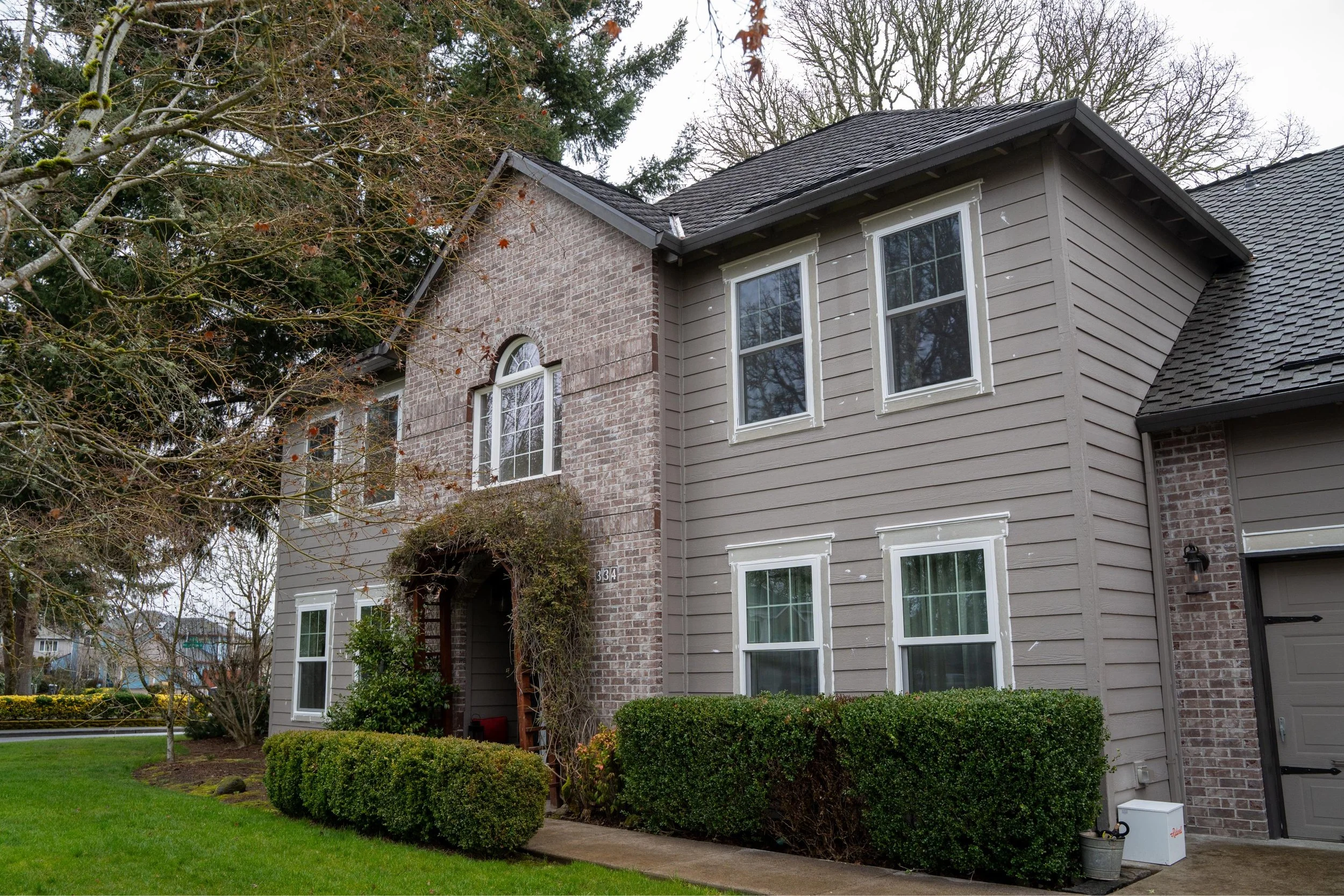
Say the house is a 2006 two-story in one of the subdivisions south of Main Street, and the call is about the gutters, because the front corner overflows every time it rains hard. The gutters are 20 years old, and the seams have opened, so the call is fair. But before VResh Construction quotes a gutter for that corner, it takes a garden hose to the bottom of the downspout, pulls the elbow, and runs water into the pipe that disappears into the lawn. If the pipe backs up and spills at the elbow, the corner overflow has a cause below the gutter as well as in it: a pipe that is blocked, crushed, or full of silt, or, in winter, ground that cannot take any more. Which one it is gets a rod or a camera down the pipe next, and the answer decides the estimate.
That pipe is the reason a gutter job in Battle Ground starts at the bottom. Nearly half the city's houses were built after 2000, many of them in subdivisions whose drainage plans put roof water into the ground or to the street through a system the builder installed with the house. Twenty years on, many that were never cleaned are full.
What the builder buried
The state's stormwater manual, which the city's code adopts, ranks the ways a builder may handle roof water, and a Battle Ground subdivision house often has one of them. A drywell or infiltration trench: a rock-filled pit or trench below the lawn that the downspouts drain into and the ground absorbs. A rain garden: a planted basin that holds a storm and soaks it away. Downspout dispersion: a splash block or a short rock trench that spreads the water thin across a length of lawn. Or a perforated stub-out: a slotted pipe in rock that soaks in what it can and carries the rest to the storm main in the street.
Which one is under a given house is shown on the plot plan filed with its building permit, which the office still has; otherwise, it is found by following the pipe.
Three of the four fail the same way. Roof grit, needles, and silt wash down the downspouts year after year and settle where the water slows: in the rock of a drywell, on the floor of a rain garden, in the trench of a stub-out, which then sends everything to the street pipe and shows that pipe's own blockages at the downspout. A system that took the whole roof in 2006 takes less of it in 2026, and the rest backs up the downspout and comes over the gutter at the nearest low corner. A dispersion run fails differently, by washing out or by the lawn compacting until the water runs off it instead of into it. And where the soil around a drywell has sealed, new rock in the same pit does not fix it, and the estimate says so.
What the hose finds, and what happens next
At that 2006 house, suppose the hose test finds a drywell that has silted through. The estimate VResh writes has two parts. The gutters: seams re-sealed where the run is sound, the front run replaced where it has pulled off the fascia, the main gutters page's sizing and hanging standard throughout. And the drywell: dug out, the rock replaced over new filter fabric, a cleanout set where the downspout meets the pipe so it can be flushed from above next time. The homeowner can take the gutters alone. The estimate says, in writing, why the corner is expected to overflow again if they do.
Where the hose finds a system that still takes water, the new downspout is connected to it, and a cleanout is added where the downspout meets the buried pipe. Where it finds nothing at all, a downspout ending on bare ground beside the foundation of a pre-2000 house in the older part of town, the estimate says where that water should go.
Anything that touches the storm main or the pipe in the street right-of-way is permitted work. Inside the city, the permit is the city's; for the four Battle Ground homes in 10 that sit outside the limits in Clark County, it is the county's. Either way, it is done by a contractor registered for right-of-way work, under that permit, and it is written as its own scope outside the gutter estimate.

Serving Portland Metro Area
VResh Construction provides window replacement, siding installation, roofing, dry rot repair and full exterior renovation services throughout the Portland metro area and Southwest Washington.
Portland Metro — Oregon
Southwest Washington
Extended Service Areas
(503) 272-6436 — Call or Text, Available 24/7
We answer calls and texts at any hour. For storm damage, active leaks, or structural emergencies, calling directly is the fastest path to a response.
Gutter questions from Battle Ground, WA


Client's Talk
We have a wealth of experience working as main building contractors on all kinds of projects, big and small, from home maintenance and improvements to extensions, refurbishments and new builds.
The cleanout
Wherever a downspout enters a buried pipe, a Battle Ground gutter job from VResh leaves a cleanout at that point, so that the next time the corner overflows, the first test takes a hose and five minutes, and no one has to dig. Call or text (503) 272-6436.